

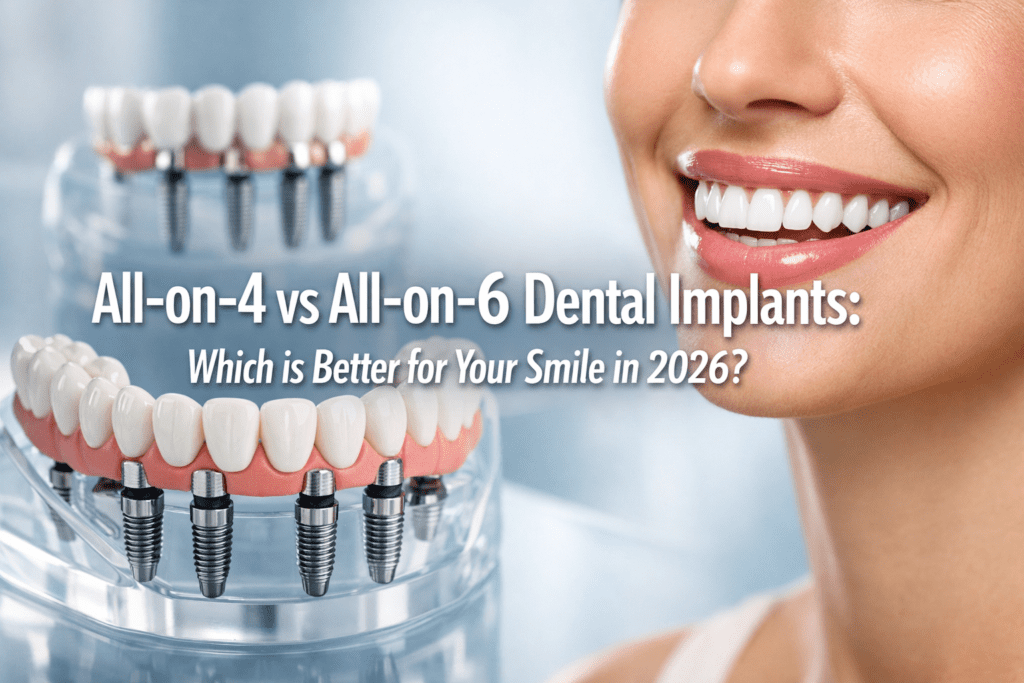
Deciding on the best full-arch tooth replacement option can be complex, especially when comparing advanced solutions like All-on-4 and All-on-6 dental implants. For many in Dallas, understanding the key differences in stability, bone requirements, and long-term outlook is crucial when considering which is better for their unique oral health needs.
Key Takeaways
- All-on-4 uses four implants, strategically angled to maximize existing bone, often avoiding bone grafting [1, 2].
- All-on-6 utilizes six implants, providing broader support and more even load distribution, generally requiring good bone density [1, 3].
- Bone Density: All-on-4 is often preferred for patients with moderate bone loss, while All-on-6 suits those with ample, healthy bone [3, 4].
- Stability & Durability: All-on-6 offers superior stability and better distribution of biting forces, potentially enhancing long-term durability, especially for heavy chewers [1, 2, 5].
- Cost: All-on-4 is typically more cost-effective due to fewer implants and often no need for bone grafts [1, 3].
- Molar Support: All-on-6 provides more comprehensive support for the entire arch, including molars, reducing fracture risk over time [6].
- Consultation is Key: A thorough examination and 3D imaging by a qualified dental implant specialist in Dallas are essential to determine the best approach for your specific situation [1].
Quick Answer
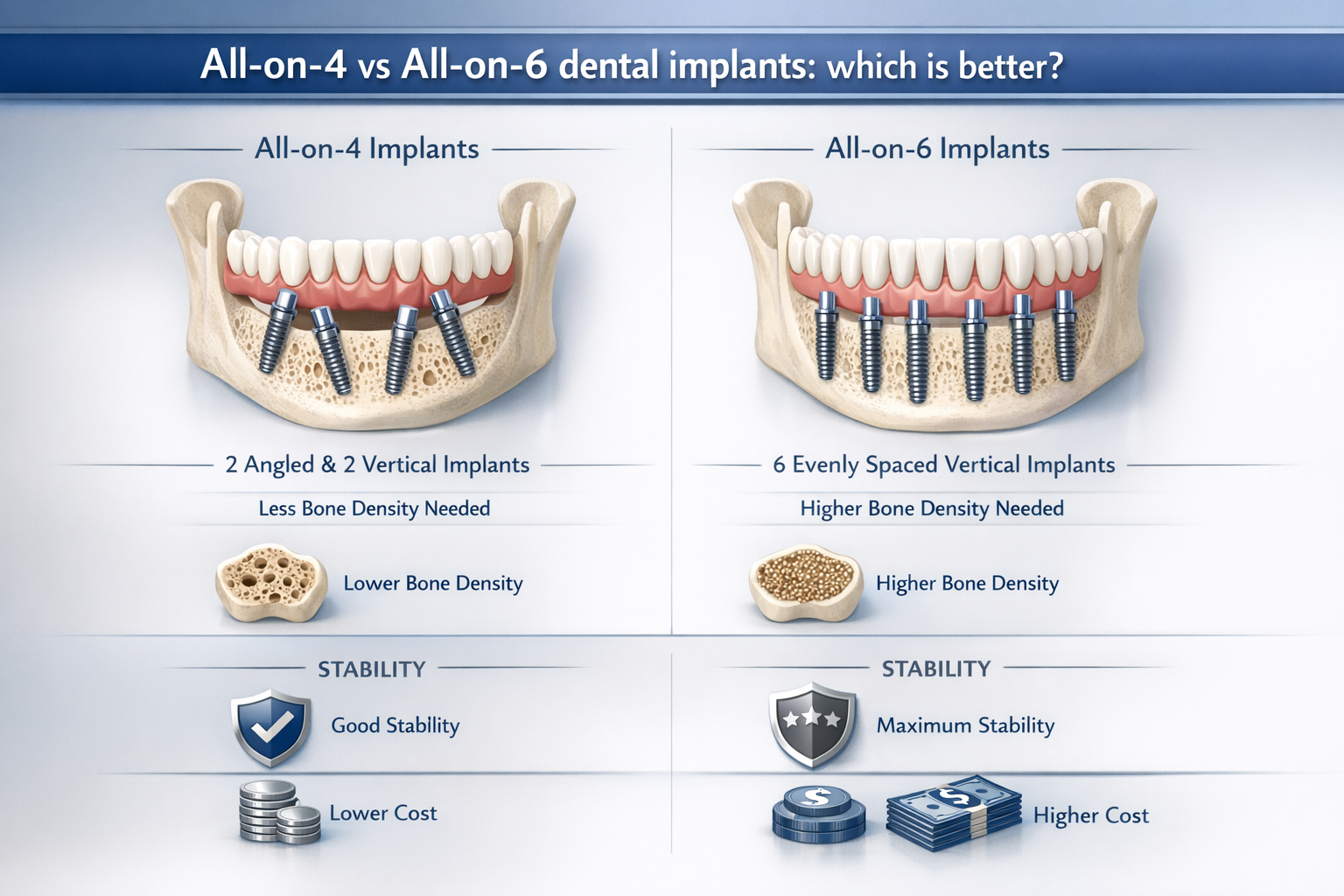
When comparing All-on-4 vs All-on-6 dental implants, All-on-4 is often better for patients with some bone loss looking for a cost-effective solution with fewer implants, while All-on-6 provides enhanced stability and more even bite force distribution, making it generally better for individuals with sufficient jawbone density seeking maximum long-term durability and comprehensive molar support [1, 2]. The ideal choice ultimately depends on your individual oral health, bone structure, and functional requirements.
What are All-on-4 and All-on-6 Dental Implants?
All-on-4 and All-on-6 dental implants are advanced full-arch tooth replacement options designed to restore an entire upper or lower set of teeth using a fixed bridge supported by a minimal number of dental implants. Both procedures offer a permanent, stable alternative to traditional dentures, providing significant improvements in chewing ability, speech, and overall quality of life. The core difference lies in the number of implants used to anchor the prosthetic arch [2].
- All-on-4 Dental Implants: This technique involves placing four dental implants into the jawbone. Two implants are placed vertically in the front of the jaw, and two are angled at 30-45 degrees in the back. This strategic angling allows for maximum engagement with existing bone, often avoiding the need for extensive bone grafting [1, 2]. A full arch of prosthetic teeth is then secured onto these four implants, typically on the same day as the implant placement. For many patients with missing teeth in Dallas, this offers a streamlined dental implant procedure.
- All-on-6 Dental Implants: As the name suggests, this method uses six dental implants, which are typically spaced more evenly across the jawbone. The additional implants provide a broader foundation for the prosthetic arch, distributing biting forces over a larger area. While also suitable for immediate loading in some cases, All-on-6 generally requires a stronger, healthier jawbone to accommodate the extra implants [1, 3].
Both systems aim to provide a fixed, comfortable, and aesthetically pleasing set of teeth, restoring functionality and confidence for individuals with significant tooth loss. The choice between them often comes down to specific patient factors, which we will explore in detail.
All-on-4 vs All-on-6 Dental Implants: Bone Density Requirements
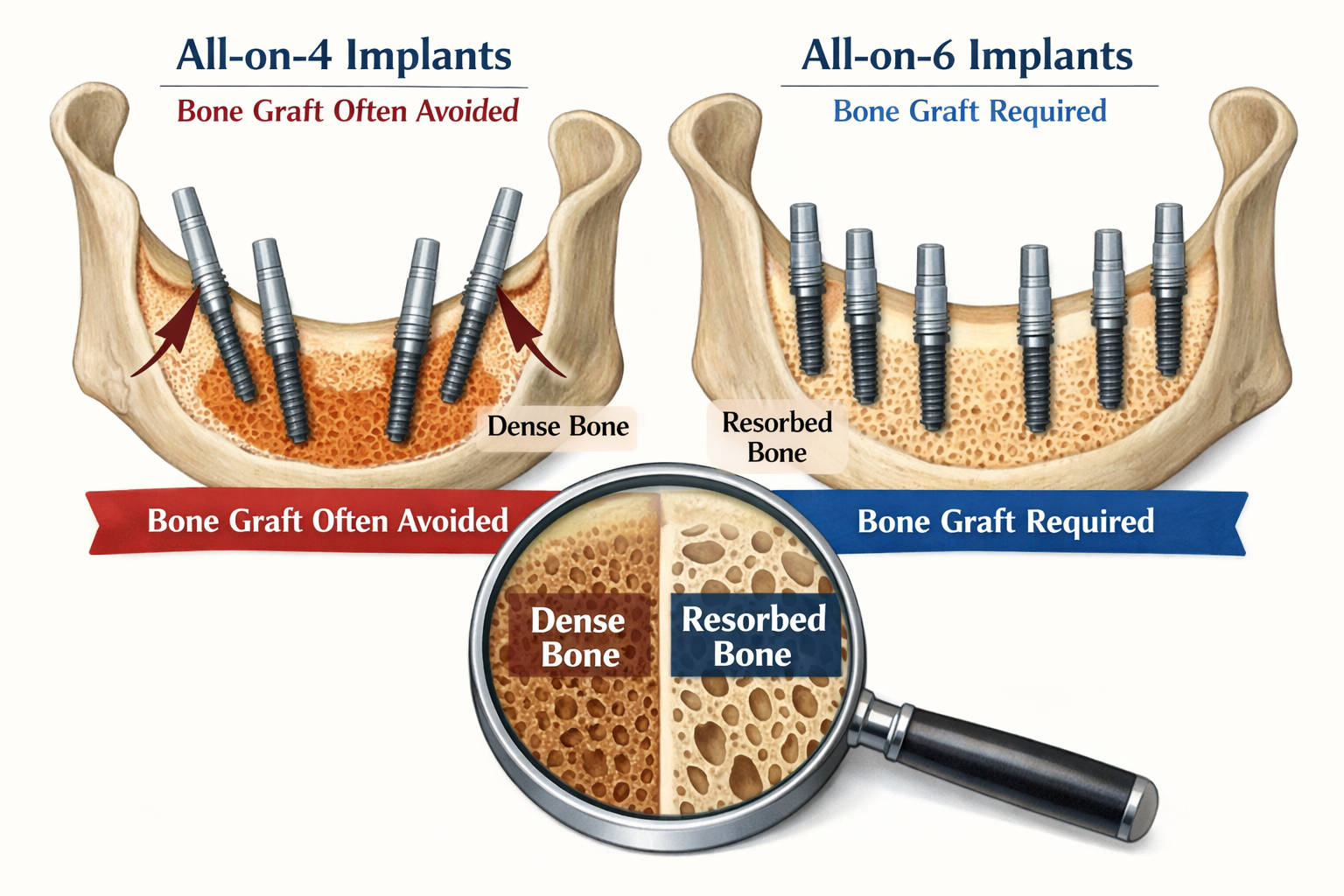
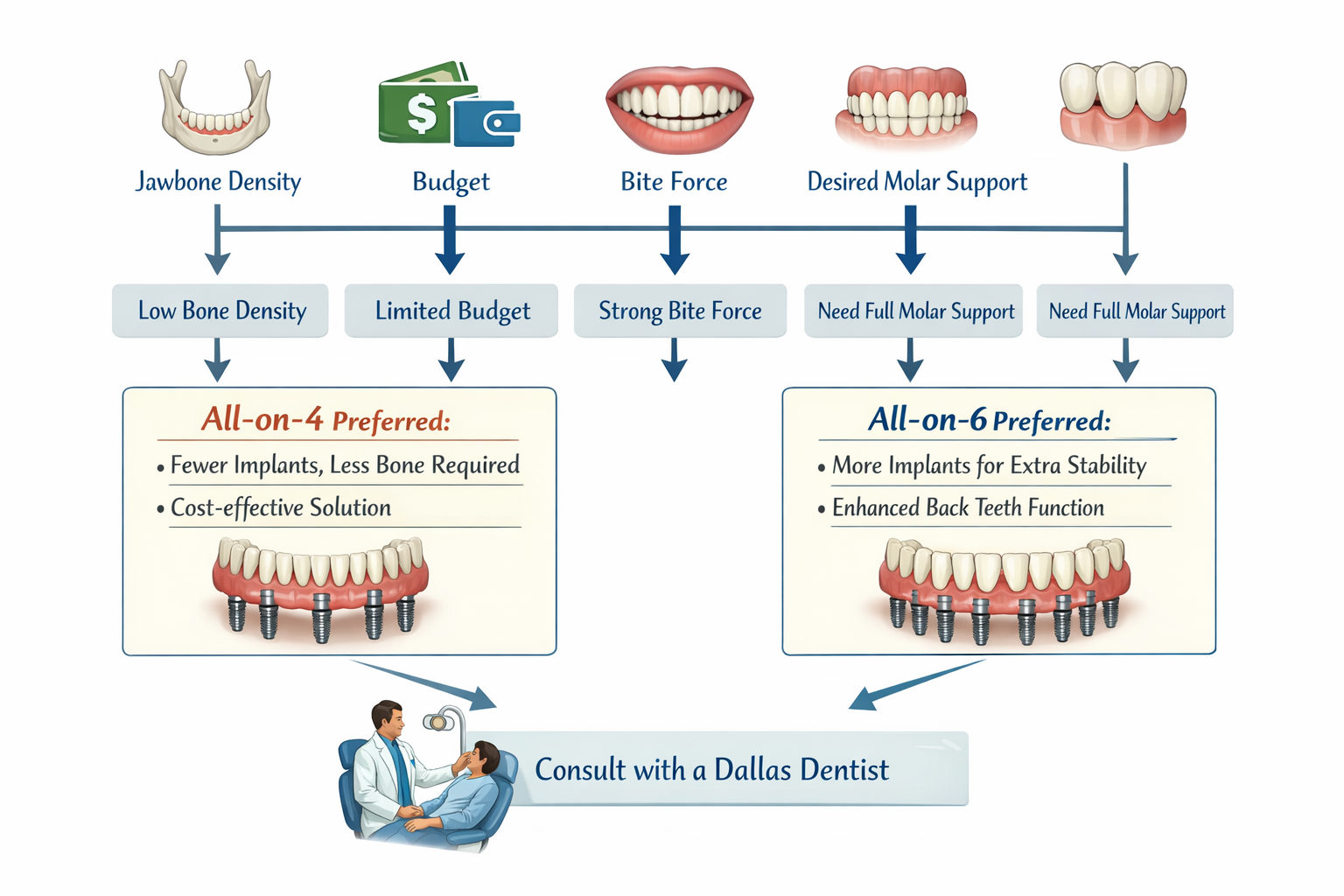
All-on-4 dental implants are generally better suited for patients with moderate bone loss, as the strategic angling of the posterior implants allows them to bypass areas of insufficient bone and engage denser bone in the front of the jaw, often eliminating the need for bone grafting [3, 4]. In contrast, All-on-6 dental implants typically require a greater volume of healthy, strong jawbone to support the additional two implants, making bone grafts more likely if significant bone loss is present [1].
When considering dental implants in Dallas, jawbone density is a critical factor:
- All-on-4 and Bone Density: The angled placement of the back implants in the All-on-4 system is a significant advantage for patients who have experienced bone resorption, particularly in the posterior jaw. This design allows the implants to anchor into the densest available bone, such as the anterior maxilla (upper jaw) or anterior mandible (lower jaw), without impinging on anatomical structures like the maxillary sinuses or mental foramen [2, 5]. This means many patients who might otherwise be deemed unsuitable for conventional implants due to bone loss can still benefit from All-on-4 without undergoing a separate, often lengthy, bone graft procedure.
- All-on-6 and Bone Density: For All-on-6, having a robust and healthy jawbone structure is ideal. The six implants are typically placed in a more spread-out, vertical orientation, distributing the load over a wider area. While this offers enhanced stability, it means there needs to be sufficient bone volume and quality across the entire arch for successful integration [1]. If a patient considering All-on-6 has areas of insufficient bone, a bone grafting procedure might be necessary before implant placement, adding to the treatment time and overall implant cost in Dallas.
A comprehensive assessment, including 3D cone beam CT scans, is essential for a Dallas dental implant specialist to accurately evaluate bone quality and quantity, guiding the recommendation for either All-on-4 or All-on-6 [1]. This patient safety measure ensures the chosen tooth replacement option is viable for long-term oral health.
All-on-4 vs All-on-6 Dental Implants: Stability and Load Distribution
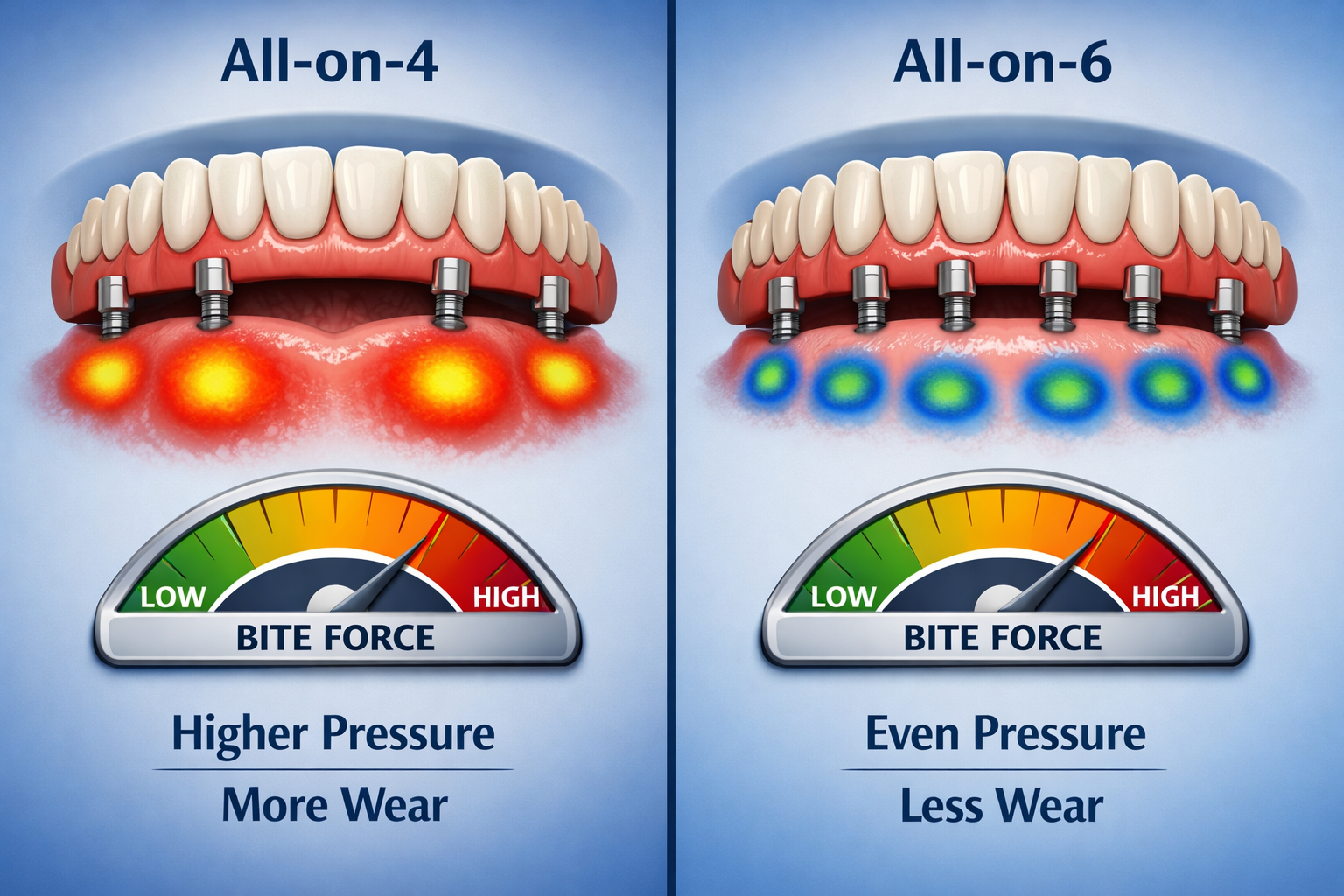
All-on-6 dental implants offer superior stability and more even load distribution across the prosthetic arch due to the presence of two additional implants, which can lead to enhanced durability and reduced stress on individual implants [1, 5]. While All-on-4 provides excellent stability, the biting forces are concentrated on four posts, which might be a consideration for patients with exceptionally strong bite forces or those who grind their teeth [2, 3].
Understanding how chewing forces are managed is key for long-term oral health:
- All-on-4 Load Distribution: With four implants supporting a full arch, the biting and chewing forces are distributed across these four anchor points. This design has proven highly effective and stable for the vast majority of patients [2]. However, the posterior sections of the prosthetic arch may extend slightly beyond the direct support of an implant, sometimes referred to as a cantilever. While engineered to withstand normal biting forces, this configuration means the back molars may not have dedicated implant support directly beneath them, potentially increasing fracture risk over many years [6].
- All-on-6 Load Distribution: The two extra implants in the All-on-6 system provide additional support, especially for the posterior (back) regions of the dental arch. This results in a more uniform distribution of chewing forces across the entire bridge, significantly reducing concentrated stress on any single implant or part of the prosthesis [1, 3]. For patients who are heavy chewers or have a history of bruxism (teeth grinding), the increased support from All-on-6 can offer greater long-term stability and resilience against potential breakage or wear [1]. This improved pressure distribution contributes to a potentially longer lifespan for the restoration and greater comfort for the patient.
| Feature | All-on-4 Dental Implants | All-on-6 Dental Implants |
|---|---|---|
| Number of Implants | 4 per arch | 6 per arch |
| Bone Grafting | Often avoided, suitable for moderate bone loss [1, 3] | May be required if bone density is insufficient [1, 3] |
| Stability | Excellent, but forces concentrated on 4 posts [2] | Superior, broader force distribution across 6 posts [1, 5] |
| Cost | Generally more cost-effective [1] | Higher initial cost due to more implants [1] |
| Ideal Candidate | Moderate bone loss, budget-conscious, seeking efficient solution [3, 4] | Healthy bone, strong bite force, seeking maximum durability [1, 5] |
| Molar Support | Less direct support for far back molars [6] | More comprehensive support across the entire arch, including molars [6] |
| Recovery | Slightly faster due to fewer implants [7] | Similar, but with two additional implant sites |
Who Is the Ideal Candidate for Each Procedure?
The ideal candidate for All-on-4 dental implants is typically someone with moderate bone loss in their jaw who wishes to avoid bone grafting and is looking for an efficient, cost-effective full-arch solution [3, 4]. Conversely, All-on-6 dental implants are generally best for patients with healthy, ample jawbone density who prioritize maximum stability, even load distribution, and superior long-term durability, especially if they have a strong bite or are prone to grinding [1, 5].
Here’s a breakdown to help you determine which tooth replacement option might be best:
Choose All-on-4 if you:
- Have experienced some degree of bone loss in your jaw, particularly in the posterior regions, and wish to avoid a bone graft procedure [3, 4].
- Are looking for a more cost-effective full-arch dental implant solution, as fewer implants and potentially no bone graft mean a lower overall implant cost in Dallas [1].
- Desire a quicker surgical recovery due to fewer implant placements [7].
- Have general good health and are a suitable candidate for implant surgery.
Choose All-on-6 if you:
- Possess a healthy volume and density of jawbone across your entire arch [1, 5].
- Have a strong bite force or a history of teeth grinding (bruxism) and need maximum support to prevent wear and fracture [1].
- Prioritize the most extensive long-term durability and stability possible, as the additional implants offer a broader foundation and more even force distribution [1, 5].
- Are willing to invest more for the added security and comprehensive molar support that six implants provide [1, 6].
- Are seeking the most robust solution for your long-term oral health and function.
Ultimately, the decision for dental implants in Dallas should be made after a thorough consultation with a dentist specializing in implant surgery. They will use advanced imaging, such as 3D scans, to assess your specific jawbone health and discuss your expectations and lifestyle to recommend the most appropriate dental implant procedure for you [1].
Conclusion
Choosing between All-on-4 and All-on-6 dental implants is a significant decision for anyone considering full-arch tooth replacement. While All-on-4 offers an excellent, often more cost-effective solution for patients with some bone loss, minimizing the need for bone grafts, All-on-6 provides enhanced stability and more even load distribution, ideal for those with strong jawbones and a desire for maximum long-term durability. Both options represent significant advancements in restoring smiles and improving quality of life.
The best way to determine which dental implant solution is right for you is through a personalized consultation with an experienced dental implant specialist in Dallas. They can conduct a comprehensive evaluation of your oral health, including detailed imaging of your jawbone, to recommend the optimal treatment plan tailored to your unique needs and goals. By understanding the nuances of each system and discussing your options with a trusted professional, you can make an informed decision for your long-term oral health.
Related Reading
- Full Mouth Dental Implants Dallas: 2026 Cost Comparison and Savings Tips
- How Long Does Dental Implant Process Take? 2026 Guide
- All-on-4 Dental Implant Cleaning Routine: 2026 Guide
FAQ
Can I get All-on-4 if I have significant bone loss?
Yes, All-on-4 is specifically designed to work well for patients with moderate bone loss due to the strategic angling of the implants, which often allows them to engage with denser bone, potentially avoiding the need for a bone graft [1, 3].
Is All-on-6 more expensive than All-on-4?
Yes, All-on-6 dental implants are generally more expensive than All-on-4 because they involve two additional implants and potentially more complex surgical planning or bone grafting, which increases the overall cost [1, 3].
Which system provides better long-term durability?
All-on-6 dental implants are often cited as providing superior long-term durability, especially for patients with strong bite forces, due to the more even distribution of chewing forces across six implants, reducing stress on individual components [1, 5].
How long is the recovery time for All-on-4 versus All-on-6?
The initial recovery time for both procedures is similar, typically involving a soft food diet for several weeks. All-on-4 might offer a slightly faster initial recovery due to fewer implant sites, but the overall healing process for osseointegration (bone fusion) is comparable [7].
Can I convert All-on-4 to All-on-6 later if needed?
While not a common procedure, it may be possible in some cases to add implants to an All-on-4 system if bone density allows, essentially converting it to an All-on-6 or All-on-X system. This would require a thorough dental evaluation.
Do I need a bone graft for All-on-6?
A bone graft might be necessary for All-on-6 if you do not have sufficient healthy jawbone density to support all six implants. This is less common with All-on-4 due to its angled implant placement [1, 3].
Which option is better for supporting back molars?
All-on-6 generally provides better support for back molars because the additional implants are typically spaced to provide more comprehensive coverage across the entire arch, reducing the cantilever effect seen in some All-on-4 designs [6].
References
[1] All On 4 Vs All On 6 – https://drfakhimi.com/blog/all-on-4-vs-all-on-6/
[2] All On 4 Vs All On 6 Dental Implants Key Differences Explained – https://www.ora4x.com/blog/all-on-4-vs-all-on-6-dental-implants-key-differences-explained/
[3] All On 4 Vs All On 6 Implant Dentures Key Differences Explained – https://gums-houston.com/all-on-4-vs-all-on-6-implant-dentures-key-differences-explained/
[4] All On 4 Vs All On 6 Implants Which Is Better For You – https://www.lakeviewfamilydentist.com/all-on-4-vs-all-on-6-implants-which-is-better-for-you/
[5] All On 4 Vs All On 6 Dental Implants – https://www.windsorimplant.com/all-on-4-vs-all-on-6-dental-implants
[6] Full Arch Dental Implants 4 Vs 6 – https://smilenowmilwaukee.com/videos/full-arch-dental-implants-4-vs-6/
[7] All On 4 Vs All On 6 Which Full Arch Implant Protocol Should You Choose – https://implanttrainingcourses.com/blog/all-on-4-vs-all-on-6-which-full-arch-implant-protocol-should-you-choose/
Leave a Reply
Share your thoughts or ask a question about dental implants. Your email address will not be published.