

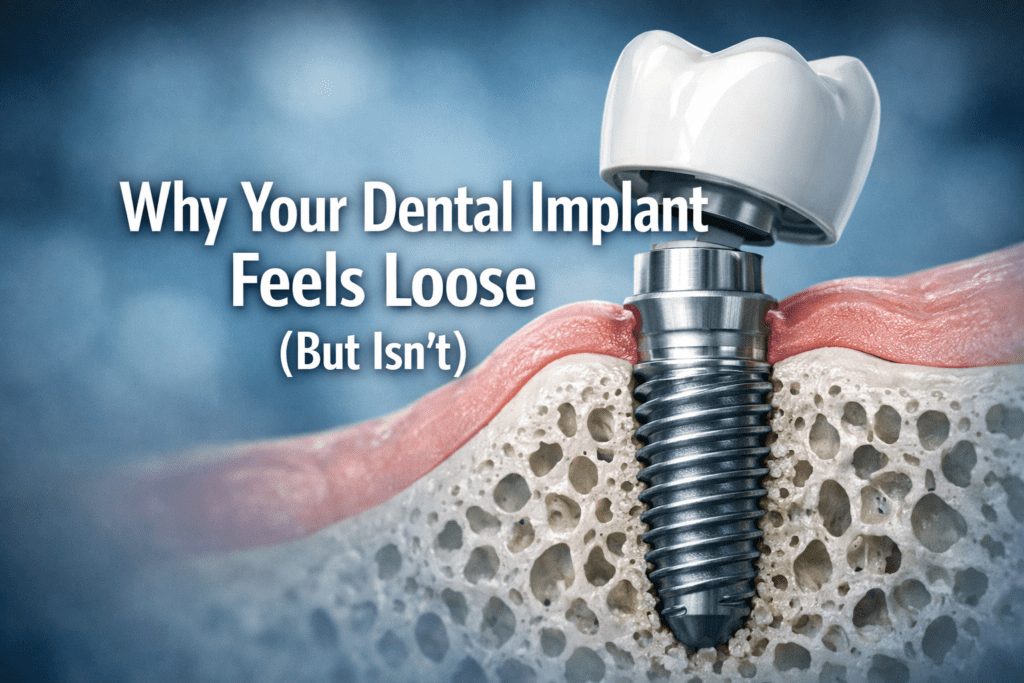
Experiencing a sensation that your dental implant feels loose can be alarming. It’s a natural reaction to worry that your investment in a stable, long-term tooth replacement option is compromised. However, in many cases, this feeling doesn’t indicate a failure of the implant itself, but rather a problem with a component attached to it, such as the crown or abutment. Understanding this distinction is crucial for patients in Dallas and can help alleviate immediate concerns while guiding you toward the appropriate professional consultation.
Key Takeaways
- A feeling of looseness often stems from issues with the crown or abutment, not the dental implant post itself.
- Loose components are generally straightforward to fix and do not necessarily mean implant failure.
- True implant mobility (failure of osseointegration) is serious and requires immediate dental intervention.
- Symptoms like discomfort, clicking, or difficulty chewing warrant a professional examination.
- Early detection and proper diagnosis by a qualified dentist are essential for preserving your implant and overall oral health.
Quick Answer
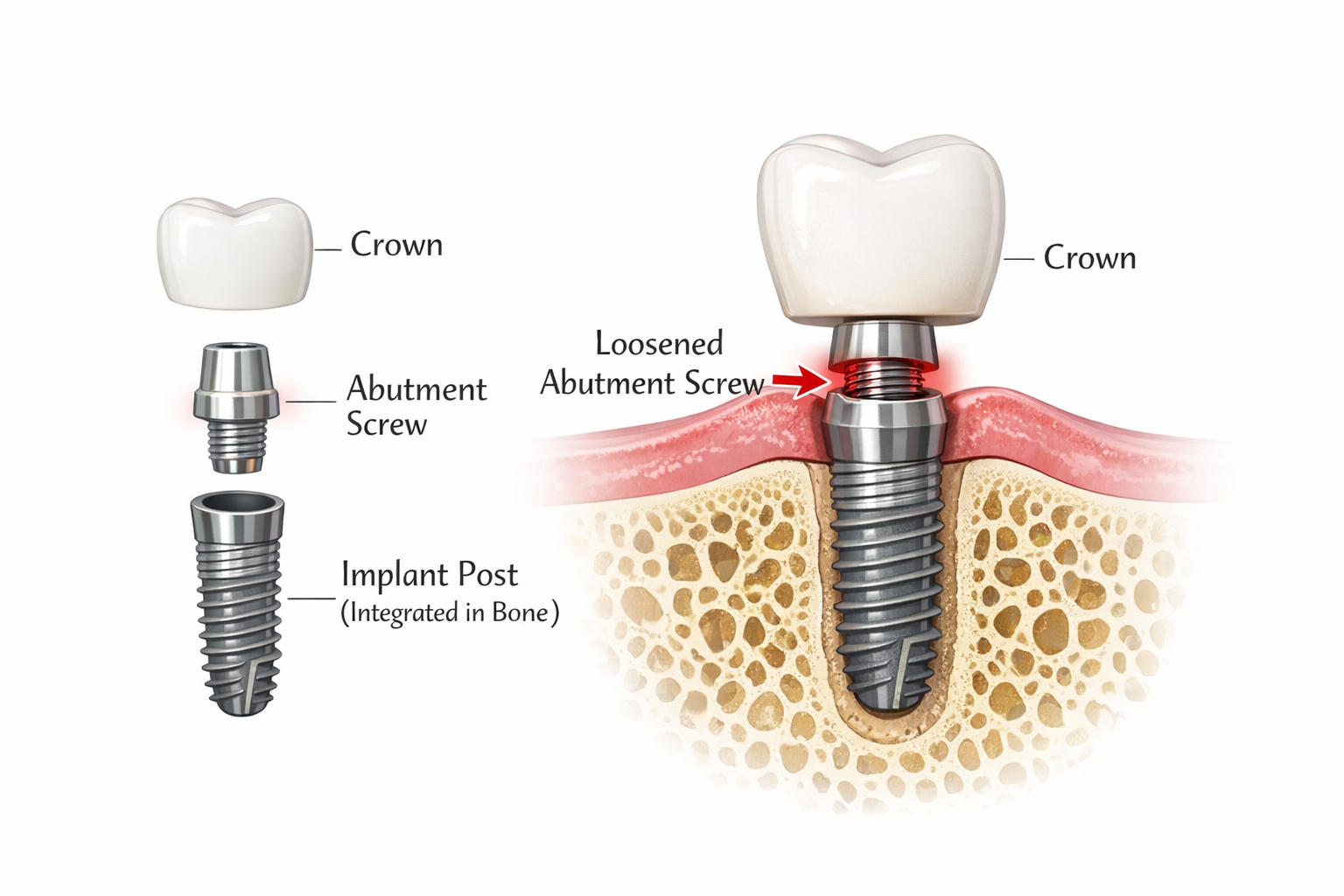
If your dental implant feels loose but isn’t, the most common reason is that a component attached to the implant, such as the crown or the abutment screw, has become loose, rather than the implant post itself. The implant post, which is surgically placed into your jawbone, is designed to integrate with the bone (osseointegration) and should not move once fully healed. Component issues are typically minor and can be resolved by your dentist without needing to remove the implant [1].
What Are the Components of a Dental Implant System?
A dental implant system consists of three main parts, and understanding each can help clarify why an implant might feel loose even when the implant itself is stable.
A dental implant is not just a single piece; it’s a system designed to mimic a natural tooth, involving a root, a connector, and a visible tooth replacement.
- The Implant Post (Fixture): This is the titanium screw-like component surgically placed into the jawbone. It serves as the artificial tooth root. Once placed, it undergoes a process called osseointegration, where it fuses directly with the bone over several months, providing a stable foundation for the replacement tooth [1]. A truly loose implant post indicates a failure of osseointegration, which is a significant concern [6].
- The Abutment: This is a small connector piece that screws into the top of the implant post. Its purpose is to extend through the gum line and provide a platform for the final restoration (the crown, bridge, or denture) [1]. A loose abutment screw is a frequent cause of a “loose implant” sensation [6].
- The Restoration (Crown, Bridge, or Denture): This is the visible part of the tooth replacement, custom-made to match your natural teeth. It attaches to the abutment, either cemented on or screwed directly into it [1]. A loose crown or restoration is perhaps the most common reason patients experience a sensation of implant looseness [6].
How Components Contribute to the Feeling of Looseness
Imagine a sturdy tree with a wobbly branch. The tree itself is firm, but the branch feels unstable. Similarly, your dental implant post can be perfectly integrated into your jawbone, but if the abutment or crown attached to it becomes loose, you’ll perceive the entire structure as loose.
- Loose Crown: If the crown that sits on top of the abutment becomes dislodged or its cement fails, it can feel like the entire implant is wiggling. This is often a straightforward fix, involving re-cementing or replacing the crown [6].
- Loose Abutment Screw: The screw connecting the abutment to the implant post can loosen over time due to chewing forces. This can cause the entire crown-and-abutment assembly to feel unstable [1]. A dentist can typically retighten this screw, often without needing anesthesia [6].
Understanding these distinct components helps in diagnosing the actual problem. If you experience any perceived looseness, a consultation with a dentist in Dallas is crucial for accurate assessment.
Why Does My Dental Implant Feel Loose (But Isn’t)?
The sensation of a loose dental implant, even when the implant post itself is firmly integrated, typically arises from a detached or loose component attached to the implant, such as the crown or the abutment. These issues create a noticeable wiggle or movement that can be mistaken for the entire implant coming loose.
Here’s a closer look at the common culprits:
1. Loose Abutment or Abutment Screw
The abutment acts as a bridge between the implant post and the crown. It’s secured to the implant with a small screw. Over time, repeated chewing forces and general wear can cause this screw to loosen [1, 6].
- Symptoms: You might feel a slight movement or wiggle when you bite down, or even hear a subtle clicking sound. The feeling might be intermittent or persistent.
- Why it feels loose but isn’t: The implant post is still fused to your bone, but the part that extends above the gum line is moving. This transmits the sensation of looseness directly to your mouth.
- Solution: Your dentist can usually access and retighten the abutment screw, often resolving the issue immediately. In some cases, if the screw is damaged, it might need to be replaced. This is a common and relatively simple procedure.
2. Loose or Decemented Crown
The dental crown is the artificial tooth that covers the abutment. It’s either cemented onto the abutment or screwed into it. If the cement fails or the retention screw (for screw-retained crowns) loosens, the crown can become unstable [6].
- Symptoms: You might feel the crown shifting when you eat, or it might even fall off completely. It can also feel “clunky” or uncomfortable.
- Why it feels loose but isn’t: Again, the actual implant post remains securely in your jawbone. The movement is limited to the crown itself.
- Solution: Your dentist can re-cement the crown or replace it if it’s damaged. For screw-retained crowns, the screw can be retightened or replaced.
3. Food Debris Trapped Under the Crown
Sometimes, food particles or other debris can get lodged beneath the crown or around the implant area, creating a sensation of pressure or instability.
- Symptoms: A feeling of something “stuck,” discomfort, or a perceived shift in the implant’s position when chewing.
- Why it feels loose but isn’t: The implant and its components are perfectly stable, but the foreign object is causing an unusual sensation.
- Solution: Thorough cleaning by brushing and flossing, and if needed, a professional cleaning by your dental hygienist. If the debris is persistent, it might indicate a marginal gap in the crown that needs attention. For tips on effective cleaning, check out our guide on Mastering Implant Care: The Essential Role of the Sulcus Brush for Implants in 2026.
4. Problem with Adjacent Teeth or Gums
Sometimes, the sensation of looseness isn’t related to the implant at all but rather to surrounding teeth or gum tissue.
- Symptoms: Pain or discomfort that seems to originate from the implant area but might actually be coming from a neighboring tooth, or inflammation in the gums around the implant.
- Why it feels loose but isn’t: The brain can sometimes misinterpret the source of discomfort. Periodontal disease in an adjacent tooth, for instance, could cause swelling or a feeling of instability in the general area.
- Solution: A thorough dental examination will identify if the problem lies with an adjacent tooth or gum tissue, allowing for targeted treatment.
It’s important to remember that these scenarios, while concerning, are often easily rectifiable. The key is to schedule a consultation with your dentist in Dallas promptly for an accurate diagnosis.
When Is a Loose Implant Actually a Problem? Understanding True Implant Mobility
While many “loose implant” sensations are due to component issues, true implant mobility, where the implant post itself is loose, is a serious concern requiring immediate attention.
True implant mobility means the titanium post, which should be firmly integrated into your jawbone, is moving. This indicates a failure of osseointegration or a significant complication [6].
Here are the critical situations where a loose implant is a genuine problem:
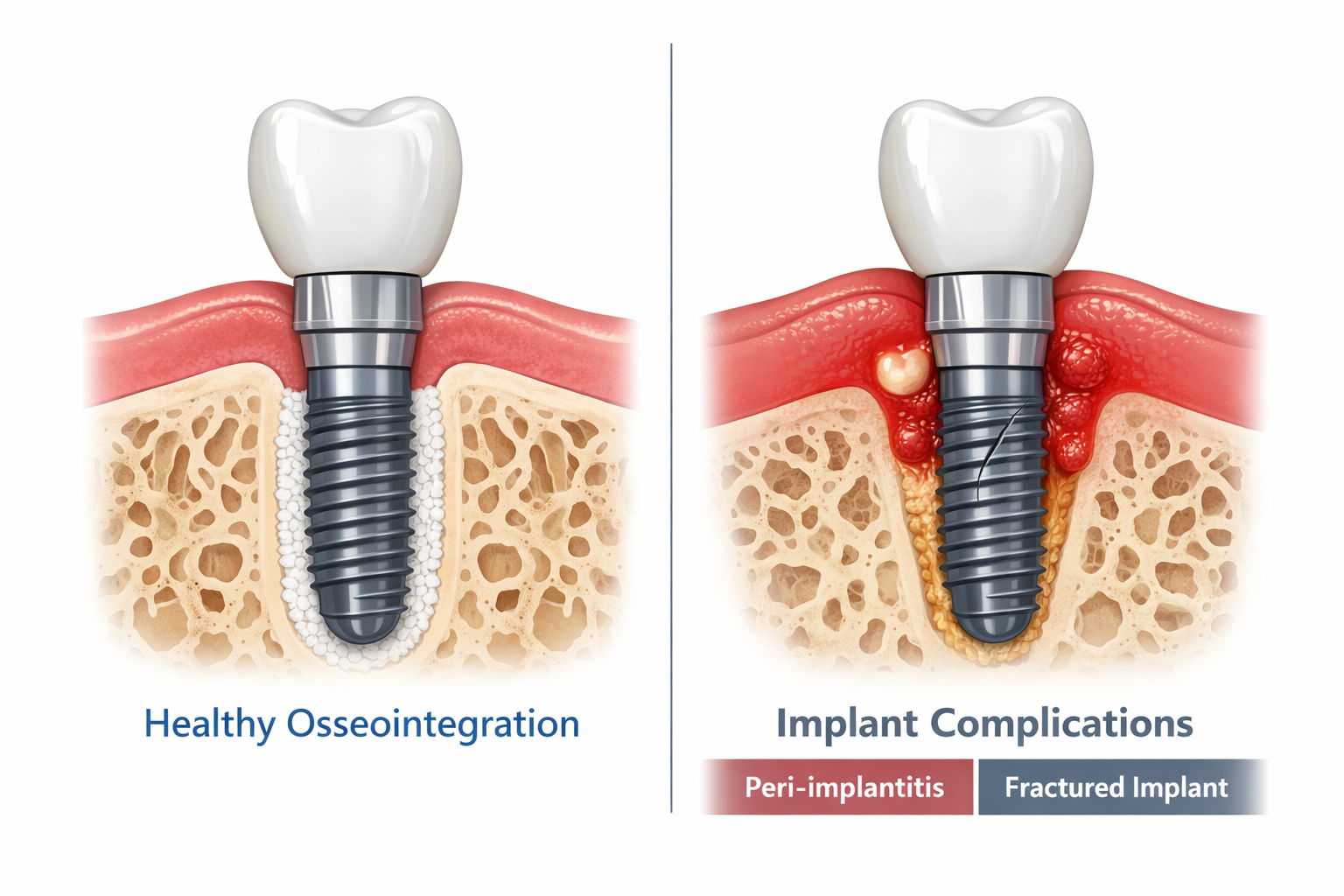
- Failed Osseointegration: This occurs when the implant post does not successfully fuse with the jawbone. This can happen during the initial healing phase or, less commonly, much later. If osseointegration never fully occurs, the implant will remain mobile [1].
- Peri-implantitis: This is an inflammatory condition affecting the tissues around a dental implant, leading to progressive bone loss around the implant. If left untreated, peri-implantitis can lead to the implant losing its bone support and becoming mobile [1, 9]. Symptoms can include bleeding gums, swelling, pain, and pus around the implant [8].
- Implant Fracture: Although rare due to the strength of titanium, a dental implant post can fracture due to excessive biting forces (e.g., from severe bruxism or clenching) or trauma. A fractured implant will be unstable [9]. If you grind your teeth, learning about Preventing Teeth Grinding & Dental Implant Damage: A Comprehensive Guide for 2026 is essential.
- Bone Loss: Severe bone loss around the implant due to disease, trauma, or improper placement can compromise the implant’s stability, leading to mobility [8].
What to Do if You Suspect True Implant Mobility
If you experience any of the following, it’s crucial to seek Emergency Dental Implant Care in Dallas immediately:
- Visible movement of the implant post itself: Not just the crown or abutment, but the implant body.
- Significant pain and swelling: Especially if accompanied by fever or pus.
- Difficulty chewing or speaking: Due to severe instability.
Early diagnosis of true implant mobility is vital. Your dentist will take X-rays or 3D scans to assess the bone level around the implant and determine the exact cause of the looseness [1]. Depending on the diagnosis, solutions could range from specialized cleaning for peri-implantitis to removal and possible replacement of the implant. For more information on managing complications, refer to our guide on Navigating Dental Implant Recovery Complications in Dallas.
Diagnosing a Perceived Loose Implant: What Your Dentist Looks For
When you visit your dentist in Dallas with a concern that your implant feels loose, they will conduct a thorough examination to determine the exact cause. It’s a systematic process to differentiate between a minor component issue and a more serious problem with the implant itself.
A precise diagnosis is the first step towards effective treatment, and your dentist will employ various tools and techniques to identify the source of the sensation.
Here’s what your dental implant specialist will typically look for:
1. Visual and Manual Examination
- Inspection of the Crown and Abutment: Your dentist will visually inspect the crown for any cracks, chips, or signs of dislodgement. They will also gently try to move the crown or abutment to see if there is any play or wiggle [1, 5].
- Gum Health Assessment: The surrounding gum tissue will be checked for signs of inflammation, redness, swelling, bleeding, or pus, which could indicate peri-implantitis [1, 8].
- Biting Pressure Test: You may be asked to bite down gently to see if the sensation of looseness is exacerbated by pressure, helping to pinpoint if the issue is with the bite or a component [7].
2. Radiographic Evaluation (X-rays and 3D Scans)
- X-rays: Conventional X-rays can reveal the bone level around the implant and help detect any bone loss or potential fractures in the implant post itself [1]. They can also show if the abutment screw is properly seated or if there’s a gap.
- 3D Cone Beam CT (CBCT) Scans: For a more detailed view, a 3D scan can provide a comprehensive picture of the bone structure, the implant’s position, and potential issues that might not be visible on a 2D X-ray [1]. This is particularly useful for assessing osseointegration and detecting subtle fractures.
3. Occlusal (Bite) Analysis
- Bite Registration: Your dentist will check your bite to ensure that the implant crown is not experiencing excessive force from opposing teeth. An unbalanced bite can put undue stress on the implant components, leading to loosening [7]. Adjusting the bite can sometimes resolve perceived looseness and prevent future issues.
4. Mobility Testing
- Percussion Test: Gently tapping on the implant crown can sometimes reveal a different sound compared to a healthy, integrated implant, though this is often subjective.
- Instrumental Mobility Assessment: Using specialized tools, your dentist can assess the micromotion of the implant and its components more objectively. True implant mobility will show measurable movement.
By combining these diagnostic methods, your dentist can accurately identify whether the feeling of looseness is due to a loose crown, a loose abutment screw, an issue with adjacent tissues, or, in more serious cases, a compromised implant post. This detailed approach ensures that patients in Dallas receive the most appropriate and effective treatment plan.
Addressing the Issue: Treatment Options for a Perceived Loose Implant
Once your dentist has accurately diagnosed why your dental implant feels loose but isn’t, the treatment typically involves addressing the specific loose component or underlying issue. The good news is that most cases of perceived looseness have straightforward solutions that don’t involve removing the implant.
Treatment options vary significantly depending on whether the problem is with the crown, abutment, or a more complex underlying condition like peri-implantitis.
Here are the common treatment approaches:
1. For a Loose or Decemented Crown
- Re-cementation: If the crown has simply come unglued from the abutment, your dentist can clean both surfaces and re-cement it securely back in place [6].
- Replacement: If the crown is damaged, chipped, or has an improper fit, a new crown may be necessary. This involves taking new impressions and fabricating a custom-made replacement.
- Screw Tightening/Replacement (for screw-retained crowns): If your crown is screw-retained and the screw has loosened, your dentist will access the screw, retighten it to the appropriate torque, and then fill the access hole. If the screw itself is stripped or damaged, it will be replaced.
2. For a Loose Abutment Screw
- Retightening: This is the most common solution. Your dentist will access the abutment screw, which usually involves removing the crown if it’s cemented, and then use a specialized torque wrench to tighten the screw to the manufacturer’s recommended specifications [1].
- Screw Replacement: If the abutment screw is fractured, stripped, or otherwise damaged, it will need to be replaced with a new one [1]. This ensures the long-term stability of the connection between the implant and the crown.
3. For Peri-implantitis or Gum Issues
- Professional Cleaning: Early-stage peri-implantitis or mucositis (inflammation of the soft tissue around the implant) can often be managed with thorough professional cleanings to remove plaque and calculus around the implant [8].
- Antibiotics: Local or systemic antibiotics may be prescribed to control bacterial infection around the implant [8].
- Surgical Intervention: For more advanced cases of peri-implantitis with significant bone loss, surgical procedures may be necessary. These can include debridement (cleaning the implant surface), bone grafting, or soft tissue grafts to restore health to the surrounding tissues and potentially regain some bone support [8]. In some severe cases, revision dental implant surgery might be considered.
4. For True Implant Mobility (Failed Osseointegration or Fracture)
- Implant Removal: If the implant post itself is truly mobile due to failed osseointegration or a fracture, it often needs to be removed [1, 8].
- Bone Grafting: After removal, the site may require bone grafting to rebuild sufficient bone volume before another implant can be placed. This allows for proper healing and preparation for a new implant [8].
- Re-implantation: Once the jawbone has healed and regenerated, a new dental implant can often be placed in the same or a nearby location. This often involves a careful assessment of the initial cause of failure to prevent recurrence.
It’s critical to consult with an experienced dentist in Dallas at the first sign of any perceived implant looseness. Prompt action can often prevent minor issues from escalating into more complex and costly problems.
Prevention is Key: Maintaining Your Dental Implant’s Stability
Maintaining the long-term stability and health of your dental implant is largely dependent on consistent and proper oral hygiene, along with regular professional dental care. Prevention is always better than treatment, especially when it comes to complex restorative procedures like dental implants.
By following a dedicated oral care routine and attending routine check-ups, you can significantly reduce the risk of your implant feeling loose, whether it’s a component issue or a more serious problem.
Here’s how patients in Dallas can best protect their dental implants:
1. Excellent Oral Hygiene Practices
- Brush Regularly and Thoroughly: Brush your teeth and implant restorations at least twice a day using a soft-bristled toothbrush. Pay special attention to the areas around the implant, gently cleaning the gum line.
- Floss Daily: Use dental floss, interdental brushes, or a water flosser specifically designed for implants to clean between your teeth and around the implant [7]. These tools are essential for removing plaque and food debris that can accumulate and lead to peri-implantitis.
- Use an Antimicrobial Mouthwash: Your dentist might recommend an antimicrobial mouthwash to help control bacteria in your mouth and further protect your implant site.
2. Regular Dental Check-ups and Professional Cleanings
- Schedule Routine Appointments: Even if your implants feel perfectly fine, it’s crucial to visit your dentist and dental hygienist in Dallas for regular check-ups and professional cleanings, typically every six months [7].
- Specialized Implant Cleaning: Dental hygienists trained in implant care use specific tools that won’t scratch the titanium surface of the implant, ensuring a thorough yet safe cleaning [7].
- Early Detection of Issues: Regular visits allow your dentist to monitor the health of your implant, assess the surrounding bone and gum tissue, and detect any potential issues with the crown or abutment before they become significant problems. This proactive approach can catch a loosening screw or early signs of peri-implantitis. For essential questions to ask, see Essential Questions to Ask Your Dentist About Implants in 2026.
3. Address Parafunctional Habits and Dietary Considerations
- Manage Bruxism (Teeth Grinding): If you grind or clench your teeth, especially at night (bruxism), this can place excessive stress on your dental implants and lead to component loosening or even fracture. Your dentist may recommend a night guard to protect your implants and natural teeth [7].
- Avoid Hard or Sticky Foods: While dental implants are strong, it’s wise to avoid excessively hard candies, nuts, or very sticky foods that could put undue stress on your crowns and abutments.
- Quit Smoking: Smoking significantly increases the risk of peri-implantitis and implant failure by impairing healing and reducing blood flow to the gums [9].
- Manage Underlying Health Conditions: Systemic diseases like uncontrolled diabetes can impact oral health and implant success. Work with your medical doctor to manage any health conditions that could affect your dental implants.
By adhering to these preventative measures, you empower yourself to maintain the long-term success and stability of your dental implants, helping them remain a comfortable and reliable solution for missing teeth.
The Mental Aspect: Dealing with Anxiety When Your Implant Feels Loose
It’s entirely normal to feel anxious, worried, or even scared when your dental implant feels loose, even if it turns out to be a minor issue. Dental implants represent a significant investment in your oral health and well-being, and any perceived problem can be deeply unsettling.
Recognizing and addressing this anxiety is an important part of managing the situation, as stress can sometimes exacerbate physical sensations.
Here’s how to deal with the mental aspect and anxiety surrounding a perceived loose implant:
- Acknowledge Your Feelings: It’s okay to feel worried. Dental procedures, especially those involving surgery, can be daunting. The initial fear that your implant is failing is a natural human response to uncertainty.
- Remember the Statistics: Remind yourself that dental implant success rates are very high, often above 95% [9]. Also, remember that a sensation of looseness is often due to a minor, easily fixable component issue, not a catastrophic failure of the implant itself [1, 6].
- Seek Professional Reassurance Promptly: The best way to reduce anxiety is to get a professional diagnosis. Schedule an appointment with your dentist in Dallas as soon as you notice any unusual sensation. Knowing the exact cause and the solution can significantly calm your nerves.
- Understand the “Why”: Read informative articles like this one to understand the common reasons why an implant feels loose but isn’t. Knowledge can be a powerful tool against anxiety, replacing fear with understanding.
- Communicate Openly with Your Dentist: Don’t hesitate to express your concerns and anxieties to your dental team. They are there to educate and reassure you. Ask questions until you feel comfortable with the information and the proposed treatment plan.
- Focus on Actionable Steps: Instead of dwelling on worst-case scenarios, focus on the immediate, actionable steps: contacting your dentist, explaining your symptoms clearly, and following their advice.
- Practice Mindfulness and Relaxation Techniques: While waiting for your appointment, techniques like deep breathing, meditation, or light exercise can help manage stress levels. Distraction through hobbies or social interaction can also be beneficial.
It’s vital to remember that dental implant care is a partnership between you and your dental professional. By staying informed, communicating openly, and seeking timely care, you can navigate any concerns about your dental implant with confidence and peace of mind.
Case Study Snapshot: Understanding Different Scenarios
To better illustrate why an implant feels loose but isn’t, let’s consider a few hypothetical scenarios based on common patient experiences in Dallas. These examples highlight how symptoms can vary and why a professional diagnosis is crucial.
| Case ID | Patient Profile | Symptoms Reported | Dentist’s Findings | Resolution | Outcome |
|---|---|---|---|---|---|
| Case 1 | Maria, 45, had a single molar implant placed 3 years ago. | Felt a slight “wobble” when chewing, no pain. | Crown was loose due to decementation. Implant post and abutment stable. | Crown re-cemented. | Immediate relief, implant stable. |
| Case 2 | David, 62, has an anterior implant placed 5 years ago. | Felt a subtle “click” and slight movement, especially when touching. | Abutment screw had loosened slightly over time. Implant post fully integrated. | Abutment screw retightened. | Sensation resolved, implant stable. |
| Case 3 | Sarah, 30, received an implant 6 months prior. | Persistent discomfort and a feeling of movement during chewing. Mild gum redness. | Diagnosed with early peri-implantitis due to inadequate oral hygiene. Implant post still stable but bone loss beginning. | Professional cleaning, oral hygiene instruction, topical antiseptic. | Symptoms improved with diligent home care and follow-up. |
| Case 4 | Robert, 55, active lifestyle, received implant 1 year ago. | Felt implant “shift” after biting down on something hard. | Small piece of popcorn hull lodged under the crown. Implant structure fully intact. | Debris removed by dental hygienist. | Discomfort gone, implant stable. |
These cases demonstrate the wide range of scenarios that can lead to a perceived loose implant. In all these instances, the implant post itself remained stable and successfully integrated into the bone. The issues were with the attached components or surrounding tissues, reinforcing the importance of a professional assessment to ensure the longevity of your tooth replacement options.
Frequently Asked Questions About Loose-Feeling Implants
Patients in Dallas often have similar questions when they experience a sensation that their dental implant feels loose. Here are answers to some of the most common concerns.
Q1: Can a dental implant actually feel loose and then tighten itself?
No, a dental implant post that has truly achieved osseointegration should not feel loose. If you perceive looseness, it indicates a component issue (like a loose crown or abutment) or a problem with the implant itself. It will not spontaneously tighten [1].
Q2: Is it normal for a new implant to feel weird or slightly mobile during healing?
During the initial healing phase after implant surgery, it’s normal to feel some strangeness or minor discomfort, but the implant post itself should not be mobile. Any movement during osseointegration could indicate a problem. Consult your dentist if you feel significant movement. For more on this, see Dental Implant Feels Weird? Timeline to Natural Comfort.
Q3: How quickly do I need to see a dentist if my implant feels loose?
You should contact your dentist as soon as possible, ideally within 24-48 hours. While it may not be an emergency, prompt attention can prevent minor issues (like a loose screw) from escalating into more significant problems [3].
Q4: Will I need surgery if my implant feels loose?
Not necessarily. Most cases of perceived looseness are due to a loose crown or abutment screw, which can be fixed with a simple tightening or re-cementation, often without surgery [6]. Surgery is typically only needed if there’s true implant failure, severe peri-implantitis, or a fractured implant.
Q5: Can stress or teeth grinding make an implant feel loose?
Yes, chronic teeth grinding (bruxism) or clenching can place excessive force on dental implants, potentially leading to the loosening of crowns or abutment screws over time [7]. Stress can exacerbate bruxism. Your dentist may recommend a night guard to protect your implants.
Q6: How much does it cost to fix a loose implant component in Dallas?
The cost to fix a loose implant component in Dallas can vary widely depending on the specific issue. Retightening an abutment screw might be a minimal charge or included in a follow-up visit, while replacing a damaged crown or screw would be more. Complex issues like peri-implantitis treatment or implant removal and replacement will be significantly more. For general pricing, refer to our guide on Dental Implant Costs in Dallas.
Q7: Can a loose crown or abutment damage the implant post?
Yes, if left unaddressed, a loose crown or abutment can put abnormal stress on the underlying implant post and jawbone. This can potentially lead to bone loss around the implant or, in rare cases, even a fracture of the implant post over time [1].
Q8: What’s the difference between a loose crown and a loose implant?
A loose crown refers to the artificial tooth portion becoming dislodged from the abutment, while the implant post remains stable. A loose implant means the titanium post itself, which is embedded in your jawbone, is mobile, indicating a failure of osseointegration or significant bone loss [6].
Q9: Does insurance cover fixing a loose implant component?
Coverage for fixing a loose implant component varies by dental insurance plan. Some plans may cover repairs to crowns or abutments, especially if it’s considered a restorative procedure. It’s best to check with your specific insurance provider and your dental office in Dallas for details on your Dental Implant Insurance Coverage.
Conclusion
Experiencing a sensation that your dental implant feels loose but isn’t can be a source of significant anxiety, but it’s important to remember that such feelings often point to a minor, easily rectifiable issue with an attached component rather than a failure of the implant post itself. Loose crowns, abutments, or even trapped food debris are far more common culprits than true implant mobility.
However, regardless of the perceived cause, any feeling of looseness or instability with your dental implant should prompt an immediate consultation with your dentist. A thorough examination, including visual inspection, manual assessment, and radiographic imaging, is essential for an accurate diagnosis. Prompt intervention, whether it’s a simple screw tightening, crown re-cementation, or addressing early signs of peri-implantitis, can prevent minor concerns from escalating into more complex problems and safeguard your long-term oral health.
For those considering tooth replacement options or managing existing dental implants in Dallas, remember that consistent oral hygiene and regular professional check-ups are your best defense against complications. Should you ever feel that your implant is loose, don’t delay – reach out to a trusted dental professional for peace of mind and expert care. Your smile and long-term oral health are worth protecting.
Key Takeaways
- A perceived loose implant is often a loose crown or abutment, not the implant post.
- The implant post, once osseointegrated, should be completely stable within the jawbone.
- Common causes include loose abutment screws, decemented crowns, or trapped food particles.
- True implant mobility is serious and indicates a failure of osseointegration, peri-implantitis, or fracture.
- Symptoms like clicking, movement during chewing, or discomfort warrant immediate dental consultation.
- Dentists use visual inspection, manual tests, X-rays, and 3D scans for accurate diagnosis.
- Treatment for component issues is usually straightforward, involving tightening or re-cementing.
- Prevention through excellent oral hygiene and regular dental check-ups is paramount for implant longevity.
- Addressing anxiety by seeking prompt professional reassurance and understanding the issue is beneficial.
References
[1] Why Are My Dental Implants Loose – https://www.apexdentalstudio.com/blog/why-are-my-dental-implants-loose/
[2] What To Do About A Loose Dental Implant – https://www.affordabledentures.com/blog/what-to-do-about-a-loose-dental-implant
[3] How To Respond When Your Dental Implant Feels Loose – https://www.shanesmithdds.com/blog/2024/04/18/how-to-respond-when-your-dental-implant-feels-loose/
[4] Dental Implant Coming Loose – https://treeddental.com/dental-implant-coming-loose/
[5] What Happens If Your Dental Implants Feel Loose – https://www.andentistry.com/what-happens-if-your-dental-implants-feel-loose/
[6] Is A Loose Dental Implant Failing – https://www.hiltonheadcosmeticdentistry.com/is-a-loose-dental-implant-failing/
[7] Dental Implant Feels Loose Common Causes And What To Do – https://www.fisherdds.com/blog/2025/06/02/dental-implant-feels-loose-common-causes-and-what-to-do/
[8] Why Do My Dental Implants Feel Loose – https://northscottsdaledentistry.com/why-do-my-dental-implants-feel-loose/
[9] Dental Implant Risks Complications In 2026 – https://www.oceanicdental.com/resource/dental-implant-risks-complications-in-2026
Leave a Reply
Share your thoughts or ask a question about dental implants. Your email address will not be published.