

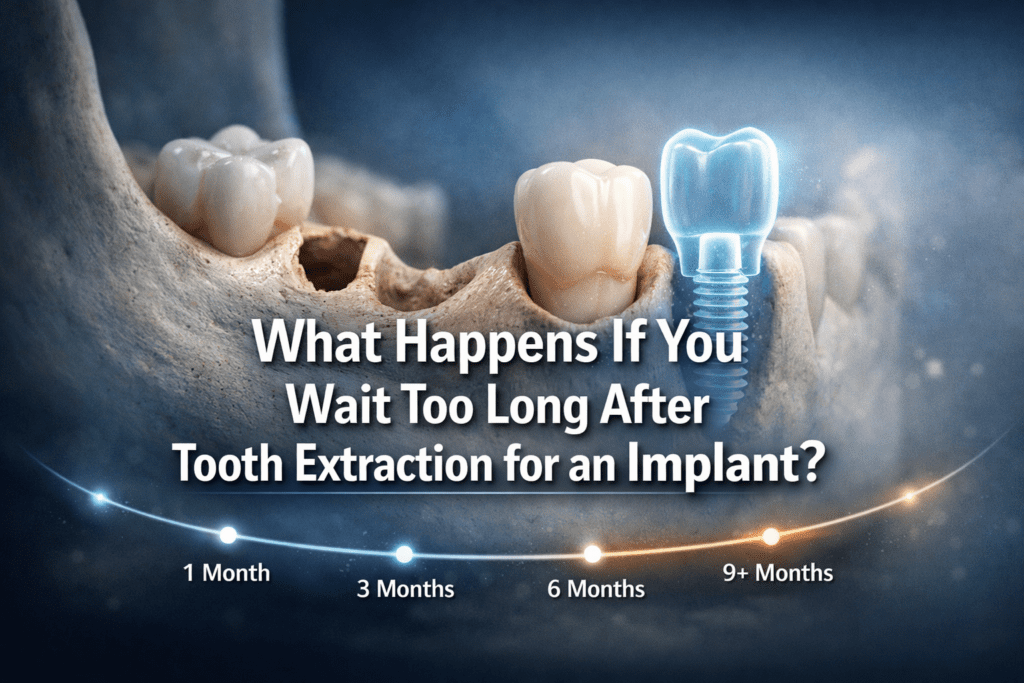
Losing a tooth can be a stressful experience, and the immediate aftermath often brings a mix of relief from pain and anxiety about the future of your smile. Many people are told that dental implants are the gold standard for tooth replacement, offering a permanent, natural-looking, and functional solution. However, the period between a tooth extraction and the placement of a dental implant isn’t just a waiting game; it’s a critical window that can significantly impact the success and complexity of your future treatment. If you find yourself wondering, “What happens if I wait too long after tooth extraction to get an implant?”, you’re not alone. This article will delve into the profound consequences of delaying implant placement, outlining the biological changes that occur and the potential additional procedures, costs, and complications you might face in 2026 and beyond.
The human body is remarkably adaptive, but this adaptability can work against us in certain dental scenarios. When a tooth is extracted, the jawbone that once supported it begins to resorb, meaning it shrinks and diminishes over time. This process is natural but can present significant challenges when you eventually decide to get an implant. Understanding these changes is crucial for making informed decisions about your oral health timeline.
Key Takeaways
- Bone Resorption is Inevitable: After a tooth extraction, the jawbone naturally begins to shrink and lose density, a process called bone resorption.
- Impact on Implant Placement: Sufficient bone volume and density are crucial for dental implant stability; delayed placement often necessitates bone grafting.
- Increased Complexity and Cost: Waiting too long typically leads to more involved procedures like bone grafts or sinus lifts, increasing treatment time and overall expenses.
- Compromised Aesthetics and Function: Significant bone loss can affect facial structure, gum lines, and the overall aesthetic outcome of the implant.
- Timely Consultation is Key: Discussing your implant options with a dental professional shortly after extraction is vital to minimize complications and optimize outcomes.
The Immediate Aftermath: Understanding Bone Resorption and Its Timeline
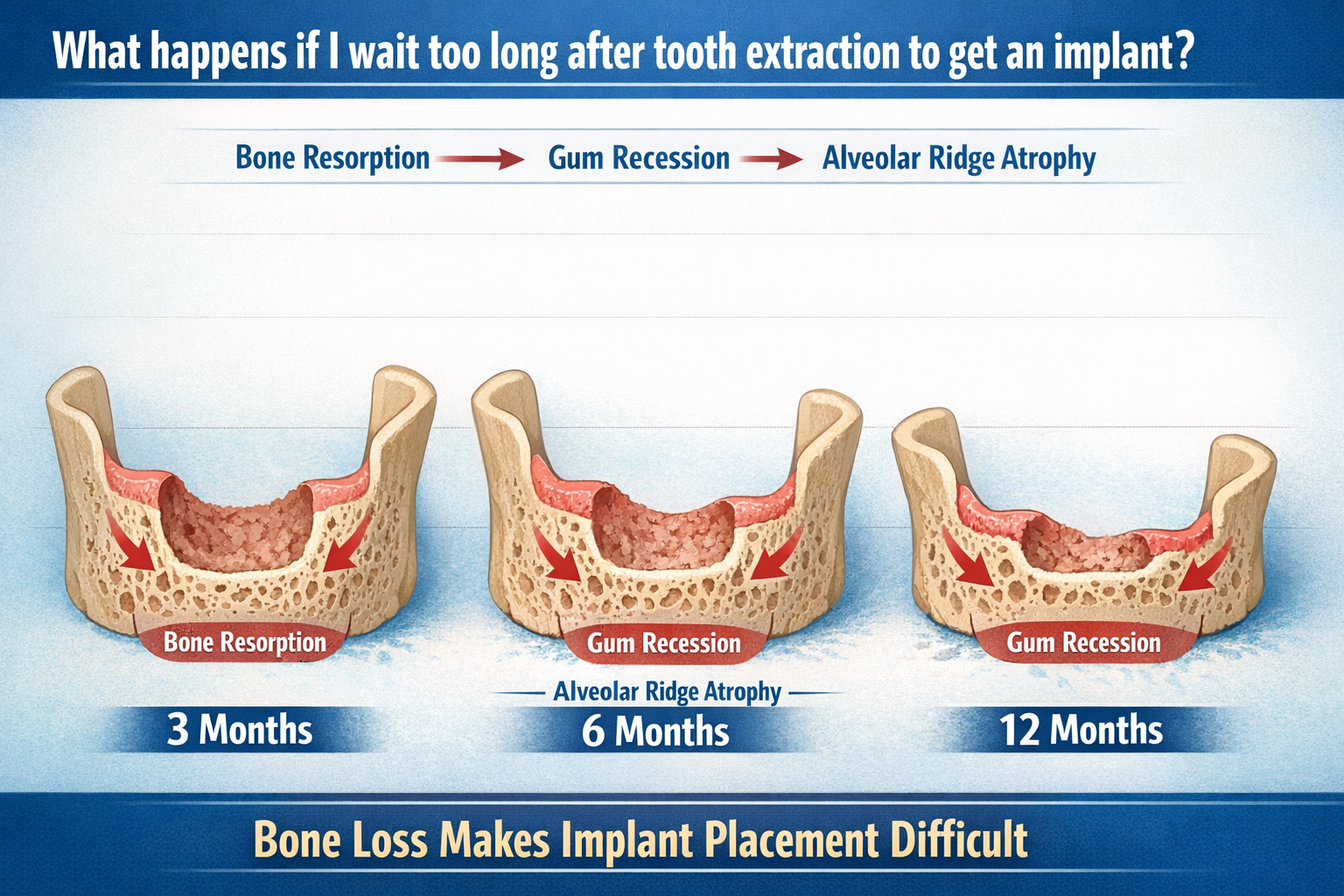
When a tooth is extracted, it leaves behind an empty socket in the jawbone. This socket, which once held the tooth firmly in place, is now devoid of its primary function – supporting a tooth. Our bodies are incredibly efficient, and anything not actively being used is often repurposed or reduced to conserve resources. In the case of the jawbone, this means that the bone tissue surrounding the extracted tooth no longer receives the stimulation it once did from chewing and biting forces transmitted through the tooth root. Without this stimulation, the body perceives the bone as unnecessary, leading to a process known as bone resorption or alveolar bone atrophy [1].
This bone loss isn’t a slow, imperceptible change; it can begin quite rapidly. Within the first few months after extraction, significant changes can occur. The width of the jawbone can decrease by as much as 25% in the first year alone, and the height can also diminish substantially over time. This process continues, albeit at a slower rate, for many years if no tooth replacement is put in place.
Let’s break down the timeline and what happens if I wait too long after tooth extraction to get an implant:
- First 3-6 Months: This is the most critical period. The socket begins to heal, filling with blood clots and new bone. However, concurrently, the outer layers of the alveolar ridge (the part of the jawbone that holds the teeth) start to resorb. You might notice a visible change in the gum line, which recedes as the underlying bone shrinks.
- 6-12 Months: Bone resorption continues. The bone can become significantly narrower and shorter. The quality of the remaining bone can also deteriorate, becoming less dense and more porous.
- Beyond 12 Months (Long-Term): The process doesn’t stop. Over several years, extensive bone loss can occur, potentially affecting adjacent teeth and even altering facial features. The lips and cheeks may appear sunken, leading to an aged appearance. This can also impact the stability of remaining natural teeth.
Why is Bone Volume and Density So Important for Implants?
Dental implants are essentially titanium posts that are surgically placed into the jawbone, where they fuse with the bone through a process called osseointegration [2]. This fusion is what gives implants their remarkable stability and longevity. For successful osseointegration to occur, there must be:
- Sufficient Bone Volume: The jawbone needs to be wide and tall enough to fully encase the implant, providing strong foundational support. Think of it like planting a tree – you need enough soil for the roots to take hold.
- Adequate Bone Density: The bone must be dense and healthy enough to properly integrate with the implant. Weak or porous bone may not provide the necessary stability for the implant to fuse correctly.
When there’s a lack of either volume or density due to prolonged waiting after extraction, the challenges of implant placement multiply significantly.
Consequences of Insufficient Bone:
- Compromised Primary Stability: The initial stability of the implant when it’s first placed is crucial. Without enough bone, achieving this stability can be difficult, increasing the risk of implant failure.
- Increased Risk of Nerve or Sinus Involvement: In the upper jaw, significant bone loss can bring the sinus cavity too close to the implant site, necessitating a sinus lift. In the lower jaw, the inferior alveolar nerve might be too close, requiring careful planning to avoid nerve damage.
- Suboptimal Aesthetic Outcome: When bone and gum tissue have receded significantly, it can be challenging to create a natural-looking gum line around the implant crown. This can result in a longer-looking tooth or visible implant components.
- Need for Additional Procedures: This is arguably the most common and impactful consequence, leading us to our next section.
💡 “The jawbone is a living structure that constantly remodels itself. When a tooth is removed, the balance shifts, and resorption becomes the dominant process. Timely intervention is crucial to preserve bone structure.”
The Impact of Delay: What Happens If I Wait Too Long After Tooth Extraction to Get an Implant?
So, you’ve understood the basic biology. Now, let’s get into the practical implications of delaying your dental implant. What happens if I wait too long after tooth extraction to get an implant? The answer is generally that the path to a successful implant becomes more complex, time-consuming, and expensive.
1. The Need for Bone Grafting
This is the most frequent consequence of waiting too long. If there isn’t enough healthy bone to support an implant, a bone graft procedure becomes necessary. Bone grafting involves adding bone material to the deficient area of your jaw. This material can come from various sources:
- Autogenous Graft: Bone taken from another part of your own body (e.g., chin, hip, tibia). This is often considered the “gold standard” due to excellent compatibility.
- Allograft: Bone taken from a human donor (processed and sterilized).
- Xenograft: Bone taken from an animal source (e.g., cow, pig, processed for safety).
- Alloplast: Synthetic bone material.
The purpose of the graft is to encourage your body to grow new, healthy bone in the area. This isn’t an instant fix. After a bone graft, there’s typically a healing period of several months (often 4-9 months, sometimes longer) before an implant can be placed. This waiting period allows the grafted bone to integrate with your existing bone and create a strong foundation. You can learn more about bone graft recovery for dental implants here.
2. Sinus Lift Procedures
Specifically for the upper jaw, if a tooth (especially a molar or premolar) is extracted, the maxillary sinus cavity often expands into the area where the bone used to be. This is called sinus pneumatization. If you wait too long after a tooth extraction, the amount of bone between your sinus floor and your mouth cavity can become dangerously thin.
In such cases, a sinus lift (also known as sinus augmentation) is required before implant placement. This procedure involves gently lifting the membrane that lines the sinus floor and placing bone graft material into the space created. Similar to other bone grafts, this requires a significant healing period (often 6-12 months) before the implant can be placed. This adds a substantial layer of complexity, cost, and treatment time.
3. Ridge Augmentation
Sometimes, the jawbone doesn’t just lose height but also width, becoming very narrow. This makes it impossible to place an implant of adequate diameter. Ridge augmentation is a procedure designed to restore the natural contour of the jawbone. It involves placing bone graft material to widen the alveolar ridge, often using block grafts. This also requires a healing period before implant placement.
4. Increased Treatment Time and Number of Appointments
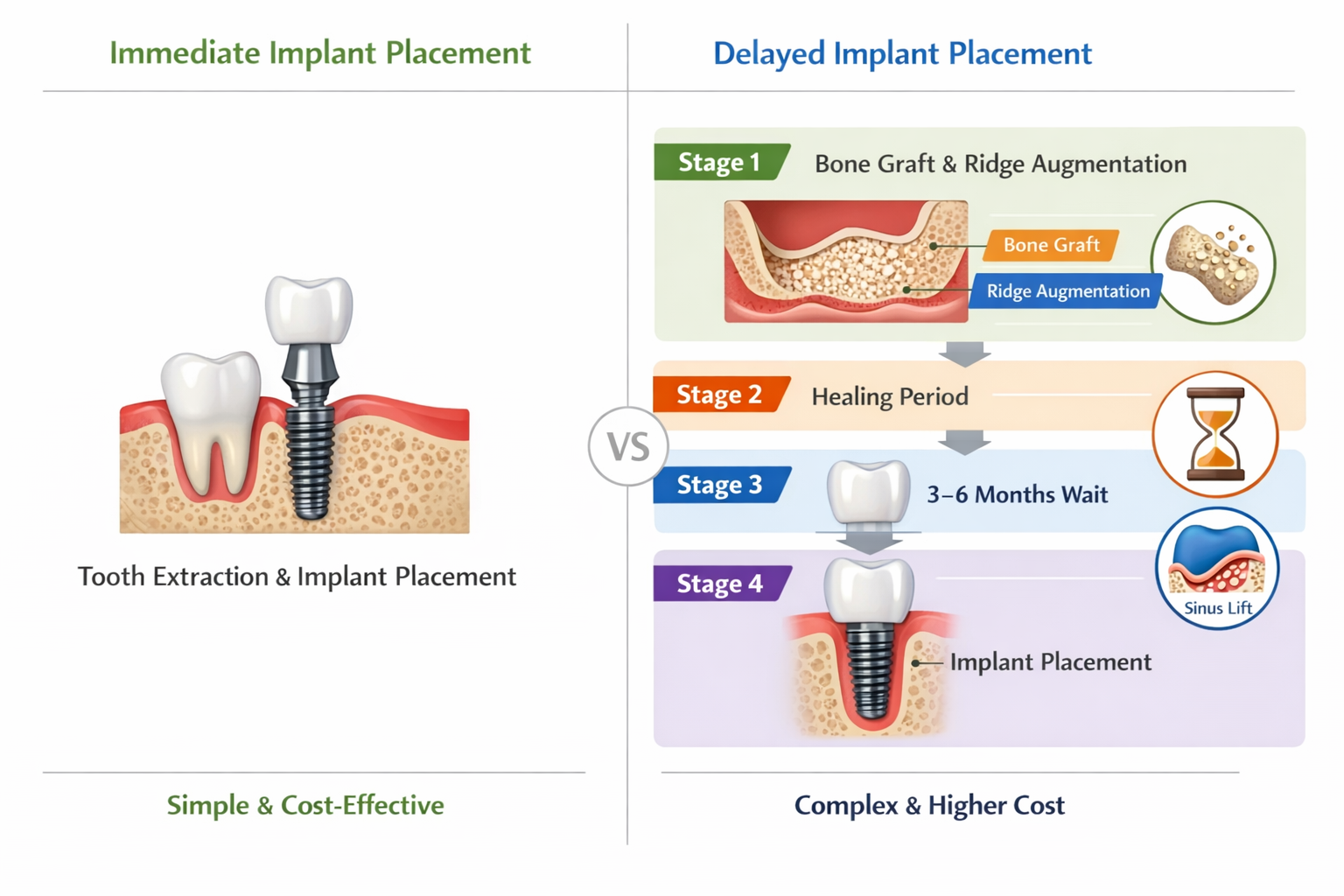
What happens if I wait too long after tooth extraction to get an implant? The most direct impact is the elongation of your treatment timeline. What could have been a relatively straightforward implant placement, possibly even immediately after extraction (immediate implant placement), now becomes a multi-stage process:
- Tooth extraction (if not already done)
- Bone grafting/sinus lift/ridge augmentation
- Healing period for graft (several months)
- Implant placement surgery
- Healing period for implant osseointegration (3-6 months)
- Abutment placement (if not integrated with implant) – learn about the complete guide to the dental implant abutment procedure
- Placement of the final crown or prosthesis
This can easily stretch a few-month process into a year or even longer. For those eager to restore their smile, this extended timeline can be frustrating.
5. Higher Overall Costs
More procedures invariably mean higher costs. Each additional surgical intervention—be it a bone graft, sinus lift, or ridge augmentation—comes with its own fees for the surgeon, anesthesiologist, materials, and follow-up care. While the initial cost of an implant may seem substantial, delaying the procedure can significantly inflate the total expense. Many dental insurance plans may cover portions of extractions or certain preparatory procedures, but coverage for advanced grafting can vary. It’s always wise to discuss the best dental implant financing options with your dental provider.
6. Potential for Compromised Aesthetics and Function
Significant bone and gum loss can make it challenging to achieve an ideal aesthetic outcome for your dental implant. The gum line around the implant may not match that of adjacent natural teeth, leading to an uneven or less natural appearance. In severe cases, the implant may need to be placed in a less-than-ideal position due to bone constraints, which can affect bite mechanics and long-term function. Furthermore, without bone to support the soft tissues, the natural contours of your face can change, potentially leading to a sunken appearance around the mouth.
7. Increased Risk of Complications
While dental implants have a very high success rate (over 95% in ideal conditions), complicated procedures carry inherently higher risks. Multiple surgeries increase the chances of infection, delayed healing, or other surgical complications. While still low, these risks are typically higher than for a straightforward implant placement into healthy bone.
8. Impact on Adjacent Teeth
In some cases, the extensive bone loss from a missing tooth can also affect the support of neighboring teeth. This can make them more susceptible to shifting, loosening, or other issues over time, creating a domino effect of oral health problems.
The Ideal Timeline: When Should an Implant Be Placed?
Understanding what happens if I wait too long after tooth extraction to get an implant naturally leads to the question: what’s the ideal timing? There are generally three main approaches to implant placement timing:
- Immediate Implant Placement: The implant is placed into the socket immediately after the tooth extraction during the same surgical appointment. This is often possible when there is no infection, ample bone, and good primary stability can be achieved. It can shorten overall treatment time significantly.
- Early Implant Placement (2-3 Months Post-Extraction): This involves waiting 8-12 weeks after extraction. This allows the soft tissues to heal and initial bone remodeling to occur, but before significant bone resorption has taken place. This is a common and often preferred approach.
- Delayed Implant Placement (3+ Months Post-Extraction): This is when the socket has fully healed, which typically takes 3-6 months or more. While this means less risk of infection from the original tooth site, it also means bone loss has likely begun, potentially requiring grafting.
For most patients, discussing options with their dentist immediately after an extraction, or even before an extraction, is the best course of action. This allows for a proactive approach to preserve bone and plan the most efficient and effective treatment. Our team at dentalimplantsdallastx.com specializes in helping patients navigate these decisions.
Factors Influencing Timing
Several factors can influence the ideal timing for your dental implant:
- Presence of Infection: If the extracted tooth had a significant infection, your dentist might recommend waiting longer to ensure the infection is completely cleared and the site is healthy before placing an implant.
- Bone Quality and Quantity: Your dentist will assess this using X-rays and potentially a 3D CT scan. If significant bone loss is already present or anticipated, a grafting procedure might be planned from the outset.
- Patient Health: Overall health conditions, smoking habits, and certain medications can affect healing and osseointegration.
- Aesthetic Requirements: For teeth in the visible smile line, aesthetic considerations might influence the timing and planning, sometimes favoring immediate or early placement to preserve gum contour.
- Financial Considerations: The cost of dental implants can be a factor, and patients may need time to arrange financing. However, it’s crucial to weigh the initial savings against the potential for increased costs down the line if waiting leads to more complex procedures. For information on costs, you can look into articles like all on 4 dental implants cost 2025. Please note: the actual cost reference is for 2025, but the article context is 2026. This link is for reference of typical cost discussion.
Preventing Bone Loss: Socket Preservation
The good news is that there are proactive measures that can be taken to minimize bone loss immediately after extraction, especially if immediate implant placement isn’t an option or is delayed. Socket preservation (also known as alveolar ridge preservation) is a common procedure where bone graft material is placed into the empty tooth socket immediately after extraction. This material, often combined with a protective membrane, helps to:
- Maintain Bone Volume: It acts as a scaffold, encouraging new bone growth and preventing the collapse of the socket walls.
- Preserve Gum Contour: By supporting the underlying bone, it helps maintain the natural shape of the gums, which is crucial for aesthetics.
- Facilitate Future Implant Placement: It ensures there’s adequate bone for a more predictable and less complicated implant surgery down the line.
While socket preservation adds a small initial cost, it can significantly reduce the need for more extensive (and expensive) bone grafting later, making it a wise investment in your future oral health. If you are facing an extraction, definitely ask your dentist about this option.
Understanding the Process: What to Expect in 2026
If you’re considering dental implants in 2026, whether immediately after an extraction or after some time has passed, here’s a general overview of what to expect from a leading dental practice:
- Comprehensive Consultation and Examination: This will involve a thorough oral examination, discussion of your medical history, and detailed imaging (X-rays, 3D CT scans). This helps your dentist assess your bone structure, nerve pathways, and sinus cavities. This initial consultation is crucial for determining if you have waited too long and what the appropriate next steps are.
- Personalized Treatment Plan: Based on the examination, your dentist will develop a customized treatment plan. This plan will outline the necessary procedures (e.g., bone graft, sinus lift), the proposed timeline, and the associated costs. They will explain what happens if I wait too long after tooth extraction to get an implant in your specific case.
- Preparatory Procedures (if needed): If bone loss is significant, procedures like bone grafting or sinus lifts will be scheduled first. These involve recovery periods.
- Implant Placement Surgery: Once sufficient bone is present, the titanium implant post is surgically placed into the jawbone. This is typically an outpatient procedure done under local anesthesia, often with sedation options available. You can learn about the complete dental implant recovery timeline to prepare.
- Osseointegration (Healing Period): The implant fuses with the jawbone over several months (typically 3-6 months). During this time, you might wear a temporary crown or partial denture.
- Abutment Placement: After osseointegration, a small connector piece called an abutment is attached to the implant. This piece will connect the implant to the final crown.
- Crown/Prosthesis Placement: Finally, a custom-made crown, bridge, or denture (depending on whether you have a single implant or multiple, like All-on-4 dental implants) is secured to the abutment, completing your new tooth replacement.
Throughout this process, your dental team will provide detailed aftercare instructions, including information on best dental implant aftercare products and what to expect during healing.
Conclusion
The question “What happens if I wait too long after tooth extraction to get an implant?” has a clear answer: it makes your journey to a restored smile more challenging, lengthier, and potentially more expensive. While dental implants remain an excellent solution for missing teeth, the biological changes that occur in your jawbone after an extraction are significant. Bone resorption is a natural and often rapid process that can quickly diminish the ideal conditions for implant placement.
Procrastination in this context often leads to the necessity of additional procedures like bone grafts, sinus lifts, or ridge augmentation, each adding complexity, healing time, and cost to your overall treatment plan. Beyond the practical implications, delaying treatment can also impact the long-term aesthetics and functional success of your implant, and potentially the stability of your remaining teeth.
Therefore, the most actionable next step is to seek professional advice as soon as possible after a tooth extraction, or ideally, even before it. A comprehensive consultation with an experienced dental implant specialist will provide you with a personalized assessment of your bone health and all available options. They can guide you through the process, discuss immediate implant placement, early placement, or socket preservation techniques to mitigate bone loss. Don’t let uncertainty delay you further; protecting your oral health and investing in a stable, beautiful smile is always a worthwhile endeavor.
References:
[1] Shapurian, B., et al. (2006). “Bone resorption after tooth extraction and its clinical consequences: a review.” Journal of Oral Maxillofacial Surgery, 64(1), 108-118.
[2] Brånemark, P-I. (1983). “Osseointegration and its experimental background.” Journal of Prosthetic Dentistry, 50(2), 221-229.
Dental Implant Waiting Period Impact Estimator
Use this tool to get an estimate of how delaying your dental implant after extraction might affect your treatment plan. This is for informational purposes only and not a substitute for professional dental advice.
*This calculator provides general estimates. The actual requirements for your dental implant depend on a detailed assessment by a qualified dental professional, including imaging like 3D CT scans. Always consult with your dentist for an accurate diagnosis and personalized treatment plan.
Leave a Reply
Share your thoughts or ask a question about dental implants. Your email address will not be published.