

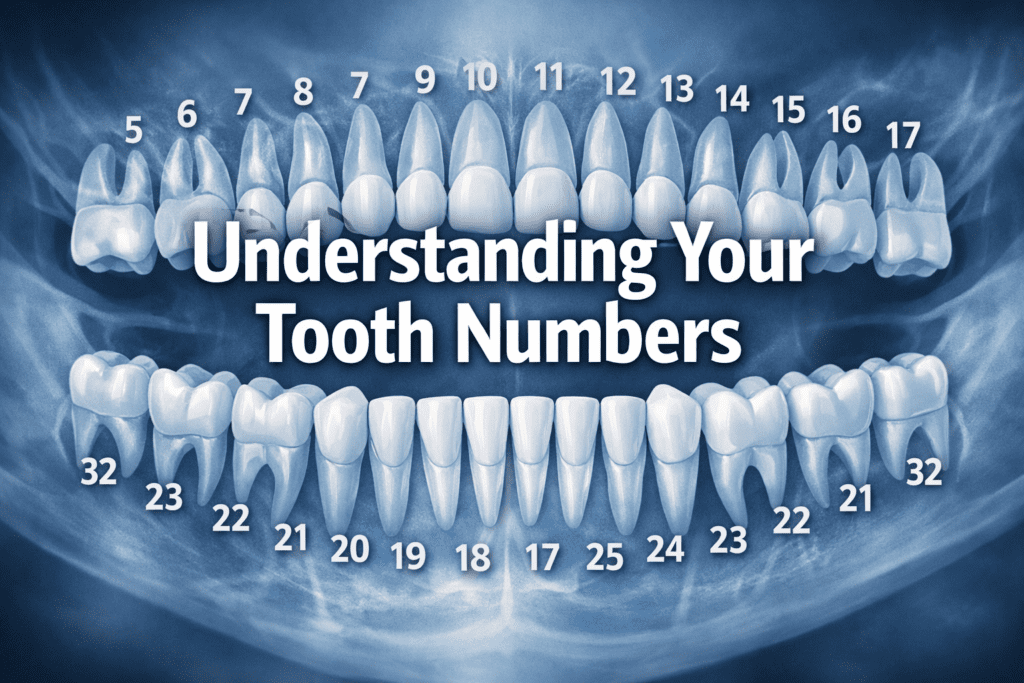
Understanding the system your dentist uses to identify your teeth, known as tooth numbers, is essential for clear communication about your oral health. Dentists use standardized numbering systems to accurately record and discuss specific teeth, which is especially important when considering procedures like dental implants in Dallas or other tooth replacement options. This guide will clarify the most common tooth numbering systems, helping you understand your dental records and conversations with your oral healthcare provider.
Key Takeaways
- Tooth numbering systems are universal: Dentists use standardized methods to identify each tooth, preventing confusion.
- Three main systems: The most common are the Universal Numbering System, the Palmer Notation Method, and the FDI World Dental Federation Notation.
- Universal System is common in the U.S.: This system assigns numbers 1-32 for adult teeth and letters A-T for primary (baby) teeth.
- Knowing your tooth numbers aids communication: It helps you understand your treatment plans, especially for procedures like implant surgery process or extractions.
- Missing teeth change the count: If you have missing teeth, the numbers remain, but the absence of a tooth in that position is noted.
- Dental implants get new “numbers”: While replacing a missing tooth, a dental implant will functionally replace the tooth corresponding to a specific number.
- Consultation is key: Always discuss any confusion about tooth numbers with your dentist during a consultation with a dentist.
What Are Tooth Numbering Systems, and Why Do Dentists Use Them?
Tooth numbering systems are standardized methods used by dental professionals to uniquely identify each tooth in a patient’s mouth. These systems are crucial for precision in diagnostics, treatment planning, and record-keeping, ensuring that a specific tooth is accurately identified regardless of which dentist or specialist is reviewing the case. For patients in Dallas, TX, understanding these systems can demystify discussions about their oral health, from routine cleanings to complex procedures involving dental implants.
By assigning each tooth a distinct number or code, dentists can communicate precisely about conditions, procedures, or missing teeth. For example, when a dentist in Dallas recommends a single tooth implant for a specific molar, referring to it by its designated tooth number eliminates any ambiguity about which tooth requires attention. This clarity is vital for patient safety and effective long-term oral health management.
The Importance of Standardized Identification:
- Accuracy in Diagnosis: Ensures the correct tooth is identified for issues like cavities, fractures, or infections.
- Precision in Treatment: Guarantees that procedures, such as fillings, crowns, or extractions, are performed on the intended tooth.
- Clear Record-Keeping: Provides a consistent language for charting and documenting patient history, which is critical for legal and insurance purposes.
- Effective Communication: Facilitates clear discussions between general dentists, specialists (like oral surgeons or periodontists), and dental labs.
- Patient Understanding: Empowers patients to follow and understand their treatment plans, including when exploring tooth replacement options like dental implants.
Knowing your tooth numbers can be particularly helpful when discussing the cost of procedures like a single tooth implant cost Dallas 2026, as different teeth (e.g., molars vs. incisors) can have varying treatment complexities and associated costs.
The Universal Numbering System: A Common Standard
The Universal Numbering System is the most widely used tooth identification method in the United States, including by dentists in Dallas. This system assigns a unique number from 1 to 32 to each permanent adult tooth, starting from the upper right wisdom tooth and moving clockwise through the upper jaw, then dropping to the lower left wisdom tooth and moving clockwise through the lower jaw. For primary (baby) teeth, the system uses letters A through T.
This clockwise numbering ensures a consistent and unambiguous way to refer to any tooth. For instance, the upper right first molar is always tooth #3, and the lower left central incisor is always tooth #24. When your Dallas dentist discusses a specific issue or a proposed dental implant procedure, they will likely refer to teeth by these Universal numbers, making it easy for you to follow along with their assessment and recommendations for your oral health education.
How the Universal System Works:
Permanent Teeth (1-32):
- Numbers 1-16 are assigned to the upper jaw (maxillary arch).
- Numbers 17-32 are assigned to the lower jaw (mandibular arch).
- The numbering begins with the upper right third molar (wisdom tooth) as #1, continues across the front to the upper left third molar as #16.
- It then drops to the lower left third molar as #17 and proceeds across the front to the lower right third molar as #32.
Primary Teeth (A-T):
- Letters A-J are assigned to the upper jaw.
- Letters K-T are assigned to the lower jaw.
- The lettering follows a similar clockwise pattern, starting with the upper right second primary molar as ‘A’ and ending with the lower right second primary molar as ‘T’.
Understanding this sequence is vital for patients when discussing options such as dental implants after tooth extraction Dallas, as the dentist will specify which numbered tooth needs to be replaced.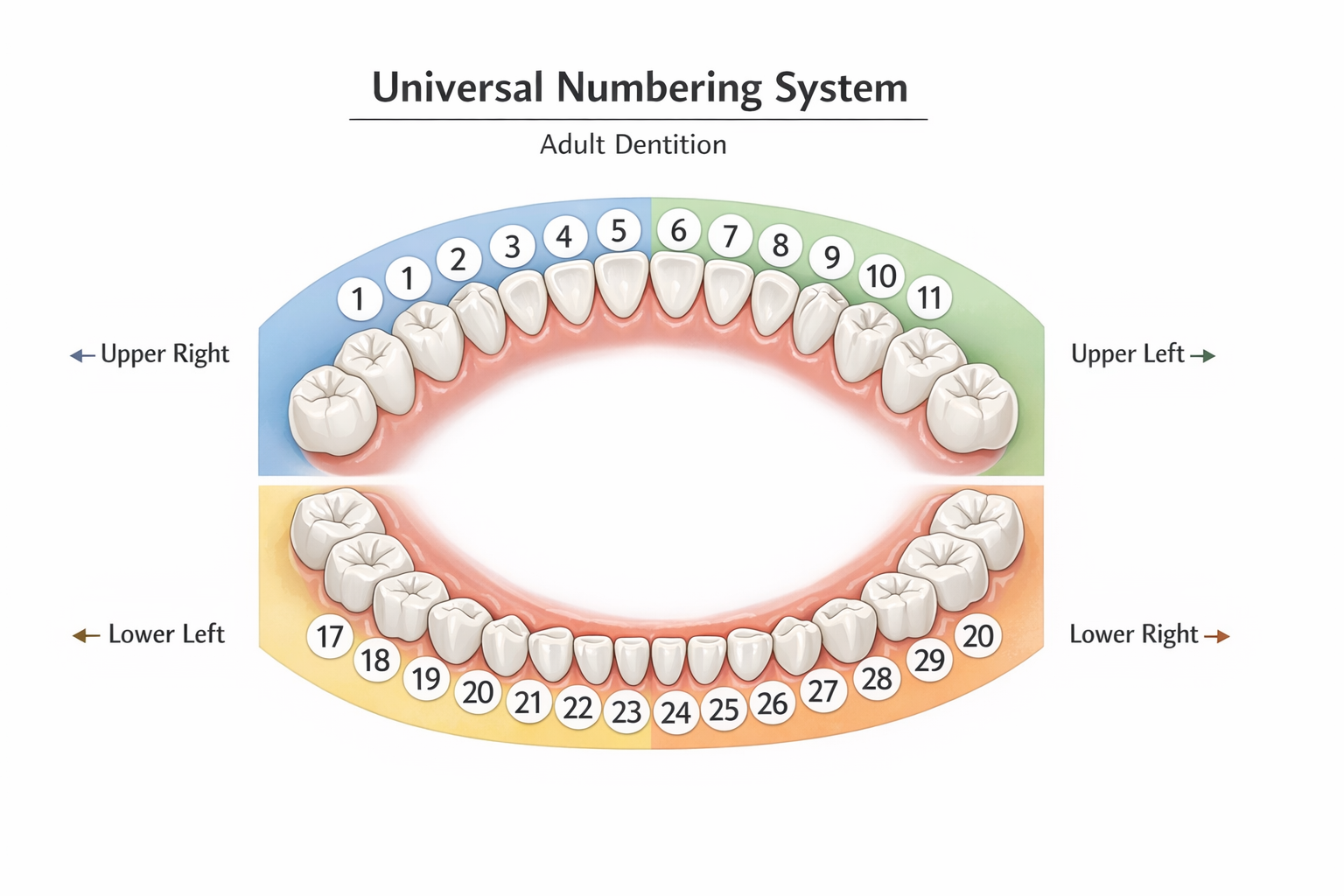
The Palmer Notation Method and FDI World Dental Federation Notation
Beyond the Universal Numbering System, two other significant tooth numbering systems are the Palmer Notation Method and the FDI World Dental Federation Notation (FDI system). While the Universal System is dominant in the U.S., dentists in international settings or those trained with different conventions might use Palmer or FDI, especially when collaborating on complex cases or referring patients.
The Palmer Notation Method, often called the “quadrant system,” uses a grid-like approach, dividing the mouth into four quadrants. Each tooth within a quadrant is then assigned a number from 1 to 8 (1 being the central incisor, 8 being the wisdom tooth), and a specific quadrant symbol indicates its location. The FDI system, widely adopted globally, uses a two-digit number for each tooth, where the first digit indicates the quadrant and the second digit identifies the tooth within that quadrant. For patients exploring dental implants in Dallas, it’s most likely their local dentist will use the Universal System, but familiarity with other systems can be beneficial for broader oral health education.
Palmer Notation Method Explained:
The Palmer method is easily recognized by its quadrant symbols:
Adult Teeth:
- Upper right:
┘(e.g.,1┘for upper right central incisor) - Upper left:
└(e.g.,1└for upper left central incisor) - Lower left:
┌(e.g.,┌1for lower left central incisor) - Lower right:
┐(e.g.,┐1for lower right central incisor) - Numbers 1-8 are used for each tooth, starting from the central incisor (1) back to the wisdom tooth (8).
- Upper right:
Primary Teeth: Letters A-E are used instead of numbers, with the same quadrant symbols.
FDI World Dental Federation Notation Explained:
The FDI system is a two-digit numbering system:
First Digit (Quadrant):
- 1: Upper right permanent
- 2: Upper left permanent
- 3: Lower left permanent
- 4: Lower right permanent
- 5: Upper right primary
- 6: Upper left primary
- 7: Lower left primary
- 8: Lower right primary
Second Digit (Tooth within Quadrant):
- 1: Central incisor
- 2: Lateral incisor
- 3: Canine
- 4: First premolar (bicuspid)
- 5: Second premolar (bicuspid)
- 6: First molar
- 7: Second molar
- 8: Third molar (wisdom tooth)
For example, tooth #3 in the Universal System (upper right first molar) would be 16 in the FDI system (quadrant 1, 6th tooth). A patient missing tooth #3 and seeking tooth replacement options in Dallas would still likely hear it referred to as “tooth number 3” by their local dentist.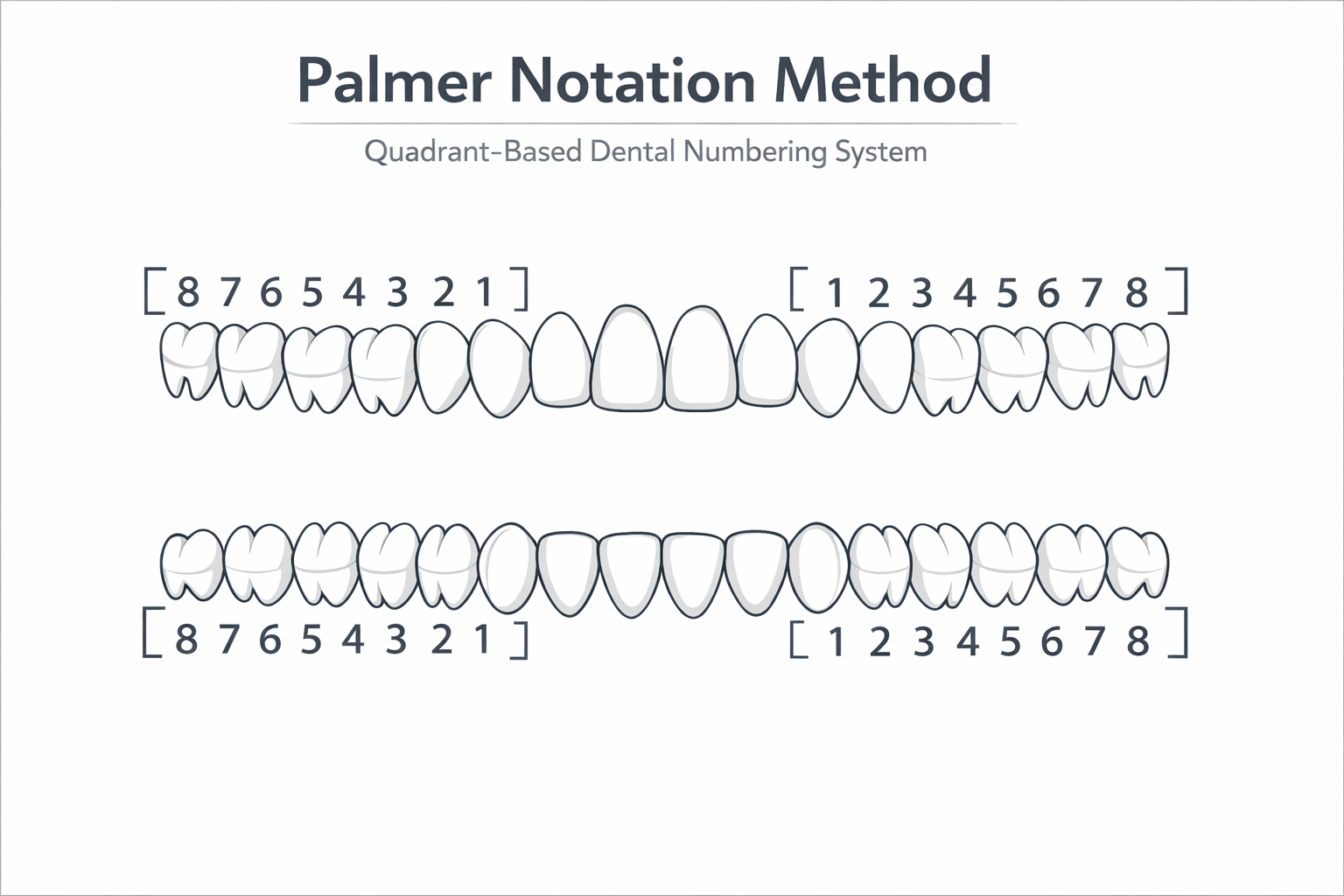
How Tooth Numbers Relate to Dental Procedures and Missing Teeth
Understanding tooth numbers is especially critical when undergoing dental procedures or managing missing teeth, a common reason individuals in Dallas seek dental care. When a tooth is missing, its number doesn’t disappear; rather, the absence of that numbered tooth is noted in your dental chart. This provides a precise reference point for planning interventions like dental implants or bridges.
For example, if you are missing your lower right first molar (Universal #30), your dentist will clearly document “missing #30.” When discussing options for tooth replacement, such as a single dental implant, they will propose placing an implant at position #30. This consistent numbering ensures that all members of your dental care team, from the hygienist to the oral surgeon, are always on the same page regarding your oral health status and treatment plan. It’s a fundamental aspect of patient safety and effective long-term oral health management.
Common Scenarios Involving Tooth Numbers:
- Extractions: If a tooth needs to be removed, your dentist will specify the tooth number to be extracted, e.g., “extraction of #18” (lower left second molar).
- Dental Implants: When replacing a missing tooth, the implant is placed in the position corresponding to the original tooth number. For instance, if you get a dental implant for a missing #14 (upper left first molar), the implant functionally restores tooth #14. This is a critical part of the dental implant procedure.
- Bridges: For an implant-supported bridge, the bridge replaces several missing teeth, and the supporting implants are typically placed at the ends of the span. For example, if teeth #5, #6, and #7 are missing, an implant-supported bridge in Dallas might involve implants at #5 and #7, supporting a prosthetic for #5, #6, and #7.
- Charting and Referrals: Dental charts use tooth numbers to record everything from cavities and fillings to gum disease and root canal treatments. When referring you to a specialist, your dentist will use these numbers to ensure clear communication.
- Wisdom Teeth: Wisdom teeth, typically #1, #16, #17, and #32, are often extracted. Understanding their numbers helps patients comprehend why a specific wisdom tooth might require removal. Learn more about wisdom tooth extraction costs.
By clarifying tooth numbers, dental professionals ensure precise care, particularly vital for restorative solutions like dental implants in Dallas. This clarity also empowers patients to take an active role in their oral health decisions.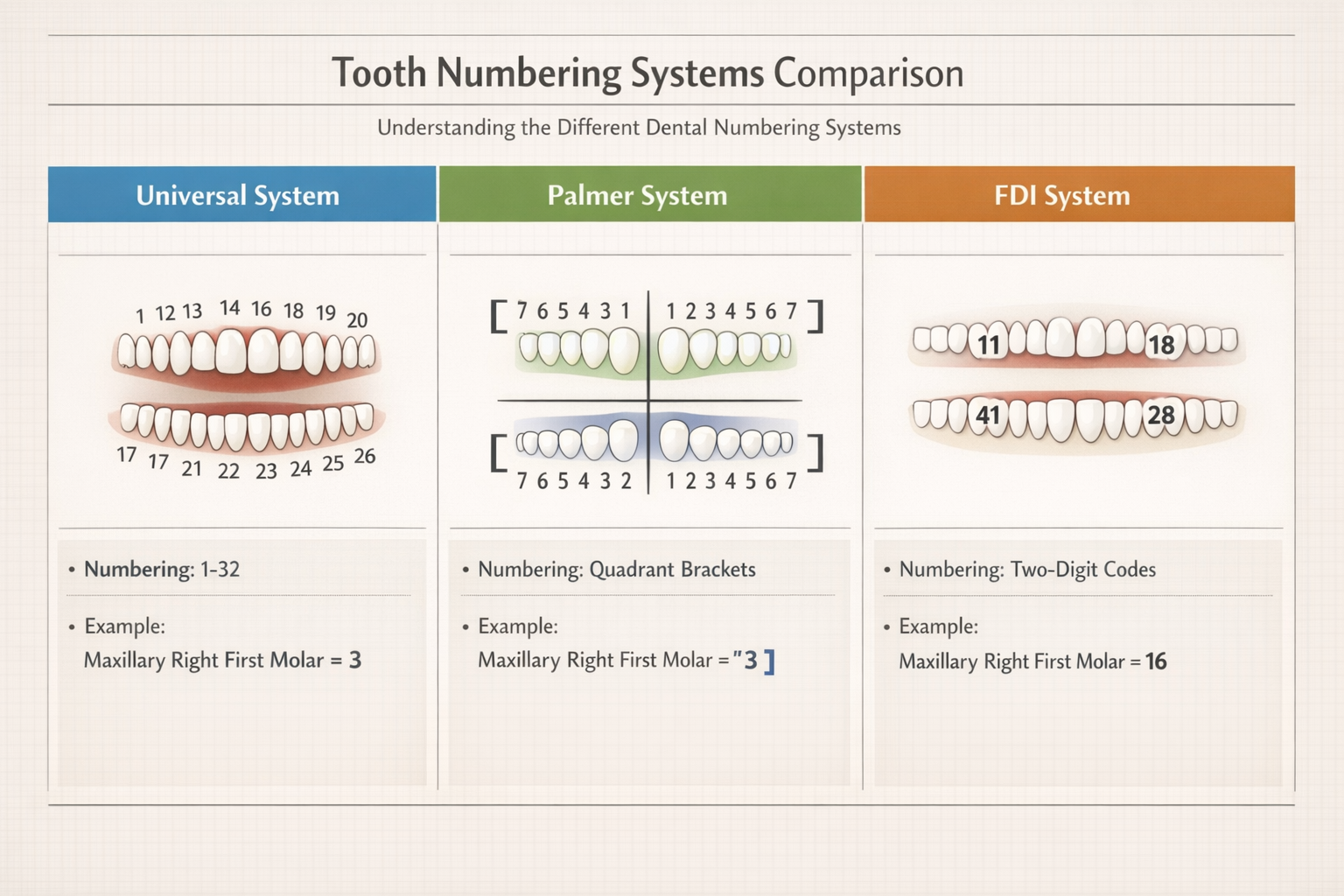
FAQ: Tooth Numbers
Q1: How many permanent teeth do adults typically have?
A1: Adults typically have 32 permanent teeth, including four wisdom teeth. If wisdom teeth are extracted or never develop, the number may be fewer.
Q2: What do tooth numbers 1-32 mean?
A2: In the Universal Numbering System, numbers 1-32 represent each permanent adult tooth. The numbering starts from the upper right wisdom tooth (#1), goes across the upper jaw to the upper left wisdom tooth (#16), then drops to the lower left wisdom tooth (#17), and goes across the lower jaw to the lower right wisdom tooth (#32).
Q3: Why is my dentist referring to a tooth by a number instead of its name (e.g., molar)?
A3: Dentists use tooth numbers to precisely identify each tooth, avoiding ambiguity that can arise with common names, especially for similar tooth types. This ensures accurate charting, diagnosis, and treatment.
Q4: If I have a missing tooth, does its number disappear?
A4: No, the tooth number remains assigned to that position in your mouth. Your dental chart will simply indicate that the tooth corresponding to that number is missing.
Q5: Will a dental implant get a tooth number?
A5: A dental implant replaces a missing natural tooth and is considered a restoration for that specific numbered tooth. For example, an implant replacing tooth #3 will be referred to as “implant at #3.”
Q6: Do baby teeth have numbers?
A6: In the Universal Numbering System, primary (baby) teeth are identified by letters A through T, rather than numbers.
Q7: What if I move to a different country? Will my tooth numbers still be understood?
A7: While the Universal System is common in the U.S., other countries primarily use the FDI World Dental Federation Notation. Your dental records should include diagrams or clear explanations to bridge any differences.
Conclusion
Understanding tooth numbers is a foundational aspect of effective communication in dentistry, offering clarity that benefits both dental professionals and patients. For residents of Dallas, TX, knowing the Universal Numbering System, commonly used by local dentists, empowers you to better comprehend your oral health status, treatment plans, and discussions about vital tooth replacement options like dental implants.
Whether you’re considering a single tooth implant, exploring solutions for missing teeth, or simply aiming for better oral health education, familiarity with these numbering systems demystifies the dental office experience. We encourage you to engage with your dental team, ask questions about your specific tooth numbers, and ensure you have a clear understanding of any recommended procedures. A well-informed patient is a confident patient, and that’s key to achieving and maintaining long-term oral health. For personalized advice and to discuss your unique needs for dental implants in Dallas, we recommend scheduling a consultation with a dentist.
References
- American Dental Association (2026). Dental Terminology & Numbering Systems.
- FDI World Dental Federation (2026). FDI Two-Digit Numbering System.
Leave a Reply
Share your thoughts or ask a question about dental implants. Your email address will not be published.