

Losing even a single tooth can have a profound impact on your oral health, confidence, and overall quality of life. While traditional tooth replacement options like bridges and dentures have long served their purpose, the advancements in modern dentistry, particularly with partial dental implants, offer a superior, long-lasting solution in 2026. If you’re in Dallas, Texas, and exploring your options for replacing one or a few missing teeth, understanding partial dental implants is a crucial step toward making an informed decision. This comprehensive guide from Dental Implant Education – Dallas TX aims to demystify the process, benefits, and considerations surrounding these innovative tooth replacement options.
Key Takeaways
- Partial dental implants are an advanced solution for replacing one or a few missing teeth, offering superior stability, aesthetics, and oral health benefits compared to traditional options.
- They integrate directly with your jawbone, preventing bone loss and preserving the integrity of adjacent natural teeth.
- Modern advancements like 3D-guided surgery, nanotechnology, and immediate loading protocols are making the implant procedure faster and more predictable in 2026.
- Understanding the different types of partial implants, such as mini and short implants, can help determine the best fit for your specific needs.
- A consultation with a dentist specializing in dental implants in Dallas is essential to assess suitability and discuss personalized treatment plans, including implant cost in Dallas.
Understanding Partial Dental Implants: A Modern Solution for Missing Teeth
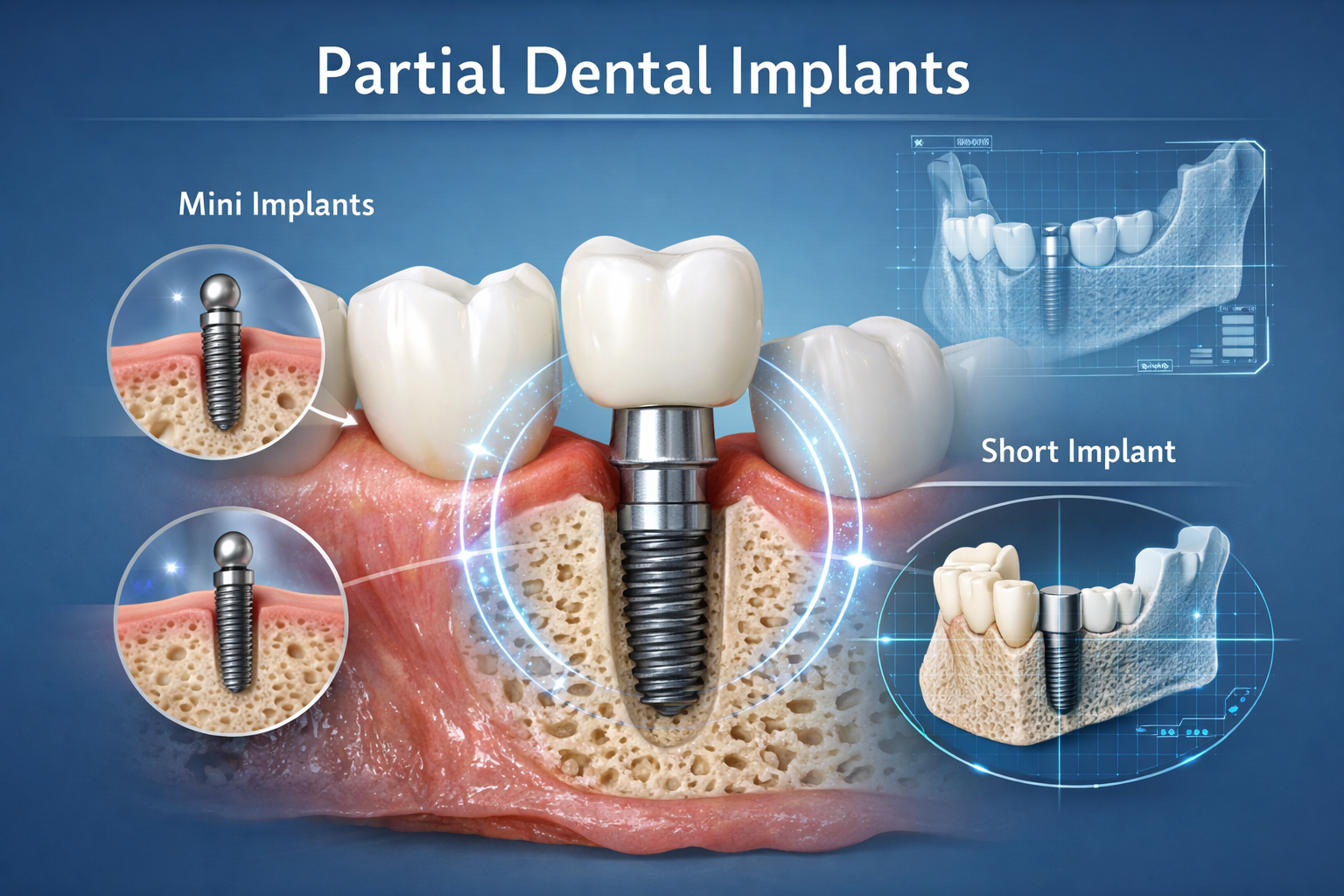
When you have one or several missing teeth but still retain a majority of your natural dentition, you’re not looking for a full mouth restoration like dentures or full arches. Instead, a targeted solution is needed to fill those gaps. This is precisely where partial dental implants excel. Unlike removable partial dentures or fixed dental bridges that rely on neighboring teeth for support, a partial dental implant functions as an independent, standalone tooth replacement. It consists of a titanium post surgically placed into the jawbone, an abutment (a connector), and a custom-made crown that seamlessly blends with your existing teeth [9].
The beauty of partial dental implants lies in their ability to mimic the structure and function of a natural tooth root. This direct integration with the bone, known as osseointegration, provides unparalleled stability, preventing the implant from shifting or slipping [4]. This also means that your jawbone is stimulated, which helps prevent the bone loss that often occurs after a tooth is extracted. Maintaining bone density is crucial for preserving your facial structure and overall long-term oral health.
“Partial dental implants offer a sophisticated and lasting solution for individuals with one or a few missing teeth, preserving both function and aesthetics while protecting your remaining natural teeth.”
The Science Behind Partial Dental Implants
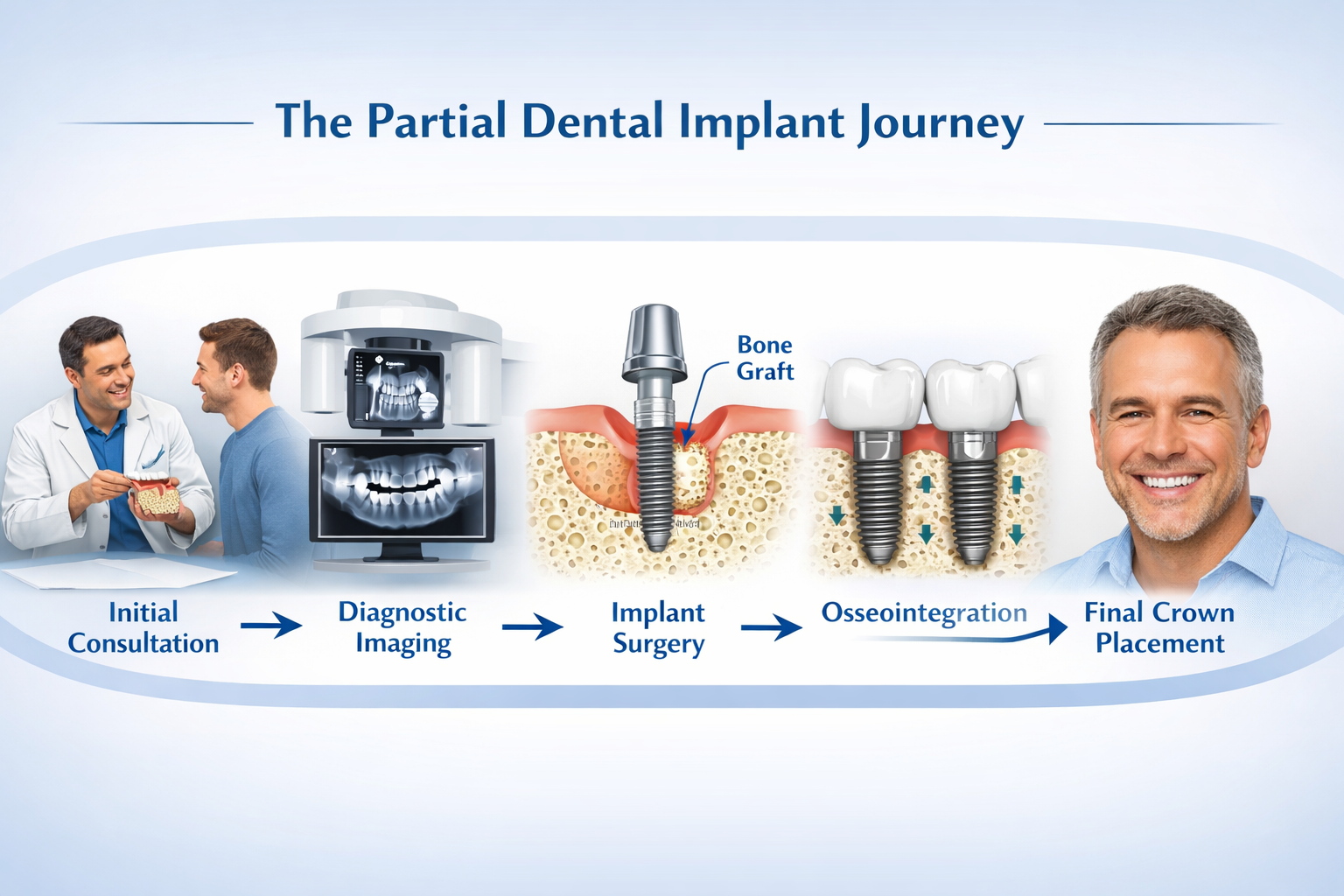
At its core, a dental implant is a small, biocompatible (meaning it’s safe for the body) screw-shaped post, typically made of titanium. Titanium is chosen for its remarkable ability to fuse with bone tissue [3]. The procedure generally involves several stages:
- Initial Assessment and Planning: This critical first step includes a thorough examination, X-rays, and often 3D imaging (like Cone Beam CT scans). This allows the dentist to assess bone quality and quantity, map out nerve pathways, and plan the precise placement of the implant [5]. This advanced planning ensures patient safety and optimal results.
- Implant Placement: The titanium post is surgically placed into the jawbone beneath the gum line. This procedure is typically performed under local anesthesia, ensuring your comfort.
- Healing and Osseointegration: This is a crucial period where the implant fuses with the surrounding bone. This process can take several months, though advancements in implant technology, such as nanotechnology coatings, are helping to reduce healing times from 3-6 months down to 8-12 weeks in some cases [3, 4]. During this time, a temporary restoration might be placed.
- Abutment Placement: Once osseointegration is complete, a small connector, called an abutment, is attached to the implant post. This piece will support the new crown.
- Crown Attachment: Finally, a custom-made crown, designed to match the color, shape, and size of your natural teeth, is permanently attached to the abutment. This completes your new, fully functional tooth.
For a visual understanding of this journey, you might find our resource on Dental Implants Process Pictures: Your Guide to a New Smile helpful.
Types of Partial Dental Implants and Their Innovations in 2026
The field of dental implants is continuously evolving, and 2026 sees remarkable innovations that make partial dental implants more accessible and efficient for a wider range of patients.
- Standard Dental Implants: These are the most common type, typically used when there is sufficient bone volume. They range from 3.4 to 5.8 mm in diameter [3].
- Mini Implants: These are narrower than standard implants, with diameters typically ranging from 1.8 to 3.3 mm [3]. Mini implants are an excellent option for patients with limited bone volume or narrow spaces where a standard implant might not fit without extensive bone grafting. They are often used for stabilizing dentures, but can also be considered for single tooth replacement in specific scenarios. Learn more about their maintenance with our Mini Implant Denture Maintenance Guide for 2026.
- Short Implants: Measuring 6-8 mm in length, compared to the traditional 10-16 mm, short implants are designed for areas with reduced bone height [3]. This innovation can sometimes reduce the need for complex bone grafting procedures in the back of the mouth, where proximity to sinuses or nerves can be a concern.
- Same-Day Implants (Immediate Loading): Thanks to advances in implant design and surgical techniques, some patients may be candidates for same-day implants, where a temporary crown is placed immediately after implant surgery [3]. This significantly reduces the waiting period for a functional and aesthetic tooth.
- All-on-4 Implants for Multiple Teeth: While primarily known for full arch replacement, the underlying principles of the All-on-4 technique can sometimes be adapted for replacing multiple teeth in a specific quadrant if the missing teeth are adjacent [7]. This approach uses strategically placed implants to support a fixed bridge. For more information, explore our guide on Unveiling the True Cost of All-on-4 Dental Implants in 2025.
Why Choose Partial Dental Implants Over Other Options?
When considering tooth replacement options, it’s natural to compare dental implants with alternatives like traditional bridges or removable partial dentures. Here’s why partial dental implants often stand out as the superior choice:
| Feature | Partial Dental Implants | Dental Bridge | Removable Partial Denture |
|---|---|---|---|
| Stability | Excellent; integrated with jawbone | Good; cemented to adjacent teeth | Fair; can shift, requires clasps |
| Bone Health | Preserves jawbone, prevents bone loss | Does not stimulate bone, can lead to bone loss underneath | Does not stimulate bone, can lead to bone loss |
| Adjacent Teeth | Does not affect adjacent natural teeth | Requires grinding down healthy adjacent teeth | Can put strain on adjacent teeth and gums |
| Longevity | Can last a lifetime with proper care (often 20+ years) | Typically 5-15 years | 5-10 years, often requires adjustments |
| Comfort | Feels like a natural tooth | Generally comfortable, but can feel bulky | Can be uncomfortable, may affect speech and eating |
| Maintenance | Brush and floss like natural teeth | Requires special cleaning under the bridge | Requires removal for cleaning, can collect food particles |
| Aesthetics | Highly natural appearance, custom-matched | Good, but adjacent teeth may show alterations | Can be noticeable, clasps may be visible |
For a deeper dive into the comparison, our article “Dental Implant vs Bridge vs Denture: 2026 Guide” offers valuable insights.
The Partial Dental Implant Procedure: What to Expect in Dallas, 2026
Embarking on the journey to restore your smile with partial dental implants is a decision that can significantly improve your quality of life. Understanding the procedure step-by-step can help alleviate any concerns and prepare you for what to expect, especially here in Dallas. Dental Implant Education – Dallas TX is committed to providing a transparent and reassuring experience.
Advanced Diagnostics and Treatment Planning
The first and arguably most crucial step in the partial dental implant procedure is a thorough diagnostic assessment and meticulous treatment planning. In 2026, this involves cutting-edge technology that enhances precision and patient safety [1].
- Comprehensive Examination: Your dentist in Dallas will conduct a full oral examination, review your medical history, and discuss your oral health goals.
- 3D Imaging (CBCT Scan): Cone Beam Computed Tomography (CBCT) scans provide detailed 3D images of your jawbone, nerves, and sinus cavities. This allows for precise measurement of bone density and volume, crucial for determining the ideal implant size and placement [1].
- AI-Assisted Planning: Increasingly, dental practices are utilizing AI-assisted software for treatment planning, allowing for virtual implant placement and prediction of outcomes, further refining the surgical guide and improving success rates [1, 5].
- Personalized Treatment Plan: Based on these diagnostics, a customized treatment plan will be developed, outlining the type of implant, the number of appointments, and the estimated implant cost in Dallas. This is also the time to discuss any necessary preparatory procedures like bone grafting if insufficient bone volume is detected.
The Surgical Phase: Implant Placement
The actual placement of the dental implant post is a surgical procedure performed in the dental office.
- Anesthesia: Local anesthesia is typically used to ensure you are comfortable and pain-free during the procedure. Sedation options are also available for anxious patients.
- Implant Insertion: A small incision is made in the gum tissue to expose the jawbone. A precise pilot hole is drilled, and the titanium implant post is carefully placed into the bone.
- Healing Cap Placement: In most cases, a healing cap or cover screw is placed over the implant, and the gum tissue is gently closed over it. This protects the implant during the initial healing phase.
- Post-Operative Care: You’ll receive detailed instructions on how to care for the surgical site, including medication for discomfort, dietary recommendations, and oral hygiene practices. For guidance on recovery, our article on Senior Dental Implant Healing Time: Guide for 2026 provides helpful information, though recovery principles apply to all adults. You can also learn about Dental Implant Tissue Punch Healing: Guide & Care if that technique is used.
Osseointegration: The Foundation of Success
This stage is critical for the long-term success of your partial dental implant. Osseointegration is the biological process where the jawbone grows around and fuses with the titanium implant surface. This creates a strong, stable anchor for your new tooth.
- Duration: This process typically takes 3 to 6 months. However, advanced implant surface technologies, sometimes involving nanotechnology, can significantly accelerate this healing to as little as 8-12 weeks in certain cases [3, 4].
- Monitoring: Your dentist will monitor your healing progress through follow-up appointments.
Restoration Phase: Abutment and Crown Placement
Once osseointegration is complete, your new tooth will be ready for its final components.
- Abutment Placement: A second minor procedure (sometimes combined with the initial implant placement if an immediate loading protocol is used) may be performed to attach the abutment to the implant. The abutment is a small connector that protrudes through the gum line and serves as the base for your new crown.
- Impression Taking: Once the gums have healed around the abutment, impressions (molds) of your mouth are taken. These impressions are sent to a dental laboratory, where a custom crown is fabricated to match your natural teeth in shape, size, and color.
- Crown Delivery: During your final appointment, the custom crown is securely attached to the abutment, completing your partial dental implant. Your new tooth will look, feel, and function just like your natural teeth.
Regular follow-up appointments with your implant specialist in Dallas are crucial to ensure the lasting success of your smile. Our guide on Dallas Dental Implant Follow-Up: Ensuring Lasting Smile Suc offers more details on this.
Maintaining Your Partial Dental Implants
Caring for your partial dental implants is similar to caring for your natural teeth.
- Oral Hygiene: Brush twice a day, floss daily, and use an antimicrobial mouthwash as recommended by your dentist. Special brushes, like a sulcus brush, can be beneficial for cleaning around implants [6]. See our guide on Sulcus Brush for Implants: 2026 Guide to Optimal Care for more information.
- Regular Dental Check-ups: Schedule routine check-ups and professional cleanings with your Dallas dentist every six months. This allows your dental team to monitor the health of your implant and surrounding tissues.
- Avoid Harmful Habits: Refrain from chewing on hard objects (ice, hard candies) and avoid tobacco products, which can compromise implant success. If you grind your teeth (bruxism), a night guard may be recommended to protect your implant [6]. For details, check our article on Bruxism & Dental Implants: Prevent Damage in 2026.
Cost Considerations for Partial Dental Implants in Dallas
The cost of partial dental implants can vary based on several factors, including the number of implants, the type of implant used, any necessary preparatory procedures (like bone grafts), and the materials chosen for the crown. While it’s an investment, the long-term benefits and durability often outweigh the initial cost compared to other options that may require more frequent replacement or repairs.
It’s important to have a transparent discussion with your dental provider about all aspects of the implant cost in Dallas. Many offices offer various payment plans and financing options to make treatment more affordable. You can explore our resources on Dallas Dental Implant Financing Options | Payment Plans 2025 and Unpacking the Price Tag: What is the Cost of a Dental Implant Tooth in 2025? to better understand the financial aspects. We also offer insights into Best Dental Insurance for Implants 2025 | Expert Guide to help you navigate insurance coverage.
Conclusion
Partial dental implants represent the pinnacle of modern dentistry for replacing individual or a few missing teeth. They offer a comprehensive solution that not only restores the aesthetics of your smile but also crucially supports your long-term oral health by preserving jawbone integrity and protecting adjacent natural teeth. In 2026, with advanced technologies like 3D-guided surgery, faster healing protocols, and innovative implant designs, the dental implant procedure is more predictable, efficient, and comfortable than ever before.
At Dental Implant Education – Dallas TX, we believe in empowering our patients with knowledge. Choosing partial dental implants is an investment in your health, comfort, and confidence. If you’re considering this excellent tooth replacement option in Dallas, the most important next step is to schedule a consultation with a qualified and experienced dental professional. They can thoroughly evaluate your specific situation, discuss your needs, explain the full dental implant procedure, and provide a personalized treatment plan, including a detailed breakdown of the implant cost in Dallas. Make an informed decision for a healthier, more beautiful smile that truly lasts.
References
[1] Dental Implants In 2026 Advances In Longevity Materials And Faster Recovery – https://trinitydentist.com/dental-implants-in-2026-advances-in-longevity-materials-and-faster-recovery/ [3] The Latest Innovations In Dental Implant Technology – https://www.blankdental.com/the-latest-innovations-in-dental-implant-technology/ [4] The Long Term Value Of Dental Implants – https://www.phdental.com/oral-health-news/2026/january/the-long-term-value-of-dental-implants/ [5] Dental Trends 2026 – https://www.brightsmiledesign.com/post/dental-trends-2026 [6] 7 Latest Dental Technologies 2026 – https://mainstreetdentalnewark.com/7-latest-dental-technologies-2026/ [7] 6 Trends Making All On 4 Dental Implants Easier And Safer In 2026 – https://trinitydentalcares.com/6-trends-making-all-on-4-dental-implants-easier-and-safer-in-2026/ [9] Dental Implants Benefits Technology Healing – https://dentist-sunsetpark.com/blog/our-office/2026/15374/dental-implants-benefits-technology-healing/
Leave a Reply
Share your thoughts or ask a question about dental implants. Your email address will not be published.