

The Implant Stability Quotient (ISQ) is a numerical scale, ranging from 1 to 99, used by dental professionals to objectively measure the stability of a dental implant within the jawbone at various stages of the healing process [1]. This measurement is crucial for determining the ideal time to attach a crown or other restoration, ensuring the implant has properly integrated with the bone and is ready to withstand biting forces [2]. Essentially, ISQ provides a vital piece of information that contributes significantly to the success and longevity of your dental implant.
The prospect of restoring your smile with dental implants in Dallas is exciting, but understanding the intricate science behind their success is just as important. One key factor that dental professionals rely on to ensure the longevity and stability of your new tooth replacement is something called the Implant Stability Quotient, or ISQ. This objective measurement plays a critical role in the planning and execution of your dental implant procedure, guiding decisions that directly impact your long-term oral health. As you explore tooth replacement options, gaining insight into metrics like ISQ can empower you to make informed decisions and feel confident in your journey toward a restored smile.
Key Takeaways
- The Implant Stability Quotient (ISQ) is a non-invasive, objective measurement, typically ranging from 1 to 99, that quantifies the mechanical stability of a dental implant using Resonance Frequency Analysis (RFA).
- ISQ values help dentists determine the optimal timing for loading a dental implant, ensuring successful osseointegration and long-term success.
- Higher ISQ values (generally above 70) indicate high stability, allowing for earlier or immediate loading of the implant, while lower values (<60) suggest delayed loading.
- Regular ISQ measurements allow dentists to monitor the healing process and identify potential issues early, contributing to patient safety and predictable outcomes for dental implants in Dallas.
- Understanding ISQ helps patients appreciate the science behind their dental implant procedure and the dentist’s careful planning for their long-term oral health.
What is Implant Stability Quotient (ISQ) and How is it Measured?
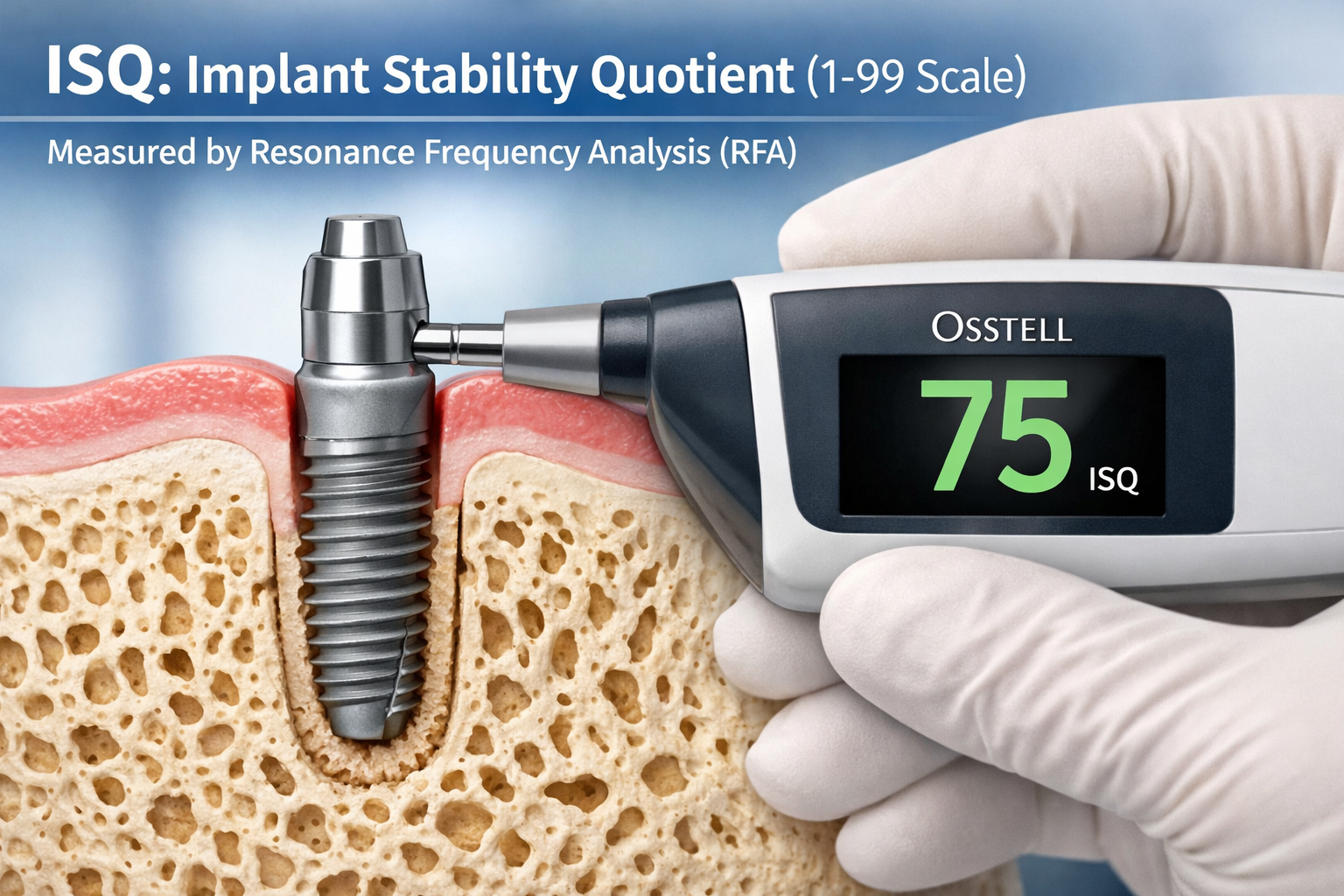
The Implant Stability Quotient (ISQ) is an objective, non-invasive measurement that quantifies the mechanical stability of a dental implant within the jawbone [1]. It is measured using a device that employs Resonance Frequency Analysis (RFA), providing a numerical value typically on a scale from 1 to 99, with higher numbers indicating greater stability [1, 3]. This measurement is vital for ensuring the success of your dental implant procedure.
The process involves attaching a small, lightweight transducer (a device that converts energy from one form to another) to the dental implant itself. This transducer emits very low-level vibrations, and the device then measures how the implant responds to these vibrations. The frequency at which the implant-bone system resonates provides the ISQ value [2].
Key Aspects of ISQ Measurement:
- Non-invasive: The measurement does not involve surgery or discomfort and can be performed quickly at various stages of treatment.
- Objective: Unlike subjective evaluations based on feel or X-rays alone, ISQ provides a concrete number that reduces guesswork.
- Repeatable: Measurements can be taken multiple times over the healing period, allowing the dentist to track changes in stability and monitor the osseointegration process [2].
- Reflects Implant-Bone Interface: ISQ measures the stiffness of the implant material itself, the interface between the implant and the surrounding bone, and the density of both the trabecular and cortical bone [2]. This comprehensive assessment provides a clear picture of how well the implant is integrating.
For patients considering dental implants, understanding that such precise measurements are part of the process can be reassuring. It demonstrates the commitment to patient safety and predictable outcomes, especially for individuals seeking quality tooth replacement options in Dallas.
Why is Measuring Implant Stability Quotient (ISQ) Important for Dental Implants?
Measuring the Implant Stability Quotient (ISQ) is crucial because it directly influences the timing of the dental implant loading process, which is when the prosthetic tooth (crown, bridge, or denture) is attached to the implant [1]. Proper timing, guided by ISQ values, is essential for successful osseointegration—the process where the bone grows directly onto the implant surface, creating a strong bond.
The primary goal of any dental implant procedure is for the implant to achieve stable osseointegration. If an implant is loaded too early, before sufficient bone integration has occurred, it can lead to micromovement at the implant-bone interface. This micromovement can disrupt the delicate healing process, potentially resulting in implant failure [1].
Benefits of ISQ Measurement:
- Optimized Loading Protocols: ISQ helps dentists decide whether an implant can be loaded immediately (within 48 hours), early (within a few weeks), or conventionally (after several months) [1]. For instance, an ISQ value of 64 or higher often permits early loading, while values below 64 typically require traditional loading protocols for a higher survival rate [1].
- Reduced Risk of Failure: By accurately assessing stability, ISQ minimizes the risk of implant failure due to premature loading. This contributes significantly to the overall success rates of dental implants.
- Monitoring Healing: Regular ISQ checks allow the dental team to monitor the ongoing osseointegration process, providing objective data on how well the bone is integrating with the implant over time [2]. This is particularly valuable for complex cases or patients with healing challenges, such as those navigating diabetic dental implant recovery.
- Enhanced Patient Safety: By ensuring the implant is stable before placing the final restoration, ISQ measurement contributes to greater patient safety and predictable long-term outcomes.
- Informed Decision-Making: Dentists can use ISQ values to confidently explain the treatment plan and expected healing timeline to patients, fostering trust and clarity. This is a key part of any comprehensive dental implant consultation in Dallas.
Understanding the role of ISQ measurements helps patients grasp why their dentist might recommend specific healing periods or follow-up appointments. It’s an integral part of ensuring that your missing teeth solutions are not just aesthetically pleasing, but also structurally sound and durable for years to come.
Interpreting ISQ Values: What Do the Numbers Mean?
Interpreting ISQ values involves understanding that a higher number signifies greater implant stability, which directly correlates with the implant’s readiness for functional loading [1]. The ISQ scale ranges from 1 to 99, providing a clear, objective guide for clinical decision-making.
The ISQ measurement reflects the stiffness of the implant-bone interface. This stiffness is influenced by factors such as the quality and quantity of the surrounding bone (cortical and trabecular), as well as the initial mechanical stability achieved during implant placement [2].
Understanding the ISQ Scale:
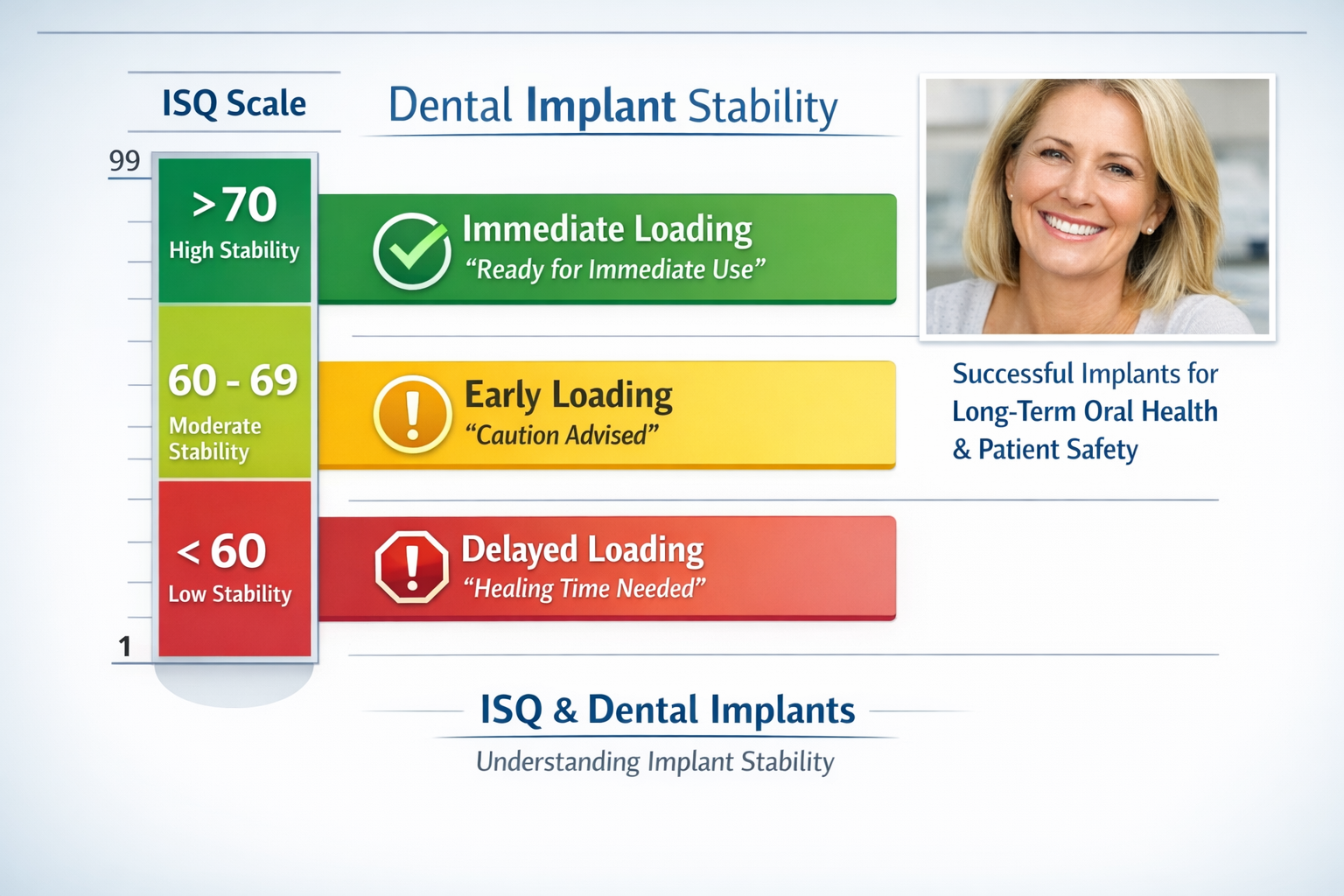
- High Stability (ISQ > 70): Implants with ISQ values above 70 are considered very stable, exhibiting low micromobility. These implants can generally withstand normal functional forces and are often candidates for early or even immediate loading [1, 4]. This indicates strong osseointegration and a high degree of confidence for placing the final restoration.
- Medium Stability (ISQ 60-69): Implants in this range demonstrate good, but not exceptionally high, stability. Dentists might consider early loading depending on other clinical factors and patient health, but often a slightly longer healing period is recommended to ensure robust osseointegration [1].
- Low Stability (ISQ < 60): An ISQ value below 60 indicates lower stability, meaning the implant requires more time for adequate osseointegration before it can be safely loaded [1, 4]. Loading such an implant prematurely could lead to failure. In these cases, a traditional healing period of several months is typically advised.
Clinical Considerations for ISQ Values:
- Typical Clinical Range: Most dental implants fall within a normal clinical range of 55-80 ISQ [1].
- Mandibular vs. Maxillary Implants: Mandibular (lower jaw) implants generally exhibit slightly higher ISQ values (around 59.8) compared to maxillary (upper jaw) implants (around 55) [3]. This difference can be attributed to the typically denser bone quality in the mandible.
- Loading Thresholds:
- ISQ ≥ 64: Often permits early loading of implants, meaning the final restoration can be placed sooner [1].
- ISQ < 64: Usually necessitates traditional loading protocols to ensure higher survival rates and allow for more complete osseointegration [1].
- Specific Protocols: For posterior implants with an ISQ > 60, or a summed ISQ of 200 across four anterior implants (often seen in All-on-4 type procedures), direct loading with an insertion torque of ≥30 Ncm might be considered [1].
Table: ISQ Value Ranges and Clinical Implications
| ISQ Range | Stability Level | Clinical Implication | Recommended Loading Protocol |
|---|---|---|---|
| > 70 | High Stability | Very stable; low micromobility; strong osseointegration | Early or Immediate Loading (often within 48 hours to few weeks) |
| 60-69 | Medium Stability | Good stability; continued monitoring recommended | Early or Conventional Loading (few weeks to few months) |
| < 60 | Low Stability | Requires more time for osseointegration; higher risk of micromotion | Conventional/Delayed Loading (several months) |
| ≥ 64 | Permits Early Loading | ||
| < 64 | Traditional Loading for Higher Survival Rates |
By carefully considering these ISQ values, your dentist in Dallas can formulate the safest and most effective treatment plan, optimizing the success of your missing teeth solutions. This objective data helps in managing patient expectations and ensuring the longevity of your implant investment.
Primary vs. Secondary Stability: The Role of ISQ Over Time
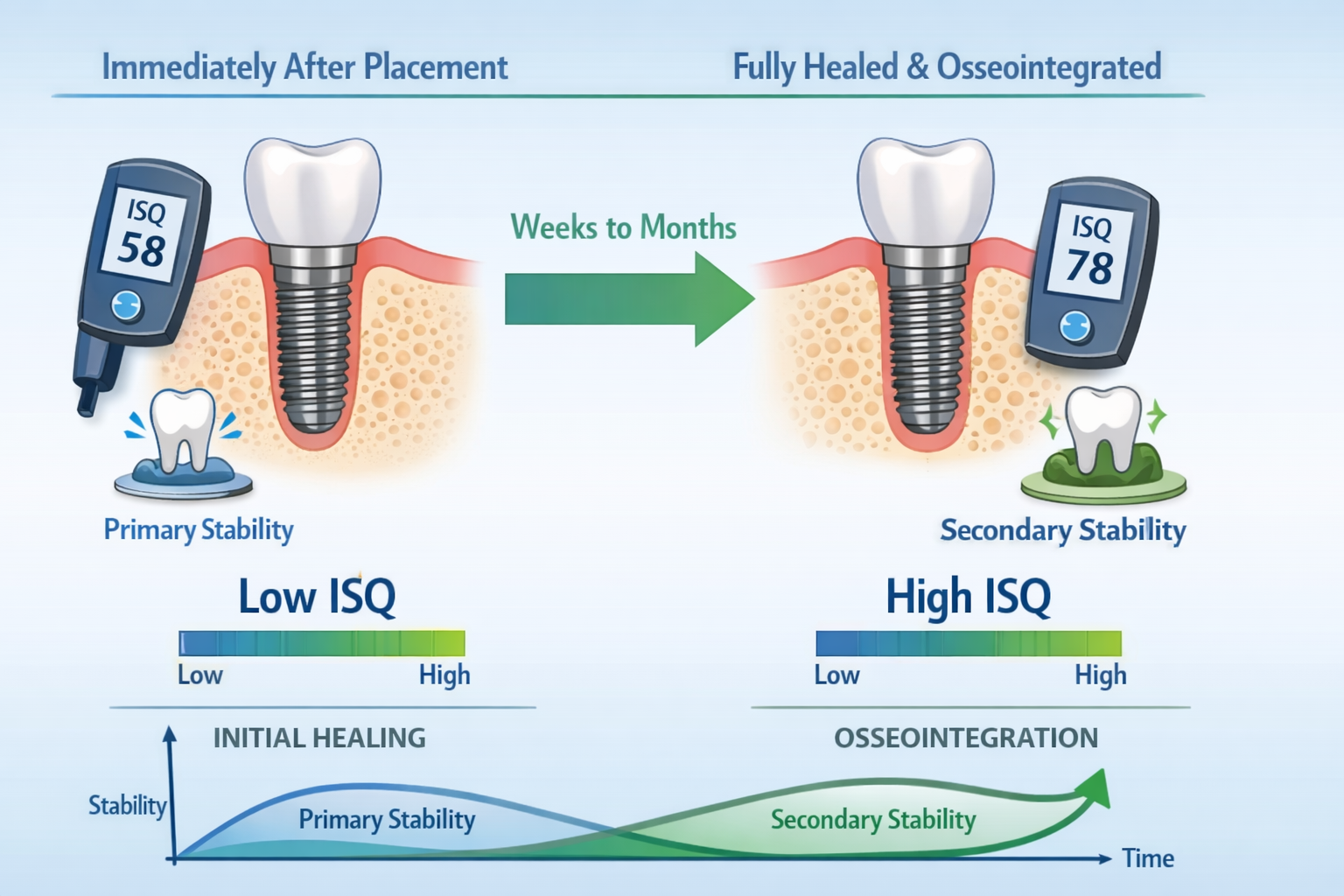
Implant stability is a dynamic process that evolves over time, moving from primary stability to secondary stability, and ISQ plays a critical role in monitoring this transition [1]. Understanding this progression is key to appreciating the dental implant healing process.
Primary Stability
Primary stability refers to the initial mechanical grip of the implant in the bone immediately after surgical placement [2]. This stability is purely mechanical and depends on factors like:
- Bone Density: Denser bone provides a better initial grip.
- Implant Design: The shape, thread pattern, and surface characteristics of the implant.
- Surgical Technique: Precise drilling and controlled insertion of the implant by the surgeon.
High primary stability is desirable as it minimizes initial micromovement, which is crucial for promoting successful bone healing around the implant. If the primary stability is too low, the implant may not heal properly, or it might even need to be removed. Dentists often aim for a certain insertion torque during placement to achieve adequate primary stability [2]. While ISQ can be measured at placement, this initial value mainly reflects primary stability.
Secondary Stability
Secondary stability develops as the bone heals and grows around the implant, a process known as osseointegration [2]. This biological bond gradually replaces the initial mechanical stability. Over several weeks to months, bone cells actively remodel and integrate with the implant surface, forming a strong, biological connection.
This is where repeated ISQ measurements become invaluable. As osseointegration progresses, the ISQ value typically increases, reflecting the strengthening of the biological bond between the implant and the bone [1]. The period during which primary stability decreases slightly as secondary stability begins to form is sometimes referred to as the “dip” in stability, which is a normal part of the healing process.
ISQ and the Healing Curve:
- At Placement: An initial ISQ reading is taken to confirm adequate primary stability.
- During Healing: Subsequent ISQ measurements, often taken at 4-6 week intervals, track the development of secondary stability. A rising ISQ indicates successful osseointegration.
- Prior to Loading: A final ISQ measurement before attaching the restoration confirms that the implant has achieved sufficient secondary stability for safe loading [1].
For patients, monitoring this transition means understanding that the stability of their implant isn’t just about the initial placement, but a continuous biological process. Your dental implant specialist in Dallas will use these ISQ readings to ensure the most appropriate timing for each stage of your treatment, from the initial implant surgery process to the final restoration. This careful monitoring is a testament to the comprehensive approach taken to ensure your long-term success.
Factors Influencing Implant Stability and ISQ Values
Several factors can influence both the initial primary stability of a dental implant and the subsequent ISQ values obtained throughout the healing process. Understanding these variables helps dentists predict outcomes and manage patient expectations for their dental implant treatment.
Key Factors Affecting ISQ:
- Bone Quality and Quantity:
- Bone Density: Denser bone (Type I or Type II, typically found in the mandible) provides a stronger initial grip for the implant, leading to higher primary stability and often higher ISQ values [3]. Softer bone (Type III or Type IV, often in the maxilla) may result in lower initial stability.
- Bone Volume: Adequate bone volume is necessary to fully embed the implant. Insufficient bone may require preliminary procedures like bone grafting, which influences healing time and stability. For more information on bone graft healing, refer to our guide on Bone Graft Healing for Dental Implants: Your 2026 Timeline.
- Implant Design:
- Shape and Thread Geometry: Implants with tapered designs or specific thread patterns can enhance primary stability, especially in softer bone.
- Surface Treatment: Surface treatments (e.g., roughened surfaces) can promote faster and stronger osseointegration, contributing to higher secondary stability and ISQ values over time.
- Length and Diameter: Longer and wider implants generally provide greater surface area for bone contact, which can contribute to better stability.
- Surgical Technique:
- Insertion Torque: The force applied during implant insertion is a direct indicator of primary stability. Optimal insertion torque helps achieve good initial stability without over-compressing the bone, which could lead to necrosis [2].
- Site Preparation: Precise drilling and osteotomy preparation minimize trauma to the bone and optimize the fit of the implant, enhancing stability.
- Flap vs. Flapless Surgery: The surgical approach can sometimes impact initial stability and healing, though its direct effect on ISQ can vary.
- Patient-Related Factors:
- General Health: Systemic conditions like uncontrolled diabetes can impair bone healing and osseointegration, potentially leading to lower ISQ values and prolonged healing times [3]. (See our guide on Diabetic Dental Implant Recovery: Guide for 2026).
- Smoking: Smoking negatively impacts blood supply and bone metabolism, hindering healing and potentially reducing implant stability.
- Oral Hygiene: Poor oral hygiene can lead to peri-implantitis, an infection around the implant that can compromise stability.
- Medications: Certain medications (e.g., bisphosphonates) can affect bone metabolism and influence osseointegration.
- Location of Implant:
- As mentioned, mandibular implants often show higher ISQ values than maxillary implants due to denser bone [3].
- Some studies suggest anterior implants might have higher ISQ values than posterior implants, though findings can vary [3].
For individuals in Dallas exploring dental implants, a thorough dental implant consultation is essential. During this consultation, your dentist will assess these factors, often using advanced imaging like X-rays, to develop a personalized treatment plan that maximizes the chances of successful implant integration and high ISQ values for your long-term oral health.
Benefits of Using ISQ Measurement in Clinical Practice
Incorporating Implant Stability Quotient (ISQ) measurements into clinical practice offers numerous advantages for both dental professionals and patients, contributing to predictable outcomes and enhanced patient safety. These benefits extend throughout the entire dental implant journey, from initial placement to long-term follow-up.
Advantages for Dental Professionals:
- Objective Decision-Making: ISQ provides a quantitative, objective measure of implant stability, removing guesswork from critical decisions about implant loading and healing timelines [1]. This is particularly useful in complex cases or when assessing borderline stability.
- Reduced Risk of Complications: By indicating when an implant is truly ready for loading, ISQ helps prevent premature loading, a common cause of implant failure. This minimizes the need for revision dental implant surgery in Dallas and other complications.
- Tailored Treatment Plans: Dentists can customize healing periods and loading protocols based on individual ISQ readings, rather than relying solely on generic timeframes. This personalized approach can lead to more efficient treatment for patients with excellent healing, or more cautious approaches for those with slower osseointegration.
- Early Detection of Issues: A decrease in ISQ values during the healing phase can be an early indicator of potential problems, such as infection or insufficient osseointegration. This allows for timely intervention, improving the chances of salvaging the implant.
- Enhanced Communication: Objective ISQ numbers facilitate clear communication with patients, allowing them to better understand their healing progress and the rationale behind treatment decisions.
- Data for Research and Quality Assurance: Collecting ISQ data contributes to clinical research and helps dental practices maintain high standards of quality and efficacy for their implant procedures.
Advantages for Patients:
- Increased Confidence and Reassurance: Knowing that their implant’s stability is scientifically measured provides patients with greater confidence in the success and longevity of their treatment.
- Optimized Healing and Success Rates: The use of ISQ helps ensure that implants are loaded only when they are biologically ready, significantly increasing the likelihood of successful, long-lasting outcomes for their missing teeth solutions.
- Potentially Shorter Treatment Times: For implants exhibiting high ISQ values, early loading protocols may be implemented, meaning patients can receive their final restorations and enjoy their new smiles sooner.
- Reduced Anxiety: A clear understanding of the healing process, supported by objective ISQ data, can reduce patient anxiety about the dental implant procedure.
- Long-Term Oral Health: By promoting optimal osseointegration and preventing early failures, ISQ contributes directly to the long-term health and function of the dental implant, allowing patients to enjoy the full benefits of their investment in their smile.
In a competitive landscape like Dallas, dentists utilizing advanced tools like ISQ measurement demonstrate a commitment to providing the highest standard of care, ensuring patient safety and predictable results for those seeking quality dental implants in Dallas.
What to Expect: ISQ Measurement During Your Dental Implant Journey in 2026
When you embark on your dental implant journey in 2026, understanding how your dentist uses the Implant Stability Quotient (ISQ) can provide valuable insight into the precision and care involved in your treatment. ISQ measurements are typically integrated into key phases of the dental implant process.
The ISQ Measurement Process:
- Initial Implant Placement: Immediately after the dental implant is surgically placed into your jawbone, your dentist may take an initial ISQ reading. This measurement assesses the primary stability—the mechanical grip of the implant in the bone [2]. A good initial ISQ confirms that the implant has been seated securely and is a strong starting point for osseointegration.
- During the Healing Phase: For implants requiring a healing period (conventional loading), follow-up ISQ measurements may be taken at various intervals, such as 4-6 weeks and then every few weeks or months. These measurements track the development of secondary stability as the bone integrates with the implant [1]. You’ll typically observe a gradual increase in your ISQ values over this time, indicating successful healing. This is a non-invasive procedure, similar to taking a quick temperature reading, and involves no discomfort.
- Before Restoration Placement (Loading): Before your final crown, bridge, or denture is attached to the implant, a critical ISQ measurement will be taken. This reading is crucial for determining if the implant has achieved sufficient osseointegration and stability to safely withstand chewing forces [1]. Your dentist will use this ISQ value to confirm whether the implant is ready for immediate, early, or conventional loading. This is a key step in preventing dental implant failure symptoms.
- Long-Term Monitoring (Less Common): In some cases, or if concerns arise, ISQ might be used for long-term monitoring, though this is less common than during the initial healing. It can help assess changes in stability over many years, providing a quantitative metric for implant health.
What You Will Experience:
The ISQ measurement itself is quick, painless, and completely non-invasive. A small, lightweight probe will be gently attached to the implant post (or an abutment specifically designed for measurement), and a device will emit subtle vibrations. The device then displays the ISQ value. You will feel virtually nothing during the measurement. It’s a simple, efficient way for your dental professional to gather vital information about your implant’s progress.
This meticulous approach ensures that your dental implant surgery process is managed with the utmost precision, contributing to predictable and successful outcomes for your long-term oral health. When seeking tooth replacement options in Dallas, understanding these steps can help you feel more comfortable and confident about your treatment.
Comparing ISQ to Other Stability Assessment Methods
While ISQ is a highly valuable tool for assessing dental implant stability, it’s important to understand how it compares to other methods traditionally used in dentistry. Each method offers a unique perspective on an implant’s integration with the bone.
Traditional Methods:
- Tactile Perception (Manual Assessment): Historically, dentists would assess implant stability by manually wiggling the implant or feeling for any movement after placement. This method is highly subjective and depends heavily on the clinician’s experience and tactile sensitivity. It lacks objectivity and is difficult to standardize or quantify.
- Percussion Test: Tapping the implant with a dental instrument and listening to the sound produced can give an indication of stability. A sharp, high-pitched sound generally suggests good stability, while a duller sound may indicate less integration. Like tactile perception, this method is subjective and relies on the clinician’s interpretation.
- Radiographic Evaluation (X-rays): X-rays, such as periapical films or CBCT scans, are essential for evaluating bone levels around the implant and checking for signs of bone loss or pathology. While X-rays provide crucial anatomical information and show the long-term health of the surrounding bone, they do not directly measure the mechanical stability or strength of the implant-bone interface in real-time. You can learn more about this in our guide on Dental Implant X-Ray Frequency Guide 2026.
- Insertion Torque Values (ITV): This measures the rotational force (in Ncm) required to place the implant into the bone [2]. A higher insertion torque often correlates with higher primary stability. However, ITV is a measurement taken only at the time of implant placement and does not provide information about changes in stability during the healing process or the development of secondary stability. It’s a snapshot, whereas ISQ can track dynamic changes.
Advantages of ISQ Measurement:
- Objectivity and Quantification: Unlike subjective methods, ISQ provides a precise, numerical value (1-99) that quantifies stability, making it easily reproducible and comparable over time [1].
- Non-Invasive: ISQ measurement is completely non-surgical and causes no discomfort to the patient, allowing for multiple measurements without disturbing the healing site [2].
- Dynamic Monitoring: ISQ allows dentists to track the crucial transition from primary to secondary stability, providing real-time data on osseointegration progress. This is something insertion torque or X-rays cannot do alone.
- Improved Clinical Decision-Making: The objective data from ISQ directly informs critical decisions regarding loading protocols, minimizing risk and optimizing patient outcomes [1].
- Standardization: The standardized nature of ISQ measurements helps improve consistency across different clinicians and practices, which is beneficial for quality control and research.
While traditional methods like X-rays and tactile assessment still hold value in the overall evaluation of dental implants, ISQ provides a superior, objective, and dynamic assessment of mechanical stability. For patients considering tooth replacement options in Dallas, seeking a practice that incorporates ISQ measurements demonstrates a commitment to advanced, evidence-based care for their long-term oral health.
Does ISQ Affect the Cost of Dental Implants in Dallas?
The direct use of an ISQ measurement device typically does not significantly impact the overall cost of dental implants in Dallas for patients. While the equipment itself represents an investment for the dental practice, it is generally considered a standard part of delivering high-quality, modern dental implant care rather than an additional charge line item.
Instead of directly increasing the price, the use of ISQ contributes to the value and predictability of your dental implant investment. It’s part of a comprehensive approach to patient safety and successful outcomes, which in turn can prevent costly complications down the line.
How ISQ Relates to Implant Cost:
- Indirect Value: ISQ helps prevent implant failure due to premature loading. An implant failure can be financially and emotionally taxing, potentially requiring additional procedures like implant removal and revision surgery, which would incur more costs. By ensuring optimal timing for loading, ISQ helps protect your initial investment in your smile.
- Efficiency: For implants with high ISQ values, early loading may be possible, potentially reducing the overall treatment time and the number of appointments needed before the final restoration is placed. While not necessarily reducing the base average cost of 1 dental implant, it can streamline the process.
- Quality of Care: Practices that utilize advanced technology like ISQ devices often reflect a commitment to a higher standard of care and precision in their implant procedures. This can be a factor to consider when comparing dental implant options and providers.
- Included in Overall Fee: Generally, the use of stability measurement tools like ISQ is integrated into the comprehensive treatment planning and surgical fees. It’s part of the dentist’s overhead for providing top-tier dental implant solutions and is not itemized as a separate fee for patients.
When discussing the factors affecting implant cost in Dallas, dentists will usually focus on elements like the type of implant, the need for bone grafting or extractions, the number of implants, and the material of the final restoration. The diagnostic tools used to ensure success, like ISQ, are often assumed to be part of that comprehensive service.
Therefore, while ISQ is an essential part of ensuring the long-term success of your dental implant, you should not expect it to be a standalone charge. Instead, it’s an assurance that your dental implant procedure is being managed with the highest level of care and precision, protecting your investment in long-term oral health.
FAQ About Implant Stability Quotient (ISQ)
What does an ISQ score of 70 mean?
An ISQ score of 70 or higher indicates very high implant stability, meaning the implant has low micromobility and is well-integrated with the bone [1]. This level of stability often allows for early or even immediate loading of the implant.
Is ISQ measurement painful?
No, ISQ measurement is completely non-invasive and painless. A small probe is gently attached to the implant, and you will not feel anything during the brief measurement process [2].
Can ISQ values change over time?
Yes, ISQ values are dynamic. They are expected to change during the healing process, typically increasing as the bone integrates with the implant, indicating the transition from primary to secondary stability [1].
What is a good ISQ score for immediate loading?
While specific thresholds can vary slightly, an ISQ value of 64 or higher is generally considered favorable for early loading, and often even higher values (e.g., >70) are desired for immediate loading protocols [1]. However, other clinical factors are also considered.
What happens if my ISQ is too low?
If your ISQ is too low (e.g., below 60), it indicates that the implant needs more time for osseointegration. Your dentist will likely recommend a conventional, delayed loading protocol to allow more bone healing, minimizing the risk of implant failure [1].
Is ISQ used for all dental implants?
Many modern dental implant practices, particularly those focused on predictable outcomes and patient safety, utilize ISQ measurements. It is a valuable tool, but its routine application can vary among clinicians.
Does bone quality affect ISQ?
Yes, bone quality (density) significantly affects ISQ. Denser bone typically results in higher initial ISQ values, while softer bone may yield lower initial readings [3].
Can I get my ISQ measured in Dallas?
Yes, many dental professionals specializing in dental implants in Dallas use ISQ measurement as part of their standard of care. It is a sign of a technologically advanced and patient-focused practice.
Key Takeaways
- Objective Measurement: ISQ provides a precise, numerical scale (1-99) for implant stability using Resonance Frequency Analysis (RFA), offering an objective assessment of osseointegration [1, 2].
- Crucial for Loading Decisions: The ISQ value guides dentists in determining the safest and most effective time to load a dental implant with a restoration (crown, bridge, or denture) [1].
- High ISQ = High Stability: Values above 70 indicate excellent stability, often allowing for early or immediate loading protocols [1, 4].
- Low ISQ = Delayed Loading: Values below 60 suggest lower stability, requiring more healing time for successful osseointegration [1, 4].
- Dynamic Process: ISQ tracks the transition from initial mechanical (primary) stability to biological (secondary) stability as the bone integrates with the implant [2].
- Non-Invasive and Repeatable: The measurement is quick, painless, and can be repeated throughout the healing process to monitor progress [2].
- Enhances Patient Safety: Utilizing ISQ reduces the risk of implant failure due to premature loading, contributing to predictable, long-term success for missing teeth solutions and patient safety.
- Dallas Dental Implant Education: For those considering dental implants in Dallas, understanding ISQ helps appreciate the advanced care and precision involved in modern implant dentistry.
Conclusion
The Implant Stability Quotient (ISQ) is far more than just a number; it is a critical, objective tool that empowers dental professionals to make informed decisions throughout your dental implant journey. By precisely measuring the mechanical stability of your implant within the bone, ISQ ensures that your new tooth replacement is optimally positioned for successful osseointegration and long-term durability. This advanced measurement helps minimize risks, enhance patient safety, and ultimately contributes to the predictable and lasting success of your smile.
For anyone in Dallas considering tooth replacement options, knowing that your dental team utilizes tools like ISQ demonstrates a commitment to the highest standard of care and precision. It signifies a patient-first approach, prioritizing the biological healing process to achieve the best possible outcomes for your long-term oral health.
If you are exploring dental implants in Dallas and want to learn more about how advanced techniques can benefit your smile, we encourage you to schedule a consultation with a dentist who prioritizes patient education and utilizes state-of-the-art diagnostic tools. Understanding what ISQ is and its role in your treatment can provide immense peace of mind as you invest in a healthy, confident future.
References
[1] The Osstell Isq Scale – https://www.osstell.com/clinical-guidelines/the-osstell-isq-scale/
[2] Three Questions On Insertion Torque Value And Implant Stability Quotient – https://www.dental-tribune.com/news/three-questions-on-insertion-torque-value-and-implant-stability-quotient/
[3] Pmc7494467 – https://pmc.ncbi.nlm.nih.gov/articles/PMC7494467/
[4] Product Spotlight Penguin Rfa – https://glidewelldental.com/education/chairside-magazine/volume-14-issue-1/product-spotlight-penguin-rfa
Leave a Reply
Share your thoughts or ask a question about dental implants. Your email address will not be published.