

Experiencing a dental implant that feels “off” can be concerning, especially after investing in a long-term solution for missing teeth. This sensation often indicates a subtle or significant issue with the implant, crown, or surrounding oral structures that requires professional attention. For residents of Dallas, Texas, understanding why your implant bite feels off and when to seek expert care is crucial for maintaining your long-term oral health and the success of your dental implant.
Key Takeaways
- An “off” feeling in your implant bite can range from minor discomfort to a sign of underlying issues.
- Common causes include improper crown fit, occlusal (bite) misalignment, bone integration problems, or clenching/grinding.
- Persistent discomfort, difficulty chewing, or changes in speech warrant immediate consultation with a dental professional.
- Early diagnosis using tools like X-rays and bite analysis is key to preventing further complications.
- Treatment options vary from simple occlusal adjustments to crown replacement or addressing implant stability.
- Regular follow-up appointments and proper oral hygiene are vital for long-term implant success and bite comfort.
- Consulting with a local Dallas dentist specializing in dental implants is essential for accurate diagnosis and effective treatment.
Quick Answer
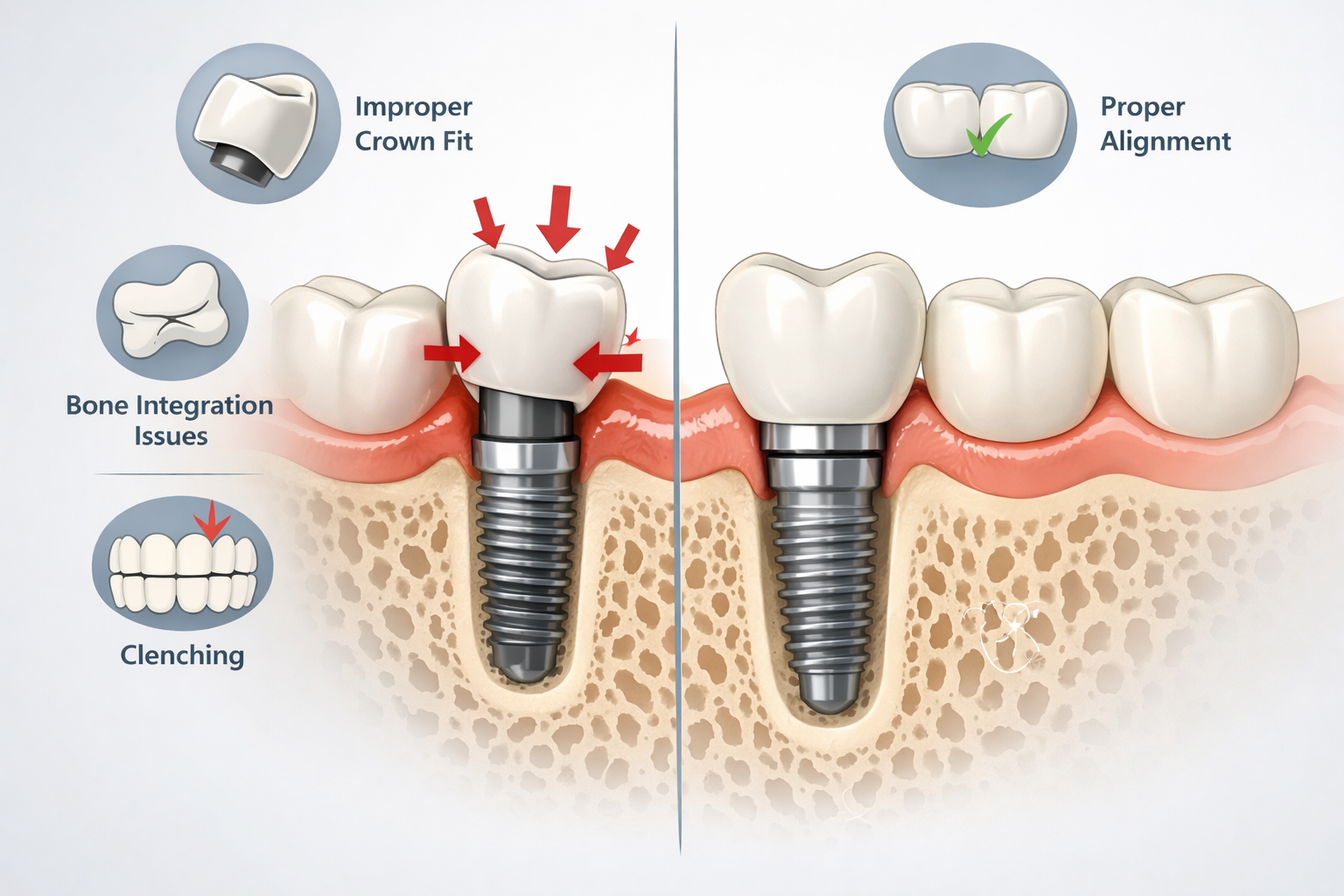
If your implant bite feels off, it means there’s a discrepancy in how your upper and lower teeth meet when you close your mouth, specifically involving your dental implant. This can stem from various causes, including the implant crown not fitting perfectly, changes in your natural teeth, or issues with the implant’s stability within the bone. Addressing this promptly with a dentist is important to prevent discomfort, damage to the implant, or impact on your overall oral health.
Why Does My Implant Bite Feel Off?
An implant bite feeling off typically signals an issue with the interaction between your dental implant, the prosthetic crown, and your natural teeth. This sensation can arise from several factors, ranging from minor adjustments needed to more significant underlying concerns impacting the stability and function of your implant.
The bite force, or the pressure exerted when you chew, is a critical factor in implant stability. Research indicates that bite force on implant-retained crowns is initially lower than on natural teeth, but it significantly increases over 6-18 months as the implant fully integrates with the bone [1, 2]. However, if your bite still feels uneven or uncomfortable after this period, or if it changes suddenly, it warrants investigation.
Here are some common reasons why your implant bite might feel off:
- Improper Crown Fit: The most frequent cause is a crown that doesn’t fit perfectly. It might be slightly too high, too wide, or angled incorrectly, leading to uneven pressure when you bite down. This can happen immediately after the crown is placed or develop over time due to wear or changes in surrounding teeth.
- Occlusal Discrepancy (Bite Misalignment): Even a millimeter difference can make your bite feel unnatural. If the implant crown is making premature contact with an opposing tooth, it can create an uncomfortable pressure point. This can lead to roof-of-mouth pain and other complications [5].
- Osseointegration Issues: While rare, if the dental implant hasn’t fully integrated with the jawbone, or if there’s any compromise to its stability, it can affect your bite. Excessive or unregulated bite force, particularly in areas with softer bone, can contribute to implant failure or bone loss if the implant isn’t stable [1, 2].
- Changes in Natural Teeth: Your natural teeth can shift slightly over time, altering your overall bite pattern. This can make a previously well-fitting implant feel out of alignment.
- Clenching or Grinding (Bruxism): Habitual clenching or grinding of teeth, especially at night, can exert excessive force on your implant, leading to discomfort and an “off” sensation. Over time, this can also cause wear on the crown or even damage the implant itself.
- Loose Abutment or Screw: The abutment is the connector between the implant post and the crown. If it becomes loose, the crown can shift slightly, leading to an uneven bite.
- Gum Tissue Changes: Swelling or recession of the gum tissue around the implant can sometimes alter the sensation of your bite, even if the implant itself is stable.
Decision Rule: If the “off” feeling is persistent, causes pain, or makes chewing difficult, you should schedule an appointment with your dentist in Dallas to have it evaluated. Waiting can lead to further complications, including implant failure [4, 6].
When to Seek Professional Help for an Off Bite
You should seek professional help for an off-feeling implant bite if the discomfort is persistent, interferes with your daily activities, or you notice any other concerning symptoms. While minor initial adjustments might be normal after crown placement, prolonged issues indicate a need for a dental professional’s assessment. For those with dental implants in Dallas, timely consultation ensures that any potential problems are addressed before they escalate.
Consider contacting your dentist if you experience any of the following:
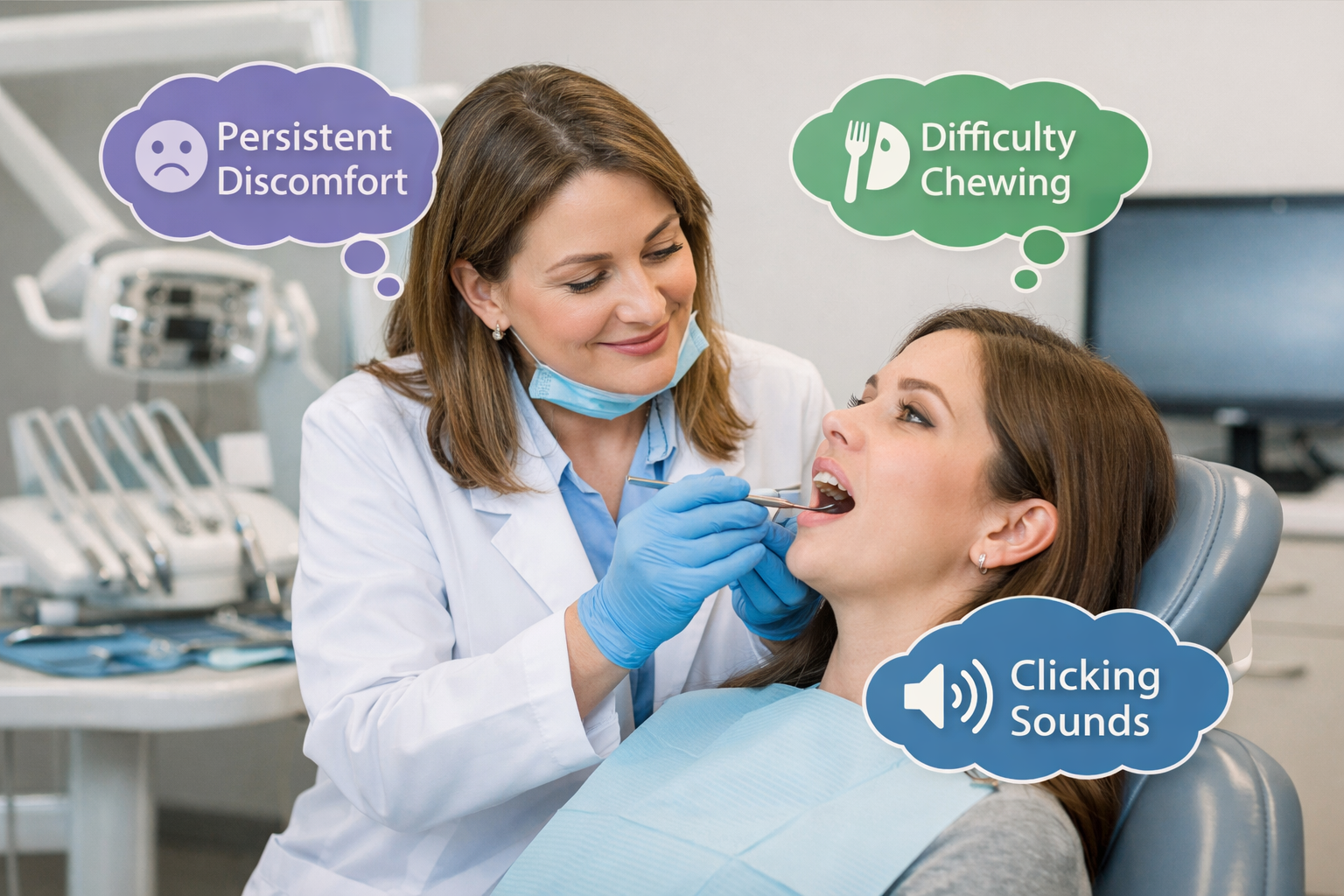
- Persistent Discomfort or Pain: If the “off” feeling progresses to actual pain or a consistent ache around the implant area, it’s a clear signal to seek help. This could indicate nerve irritation, gum inflammation, or an issue with the implant or crown.
- Difficulty Chewing: One of the primary benefits of dental implants is restored chewing function [8]. If your implant bite feels off to the point where you struggle to chew food comfortably or efficiently, it negatively impacts your nutrition and overall quality of life.
- Changes in Speech: An improper bite can sometimes affect how you articulate words, especially if the implant is located in the front of your mouth.
- Clicking, Popping, or Shifting Sensation: Any unusual sounds or sensations of movement when you bite down or open your mouth should be investigated immediately. This might indicate a loose component within the implant structure or an issue with your jaw joint (TMJ).
- Increased Sensitivity to Hot or Cold: While uncommon with implants themselves, sensitivity in surrounding teeth due to an uneven bite can occur.
- Visible Wear or Damage to the Crown: If you notice your implant crown or adjacent natural teeth appear worn down, chipped, or fractured, it could be a result of an imbalanced bite.
- Swelling or Redness around the Implant: Although potentially unrelated to bite issues, these symptoms could indicate an infection (peri-implantitis) that an uneven bite might exacerbate. You can learn more about this by reading, “Can Dental Implants Get Infected Years Later? Your 2026 Guide” [https://dentalimplantsdallastx.com/can-a-dental-implant-get-infected-years-after-placement-a-comprehensive-guide-for-2026/].
Common Mistake to Avoid: Don’t assume the discomfort will resolve on its own. Untreated bite problems can lead to complications such as bone loss around the implant, damage to other teeth, or even implant failure [4, 6, 7]. Early intervention often means simpler, less invasive solutions.
Diagnosing the Issue When Your Implant Bite Feels Off
Diagnosing why your implant bite feels off involves a thorough clinical examination and diagnostic imaging by a qualified dental professional. The goal is to pinpoint the exact source of the discomfort, whether it’s related to the crown, the implant itself, or surrounding oral structures. For patients considering or having received dental implants in Dallas, this diagnostic process is a critical step towards effective treatment.
When you visit your dentist in Dallas with concerns about your implant bite, they will likely perform the following:
- Comprehensive Oral Examination: The dentist will visually inspect your implant, crown, and surrounding gum tissue for any signs of inflammation, recession, or damage. They will also check for any visible wear patterns on your teeth.
- Bite Assessment (Occlusal Analysis):
- Articulating Paper: This colored paper is placed between your teeth, and you’ll be asked to bite down. The marks left on your teeth or crown show where the contact points are heaviest, revealing areas of premature or excessive contact.
- Patient Feedback: Your description of when and where your bite feels off, and what makes it better or worse, provides crucial information.
- Manual Examination: The dentist may gently press on the implant and surrounding areas to check for tenderness or instability.
- Radiographic Imaging (X-rays):
- Periapical X-rays: These provide detailed images of the implant and the bone surrounding it, allowing the dentist to assess osseointegration and check for any bone loss or issues with the implant post itself.
- Panoramic X-rays or 3D Cone Beam CT (CBCT): For a more comprehensive view, especially if bone issues are suspected, a CBCT scan can provide a detailed, three-dimensional image of your jawbone, nerve pathways, and sinus cavities. This helps detect subtle problems not visible on standard X-rays.
- Palpation: The dentist may feel your jaw muscles and temporomandibular joints (TMJ) to check for tenderness or dysfunction, which can sometimes be exacerbated by an uneven bite.
- Assessment of Abutment and Screw: If a loose crown or abutment is suspected, the dentist may carefully check the tightness of the components that connect the crown to the implant.
Example Scenario: A patient in Dallas reports their “implant bite feels off” only when they chew hard foods. The dentist performs a bite assessment with articulating paper, revealing a slightly high spot on the implant crown. X-rays confirm healthy osseointegration and no visible issues with the implant post. This diagnostic process leads to a clear conclusion: a minor occlusal adjustment is needed.
Treatment Options for an Off-Feeling Implant Bite
Treatment for an implant bite that feels off is tailored to the specific diagnosis, ranging from simple adjustments to more involved procedures. The primary goal is to restore a comfortable, balanced bite that supports the long-term health and function of your dental implant. For individuals living in Dallas, TX, your dentist will guide you through the most appropriate tooth replacement options and solutions.
Here are common treatment options:
- Occlusal Adjustment (Bite Adjustment):
- What it is: This is often the first and simplest step if the crown is slightly too high or has an uneven contact point.
- Procedure: The dentist uses fine polishing instruments to carefully reshape small areas of the implant crown, eliminating premature contacts and balancing the bite. This process is usually quick, painless, and does not require anesthesia.
- When it applies: Ideal for minor bite discrepancies and high spots.
- Crown Replacement:
- What it is: If the implant crown is significantly ill-fitting, damaged, or has major occlusal issues that cannot be corrected by adjustment, a new crown may be necessary.
- Procedure: The old crown is removed, new impressions are taken, and a custom-fabricated crown is made to ensure optimal fit and bite alignment. You can learn more about this by reading our guide on “Dental Implant Crown Replacement Cost Dallas 2026 Guide“.
- When it applies: For crowns with poor aesthetics, significant wear, fractures, or persistent bite problems despite adjustments.
- Tightening or Replacing Loose Components:
- What it is: If a loose abutment screw or the abutment itself is the cause, it needs to be addressed promptly.
- Procedure: The dentist will access the screw, tighten it, or replace the abutment if it’s damaged.
- When it applies: When diagnostic imaging and clinical examination reveal loose internal components.
- Addressing Underlying Implant Issues:
- What it is: In rare cases, the implant itself might have stability issues due to insufficient osseointegration or bone loss.
- Procedure: This might involve more complex procedures such as bone grafting to improve bone support, or in severe cases, removal and revision dental implant surgery.
- When it applies: When X-rays or CBCT scans indicate compromised bone support or implant mobility.
- Nightguard or Splint Therapy:
- What it is: If bruxism (clenching or grinding) is contributing to the uneven bite sensation, a custom-fitted nightguard can protect your implant and natural teeth from excessive forces.
- Procedure: An impression of your teeth is taken, and a clear acrylic appliance is fabricated to be worn during sleep.
- When it applies: For patients showing signs of bruxism-related wear or discomfort.
Comparison of Common Treatment Options for “Off-Bite” Implants
| Treatment Option | Best For | Procedure Complexity | Typical Recovery Time |
|---|---|---|---|
| Occlusal Adjustment | Minor high spots, subtle bite discrepancies | Low | Immediate |
| Crown Replacement | Significant crown damage, poor fit, major issues | Medium | Days (for impressions/new crown) |
| Tightening Components | Loose abutment or screw | Low-Medium | Immediate to a few hours |
| Bone Grafting | Insufficient bone support for implant | High | Several months |
| Nightguard | Bruxism (teeth grinding/clenching) | Low | Immediate (once fitted) |
Choosing the right treatment always begins with a precise diagnosis from a trusted dentist experienced with dental implants in Dallas.
Preventing an Off Implant Bite in Dallas
Preventing your implant bite from feeling off involves proactive measures, including excellent oral hygiene, regular dental check-ups, and mindful habits. By adhering to these guidelines, patients receiving dental implants in Dallas can significantly improve the longevity and comfort of their investment in long-term oral health.
Here are key preventive strategies:
- Maintain Excellent Oral Hygiene: Just like natural teeth, dental implants require diligent daily cleaning. Brush twice a day, floss around your implant, and consider using an interdental brush or water flosser. This prevents plaque buildup, which can lead to gum inflammation and potentially affect implant stability over time. For specific guidance, you can refer to “Mini Implant Denture Maintenance: Your 2026 Care Guide” [https://dentalimplantsdallastx.com/optimal-mini-implant-denture-maintenance-your-comprehensive-2026-guide/].
- Regular Dental Check-ups in Dallas: Schedule and attend all recommended follow-up appointments and regular hygiene visits with your Dallas dentist. These appointments are crucial for monitoring your implant, assessing your bite, and catching potential issues early. Your dentist can identify subtle changes in your bite or implant health before they become noticeable problems. Our team at Dental Implant Education – Dallas TX emphasizes the importance of these visits for patient safety and long-term success.
- Address Bruxism (Teeth Grinding/Clenching): If you grind or clench your teeth, especially at night, discuss this with your dentist. They may recommend a custom-fitted nightguard to protect your implant and natural teeth from excessive forces, which can otherwise cause the implant bite to feel off or even lead to implant damage [1, 2].
- Avoid Chewing Hard or Sticky Foods Immediately After Placement: While implants are strong, it’s wise to be cautious. Avoid excessively hard candies, ice, or very sticky foods that could put undue stress on your implant, especially during the initial healing and osseointegration phase.
- Follow Post-Operative Instructions: Adhering strictly to your dentist’s post-dental implant instructions is critical for successful healing and integration. This includes dietary recommendations, oral hygiene practices, and medication use.
- Promptly Address Any Concerns: If you notice any unusual sensations, discomfort, or changes in your bite, contact your dentist in Dallas without delay. Early intervention is always best.
Edge Case: Even with perfect care, sometimes minor bite adjustments are needed months or years after implant placement due to natural tooth movement or subtle wear. This is normal and easily corrected during a routine visit.
The Importance of Follow-Up Care for Your Implant
Consistent follow-up care is paramount for the long-term success and comfort of your dental implant, especially in addressing and preventing issues where your implant bite feels off. Regular check-ups with your dentist in Dallas ensure that your implant remains stable, your bite stays balanced, and any potential problems are identified and managed early. This commitment to ongoing care significantly contributes to your long-term oral health.
Here’s why diligent follow-up care is so important:
- Monitoring Osseointegration and Stability: During your initial healing period, follow-up appointments allow your dentist to monitor how well the implant is fusing with your jawbone (osseointegration). Even after the healing phase, ongoing checks ensure the implant remains stable. Studies show that implant stability, influenced by factors like bite force, increases over 6-18 months [1, 2].
- Bite Assessment and Adjustment: Your bite can change over time due to natural tooth wear, movement of adjacent teeth, or even slight shifts in your jaw. Routine follow-ups include checking your bite, allowing your dentist to make minor occlusal adjustments if your implant bite feels off, preventing discomfort or damage.
- Proactive Problem Detection: Many implant-related issues, such as peri-implantitis (gum inflammation around the implant) or a loose abutment, develop gradually. Regular check-ups with X-rays allow your dentist to detect these problems early, often before you even feel significant symptoms. Early detection prevents minor issues from escalating into major complications like implant failure [4, 6].
- Professional Cleaning and Maintenance: While you maintain excellent home care, professional cleanings are essential for removing hardened plaque (calculus) from around your implant and natural teeth. Special instruments are used to clean implants without scratching them, contributing to the health of the surrounding gum tissue. Our article on “Dallas Dental Implant Follow-Up: Ensuring Lasting Smile Success” provides more insights into this.
- Protection Against Bruxism: If you’re prone to teeth grinding or clenching, your dentist can monitor the wear on your implant crown and natural teeth and ensure your nightguard is still fitting correctly. This helps protect your implant from excessive forces that could lead to an uneven bite or damage.
- Patient Education and Guidance: Follow-up visits are an opportunity to ask questions, reinforce proper home care techniques, and discuss any concerns you might have about your implant or overall oral health.
What to Expect During a Follow-Up: A typical follow-up appointment will include a visual examination, a bite check using articulating paper, a review of your oral hygiene, and potentially X-rays to assess bone levels around the implant. If any issues are found, your Dallas dentist will discuss the necessary steps.
Frequently Asked Questions
Is it normal for an implant bite to feel off immediately after crown placement?
Yes, it can be normal for your implant bite to feel slightly off immediately after the crown is placed. Minor adjustments are often needed in the days or weeks following to ensure a perfect fit and comfortable bite. Always communicate any discomfort to your dentist.
Can an off implant bite cause pain?
Yes, an off implant bite can definitely cause pain. Uneven pressure can lead to discomfort in the implant area, jaw muscles, or even roof of the mouth pain [5]. Persistent pain is a strong indicator that professional adjustment is needed.
How long does it take to get used to a dental implant bite?
It can take anywhere from a few days to several weeks to fully adjust to a new dental implant crown. The brain needs time to adapt to the new bite sensation. Bite force on implant-retained crowns also increases significantly over 6-18 months as osseointegration improves [1, 2].
What happens if I ignore an off implant bite?
Ignoring an off implant bite can lead to several complications, including chronic pain, excessive wear on the implant crown or opposing natural teeth, bone loss around the implant, and in severe cases, even implant failure [4, 6, 7].
Can clenching my teeth make my implant bite feel off?
Yes, habitual clenching or grinding (bruxism) can exert excessive forces on your implant, potentially causing it to feel off. It can also lead to wear on the crown or surrounding teeth, necessitating professional intervention.
Do dental implants shift over time?
A properly integrated dental implant should not shift. If your implant feels loose or moves, it’s a serious issue indicating possible implant failure or a loose component, and you should see your dentist immediately.
Will my insurance cover adjustments if my implant bite feels off?
Coverage for adjustments or repairs for an off implant bite depends on your specific dental insurance plan. It’s best to contact your insurance provider directly or consult with your dental office in Dallas regarding dental implant insurance coverage in Dallas to understand your benefits.
Should I see an oral surgeon or a general dentist for an off implant bite?
For issues with your implant bite, your general dentist is typically the first point of contact. They can diagnose and often treat minor bite discrepancies. If the issue is complex, such as bone loss or implant instability, they may refer you to a specialist like an oral surgeon or periodontist.
How can I find a dentist in Dallas who specializes in dental implants?
You can find a dentist specializing in dental implants in Dallas by searching online directories, reading patient reviews, or asking for referrals from friends or your general practitioner. Look for dentists who emphasize patient education, use advanced technology, and have significant experience with dental implant procedures.
Conclusion
When your implant bite feels off, it’s a clear signal from your body that something isn’t quite right. While the sensation can sometimes be a minor adjustment issue, it’s never something to ignore. Proactive communication with your dental professional, especially if you’re in the Dallas area, is essential for identifying the underlying cause and implementing the correct solution. From simple occlusal adjustments to addressing more complex issues with the implant or crown, timely intervention ensures the longevity and comfort of your dental implant, preserving your investment in a healthy, confident smile. Prioritizing regular follow-up care and maintaining excellent oral hygiene are your best defenses against future bite discomfort, securing your long-term oral health. Don’t hesitate to reach out to a trusted dental practice in Dallas for a comprehensive consultation if you find your implant bite feels off.
References
[1] Article – https://journals.plos.org/plosone/article?id=10.1371%2Fjournal.pone.0340355
[2] Pmc12818635 – https://pmc.ncbi.nlm.nih.gov/articles/PMC12818635/
[3] pubmed.ncbi.nlm.nih.gov – https://pubmed.ncbi.nlm.nih.gov/41557632/
[4] Dental Implant Failure Rates What The Research Actually Says And What It Means For You – https://biteclubchi.com/dental-implant-failure-rates-what-the-research-actually-says-and-what-it-means-for-you/
[5] Can Cause Roof Of Mouth Pain After Implants – https://allin1dental.com/can-cause-roof-of-mouth-pain-after-implants/
[6] Dental Implant Risks Complications In 2026 – https://www.oceanicdental.com/resource/dental-implant-risks-complications-in-2026
[7] Eastman Institute Awarded 2 9 Million To Study Dental Implant Failures – https://www.urmc.rochester.edu/news/story/eastman-institute-awarded-2-9-million-to-study-dental-implant-failures
[8] How Dental Implants Improve Speech Chewing – https://dentalgroupoflubbock.com/how-dental-implants-improve-speech-chewing/
Leave a Reply
Share your thoughts or ask a question about dental implants. Your email address will not be published.