

Losing a tooth can significantly impact your daily life, affecting everything from your ability to chew and speak confidently to your overall self-esteem. If you’re searching for a reliable, long-lasting solution for missing teeth in Dallas, you’ve likely encountered the term “fixed dental implants.” These innovative dental prosthetics offer a remarkable opportunity to restore your smile, function, and confidence with results that feel incredibly natural. In 2026, fixed dental implants continue to stand out as a premier tooth replacement option, providing stability and durability that traditional dentures and bridges simply cannot match.
At Dental Implant Education – Dallas TX, we are committed to providing clear, factual, and reassuring information about dental implant procedures. Our goal is to empower you with the knowledge needed to make informed decisions about your oral health, without pressure or exaggerated claims. This comprehensive guide will explore what fixed dental implants are, how they work, their benefits, and what to expect during the procedure, ensuring you understand why they are a leading choice for long-term oral health.
Key Takeaways
- Fixed dental implants provide a permanent, stable solution for missing teeth, mimicking the look, feel, and function of natural teeth.
- They integrate directly with your jawbone, offering superior bite force (90-95% natural restoration) and preventing bone loss, unlike traditional dentures [5].
- Modern advancements, including digital planning and advanced imaging, make the dental implant procedure more precise and predictable than ever before [1].
- While the initial investment for implant cost in Dallas may seem higher, fixed dental implants offer exceptional long-term value, durability, and improved quality of life.
- A comprehensive consultation with a dentist specializing in dental implants is essential to determine if fixed dental implants are the right tooth replacement option for your individual needs.
Understanding Fixed Dental Implants: A Foundation for Your Smile
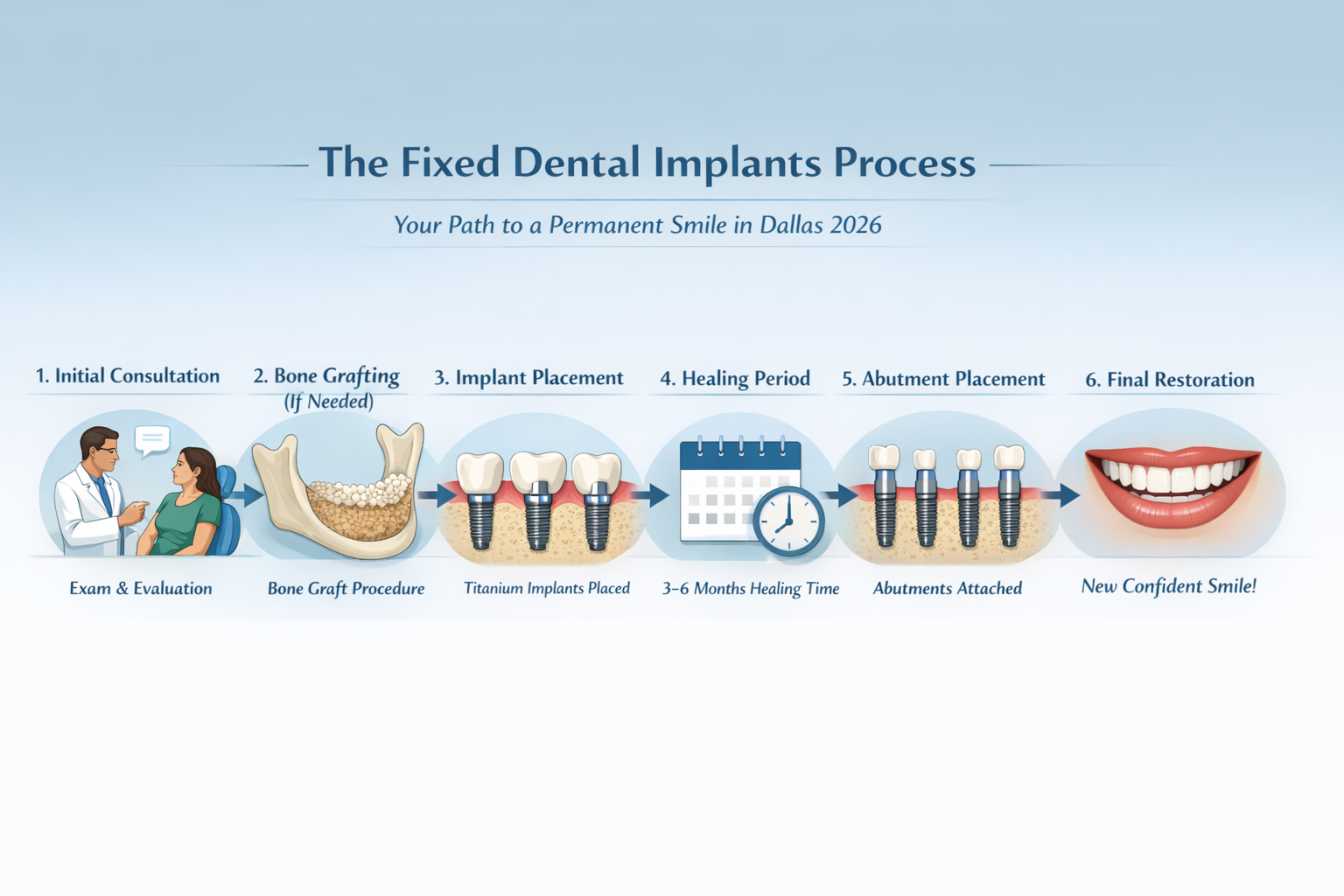
When we talk about fixed dental implants, we’re referring to a permanent tooth replacement solution that is anchored directly into your jawbone. Unlike removable dentures or partials, fixed implants are not taken out for cleaning or at night. They become a stable, integral part of your mouth, designed to look, feel, and function much like your natural teeth. This stability is achieved because the implant itself is a small, screw-shaped post, typically made of biocompatible titanium, which is surgically placed into the jawbone.
The magic of fixed dental implants lies in a biological process called osseointegration. Over several months, the titanium implant fuses with the surrounding bone, creating a remarkably strong and stable foundation. Once this fusion is complete, a custom-made crown, bridge, or full arch of teeth is securely attached to the implant, providing a permanent and aesthetically pleasing restoration [2].
The Core Components of Fixed Dental Implants
To better understand this remarkable technology, let’s break down the three main components of a fixed dental implant system:
- The Implant Post (Fixture): This is the titanium screw placed into the jawbone. It acts as the artificial tooth root, providing the stability and support necessary for the replacement tooth. Titanium is chosen for its biocompatibility, meaning it is readily accepted by the body without causing adverse reactions.
- The Abutment: This small connector piece is attached to the implant post after osseointegration. It protrudes slightly above the gum line and serves as the anchor for the final restoration.
- The Prosthesis (Crown, Bridge, or Denture): This is the visible part of the tooth replacement, custom-designed to match your natural teeth in shape, size, and color. Depending on your needs, this could be:
- Single Crown: For replacing one missing tooth.
- Dental Bridge: For replacing several consecutive missing teeth, anchored by two or more implants.
- Full Arch Denture: For replacing an entire arch of missing teeth (upper or lower jaw), often supported by four or more implants (like All-on-4 or All-on-6 systems).
These components work together seamlessly to create a tooth replacement that is not only visually appealing but also incredibly functional.
Why Choose Fixed Dental Implants?
For many individuals with missing teeth, fixed dental implants represent a significant upgrade over traditional tooth replacement options. Their permanence and stability translate into numerous benefits for long-term oral health and overall quality of life.
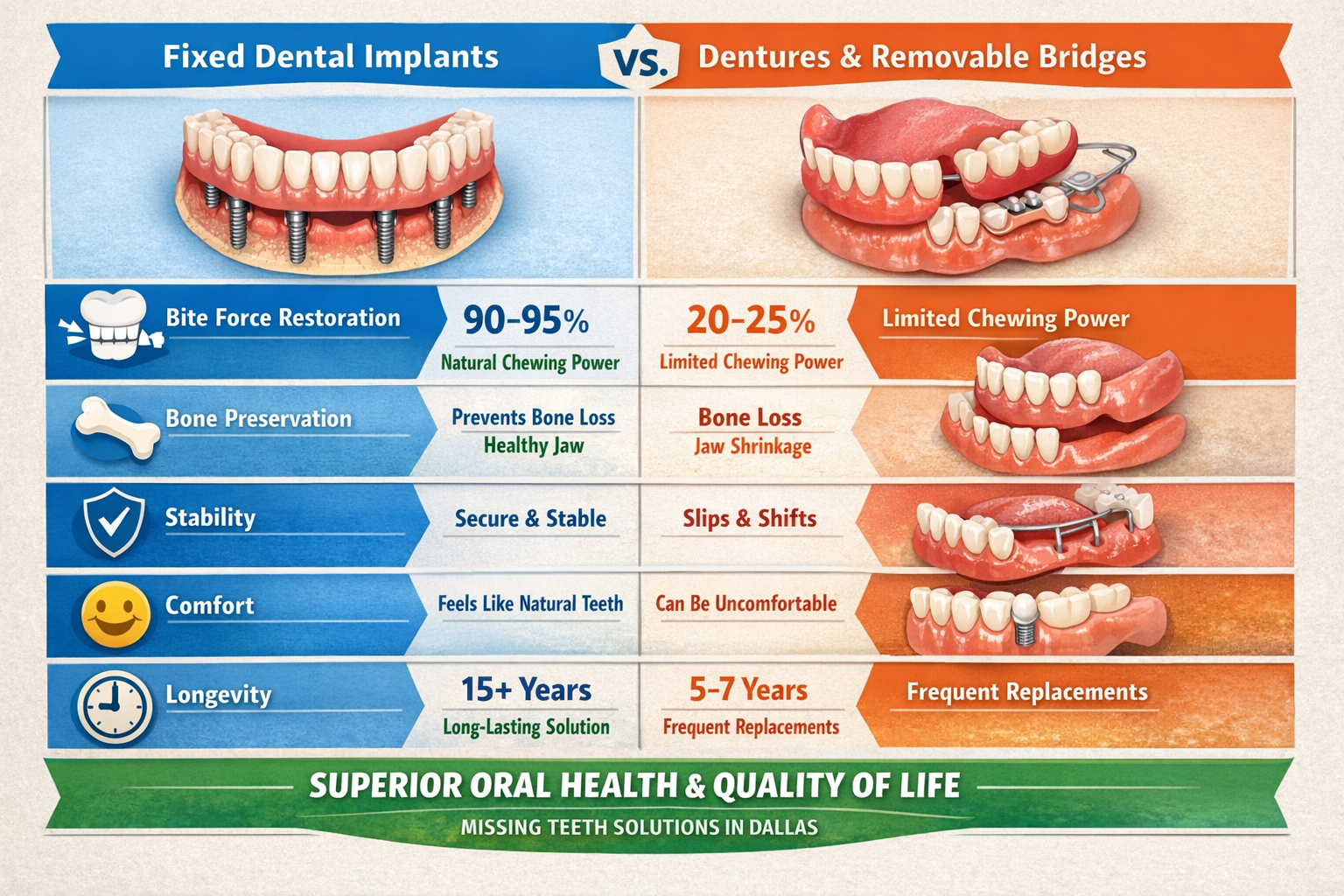
Consider the common challenges faced by those with conventional dentures: difficulty eating certain foods, concerns about slippage or discomfort, and the gradual bone loss that occurs when teeth are absent. Fixed dental implants address these issues head-on. They restore up to 90-95% of natural bite force, a stark contrast to the 20-25% offered by traditional dentures, allowing you to enjoy your favorite foods again without hesitation [5]. Furthermore, by stimulating the jawbone, implants help prevent the bone deterioration that can lead to a sunken facial appearance over time [5].
If you’re exploring dental implants in Dallas, it’s essential to understand that this treatment is an investment in your health and well-being. While the initial dental implant procedure requires a commitment of time and resources, the long-term benefits often far outweigh other options.
The Dental Implant Procedure: Your Journey to a Restored Smile
The journey to receiving fixed dental implants is a carefully planned and executed process, often spanning several months to ensure optimal results and lasting success. However, advancements in dental technology and techniques are continually making the process more efficient and comfortable for patients in 2026. Understanding each stage can help alleviate concerns and set proper expectations for your dental implant journey.
Initial Consultation and Planning
The first and most critical step is a comprehensive dental implant consultation with a qualified dental professional. During this appointment, your dentist will:
- Assess your oral health: This includes a thorough examination of your teeth, gums, and jawbone.
- Review your medical history: Certain medical conditions or medications might affect your suitability for implants, such as uncontrolled diabetes, which can impact diabetic dental implant recovery [10].
- Utilize advanced imaging: Cone-beam CT (CBCT) scans are standard by 2026, providing detailed 3D images of your jawbone, nerves, and sinus cavities. This allows for precise planning of implant placement, optimizing based on prosthetic goals rather than just bone availability [1].
- Discuss your goals and expectations: This ensures the treatment plan aligns with your desired outcome.
If your jawbone density is insufficient, a bone graft may be necessary to build up the bone before implant placement. For more information on this, you can learn about bone graft healing for dental implants. This initial planning phase, often supported by AI-assisted tools, is crucial for the long-term success of fixed dental implants [1].
Implant Placement Surgery
Once your mouth is prepared, the implant surgery process begins. This outpatient procedure is typically performed with local anesthesia, and sedation options are often available to ensure your comfort.
The dentist or oral surgeon will:
- Make a small incision in the gum to expose the jawbone.
- Carefully drill a pilot hole, followed by widening the space to precisely fit the implant post.
- Gently insert the titanium implant into the jawbone.
- Close the gum tissue over the implant, or sometimes a healing abutment is placed immediately.
Post-operative instructions are provided to manage any discomfort and ensure proper healing. Understanding dental implant pain relief is important during this initial recovery phase.
Osseointegration and Healing
This is the period where the implant fuses with your jawbone. It typically takes 3 to 6 months, though individual healing times can vary. During this time, it’s common to wear a temporary tooth while waiting for implant to maintain aesthetics and function. This biological process is vital for the stability and success of your fixed dental implants.
Abutment Placement and Prosthesis Attachment
After successful osseointegration, a second minor procedure may be performed (if the abutment wasn’t placed during the initial surgery) to attach the abutment to the implant. Once the gum tissue around the abutment has healed, impressions are taken. By 2026, digital workflows using intraoral scanning and photogrammetry systems (like PIC Dental or iMetric) capture implant positions with micron-level accuracy, creating passive-fit prostheses that eliminate internal stress and ensure a perfect fit [1].
Finally, your custom-made crown, bridge, or full arch prosthesis is securely attached to the abutment. This final restoration is meticulously crafted to blend seamlessly with your natural teeth, completing your new, permanent smile.
Advanced Fixed Dental Implant Options
For patients with multiple missing teeth or significant bone loss, there are specialized fixed dental implant solutions:
- All-on-4® and All-on-X Systems: These concepts involve placing a minimal number of implants (typically four to six) to support a full arch of fixed teeth. This approach can often provide immediate functional teeth, significantly shortening the treatment timeline [1]. A 2024 systematic review on immediate loading protocols reported survival rates above 93% across included studies, affirming the reliability of these methods [1].
- All-on-6 Designs: These are increasingly used when additional posterior support is needed to improve force distribution and reduce cantilever length, especially for patients with stronger bite forces or softer bone [1].
- Tilted Posterior Implants: These implants are angled into denser bone, avoiding sinus cavities and reducing cantilever length, which is biomechanically superior to relying on implant count alone [1].
- Zygomatic and Pterygoid Implants: For individuals with severe maxillary bone loss, these specialized implants offer alternatives to extensive grafting, though they require specific training and expertise [1].
These advanced techniques, combined with monolithic zirconia bridges and digital planning, are making fixed dental implants more accessible and predictable for a wider range of patients in 2026 [1].
The Benefits of Fixed Dental Implants for Long-Term Oral Health
The advantages of choosing fixed dental implants extend far beyond aesthetics, contributing significantly to your long-term oral health and overall well-being. For those considering tooth replacement options in Dallas, understanding these benefits is crucial for making an informed decision.
Superior Stability and Function
One of the most compelling benefits of fixed dental implants is their unparalleled stability. Because they are integrated directly into the jawbone, they act just like natural tooth roots. This provides:
- Restored Bite Force: As mentioned, fixed dental implants can restore 90-95% of your natural chewing ability [5]. This means you can enjoy a diverse diet, including crunchy fruits, vegetables, and meats, without worrying about your teeth slipping or causing discomfort. This improved function can significantly enhance your quality of life.
- No Slippage or Movement: Unlike traditional dentures that can shift, cause sores, or affect speech, fixed implants stay firmly in place. This eliminates embarrassment and allows for confident speaking, eating, and smiling.
- Improved Speech: Missing teeth or ill-fitting dentures can impact speech clarity. Fixed implants provide a stable foundation that allows for natural articulation.
Preservation of Jawbone and Facial Structure
When a tooth is lost, the jawbone beneath it no longer receives the stimulation it needs to maintain its density. Over time, this can lead to bone loss, which can weaken adjacent teeth, change the shape of your jaw, and give your face a sunken, aged appearance.
- Bone Stimulation: Fixed dental implants are the only tooth replacement option that actively stimulates the jawbone, preventing the bone resorption that naturally occurs after tooth loss [5]. This helps preserve your natural facial contours and supports the health of surrounding teeth.
- Prevention of Further Tooth Loss: By filling gaps and preventing bone loss, implants help maintain the structural integrity of your jaw, reducing the risk of adjacent teeth shifting or becoming loose.
Durability and Longevity
Fixed dental implants are designed for durability. Made from biocompatible materials like titanium, the implant posts themselves can last a lifetime with proper care [3]. While the crowns, bridges, or dentures attached to them may need replacement due to wear and tear (typically after 10-15 years), the implant foundation remains intact.
- High Success Rates: Studies show impressive long-term success rates. For example, 10-year survival rates for full-arch implant systems (like All-on-4) range from approximately 93% to 95%, depending on the loading strategy [1]. Prosthesis survival rates exceeding 99% over up to 10 years have been reported for full-arch mandibular cases in landmark studies [1].
- Long-Term Investment: While the initial cost of dental implants in Dallas can be a consideration, their longevity often makes them a more cost-effective solution than other options that require more frequent adjustments, repairs, or replacements over time. You might explore dental implant financing options to make this investment manageable.
Enhanced Oral Hygiene and Comfort
Maintaining good oral hygiene is essential for the longevity of your implants and your overall oral health.
- Ease of Cleaning: Because fixed implants function like natural teeth, they are cleaned with regular brushing and flossing, just like your other teeth. This is a significant advantage over removable dentures, which require special cleaning routines.
- Natural Feel: Patients often report that fixed dental implants feel so natural, they forget they ever had missing teeth. There are no adhesives, no discomfort from rubbing, just a comfortable, stable foundation.
Improved Aesthetics and Confidence
Beyond function, fixed dental implants offer significant aesthetic benefits:
- Natural Appearance: The custom-made crowns and bridges are meticulously crafted to match the color, shape, and size of your existing teeth, creating a seamless and beautiful smile. For a visual understanding, you can review dental implants process pictures.
- Boosted Self-Esteem: Restoring your smile can have a profound positive impact on your confidence, allowing you to socialize, laugh, and live life to the fullest without hesitation.
In summary, fixed dental implants are a robust, reliable, and aesthetically pleasing solution for anyone seeking to address missing teeth. Their ability to restore function, preserve bone, and offer a long-lasting, natural-feeling smile makes them a leading choice in modern dentistry.
Cost Considerations for Fixed Dental Implants in Dallas 2026
Understanding the implant cost in Dallas is a common concern for many patients considering fixed dental implants. It’s important to view dental implants as a long-term investment in your oral health and quality of life. While the initial cost may seem higher than other tooth replacement options, their durability, functional benefits, and bone preservation qualities often make them a more cost-effective solution over many years.
The total cost of fixed dental implants can vary significantly based on several factors:
- Number of Implants: Replacing a single tooth will naturally cost less than replacing multiple teeth with an implant-supported bridge or a full arch with an All-on-4 or All-on-6 system.
- Type of Prosthesis: A single crown, a multi-tooth bridge, or a full-arch denture will have different associated costs.
- Preliminary Procedures: Some patients require preparatory treatments like bone grafting to ensure sufficient jawbone density, or tooth extractions, which will add to the overall cost. For example, unveiling the cost of 2 dental implants in 2025 will differ from a single implant or a full mouth solution.
- Material of the Prosthesis: High-quality materials like monolithic zirconia bridges, known for their strength and aesthetics, may influence the price [1].
- Location and Dentist’s Expertise: The cost can vary based on the dental practice’s location within Dallas and the experience level of the implant specialist. Generally, more complex cases handled by highly specialized practitioners may have different pricing structures.
- Anesthesia and Sedation: The type of anesthesia chosen can impact the overall expense.
For a general overview of pricing, you can refer to our guides on dental implant costs or average dental implant costs. If you’re looking at replacing a single tooth, our article on how much for one tooth implant in 2025 provides detailed information.
Navigating Payment and Financing Options
We understand that the financial aspect is a significant consideration. Dental Implant Education – Dallas TX aims to provide clear guidance on making dental implants accessible.
- Dental Insurance: While many dental insurance plans offer limited coverage for dental implants, some plans are beginning to recognize them as a standard treatment. It’s crucial to check with your insurance provider about your specific benefits. Our guide on demystifying dental implant costs: a 2025 guide to average prices & value – dallas dental implant cost | compare prices, options & find affordable dentists provides insights into navigating insurance. For specific details on coverage with insurance, you can also read about demystifying the cost of dental implants with insurance in 2025.
- Financing Plans: Many dental offices, including those in Dallas, offer flexible payment plans for implants in Dallas through third-party financing companies. These plans can break down the total cost into manageable monthly payments.
- Health Savings Accounts (HSAs) and Flexible Spending Accounts (FSAs): These accounts allow you to save and use pre-tax dollars for qualified medical expenses, including dental implants.
When comparing treatment options, remember to consider the long-term value. Fixed dental implants, with their high success rates and ability to prevent future oral health issues, often prove to be a wise investment, saving you money on potential future dental work that might arise from untreated missing teeth. We encourage a transparent discussion about all costs during your consultation to ensure a comfortable and clear understanding of your investment.
Maintaining Your Fixed Dental Implants
Just like natural teeth, your fixed dental implants require consistent care to ensure their longevity and to maintain your overall oral health. While the implants themselves are not susceptible to cavities, the surrounding gum tissue can still be affected by plaque and bacteria, leading to conditions like peri-implantitis (gum disease around an implant).
Here’s what you need to know about caring for your fixed dental implants in 2026:
Daily Oral Hygiene Practices
- Brushing: Brush your teeth and implants at least twice a day using a soft-bristled toothbrush. Electric toothbrushes are often recommended for their effectiveness in removing plaque.
- Flossing: Daily flossing is crucial to remove food particles and plaque from around the implant and under the gum line. Special floss designed for implants, interdental brushes, or water flossers can be particularly effective.
- Mouthwash: An antimicrobial mouthwash can help reduce bacteria in your mouth. Your dentist may recommend a specific type.
Regular Dental Check-ups
Even with excellent home care, regular visits to your dentist are vital for monitoring the health of your fixed dental implants and your overall oral health.
- Professional Cleanings: Your dental hygienist will use specialized tools designed for implants to gently clean around them, removing any hardened plaque (tartar) that cannot be removed by brushing alone.
- Examinations: Your dentist will check the integrity of your implants, abutments, and prosthetics, ensuring everything is stable and functioning correctly. They will also look for any signs of gum inflammation or other issues.
- X-rays: Periodic X-rays are important to monitor the bone level around your implants and detect any issues that aren’t visible during a visual exam. You can learn more about dental implant x-ray frequency for optimal care.
Avoiding Damaging Habits
To protect your investment in fixed dental implants, it’s wise to avoid certain habits:
- Smoking: Smoking significantly increases the risk of implant failure and peri-implantitis. If you smoke, your dentist will strongly advise you to quit before and after implant surgery.
- Grinding or Clenching (Bruxism): Excessive force from grinding or clenching your teeth can put undue stress on your implants and prosthetic. Your dentist might recommend a dental implant night guard to protect them.
- Using Your Teeth as Tools: Avoid opening packages or biting on hard objects (like ice or pen caps) with your implant-supported teeth, as this can damage the prosthesis.
Recognizing Potential Issues
While fixed dental implants boast high success rates, it’s important to be aware of any unusual symptoms and report them to your dentist promptly.
- Pain or Discomfort: Persistent pain, tenderness, or swelling around an implant should be evaluated.
- Loose Feeling: If your implant feels loose, or if the crown/bridge feels wobbly, contact your dentist immediately.
- Bad Breath: Persistent bad breath from dental implants could indicate an underlying issue like infection or improper hygiene.
By adhering to these simple yet effective maintenance practices, you can ensure your fixed dental implants remain a healthy, beautiful, and functional part of your smile for many years to come. At Dental Implant Education – Dallas TX, we emphasize patient safety and long-term oral health through comprehensive post-operative guidance and ongoing support.
Conclusion: Reclaiming Your Smile and Oral Health in 2026
Fixed dental implants stand as a beacon of modern dentistry, offering a permanent, stable, and aesthetically pleasing solution for individuals grappling with missing teeth. In 2026, thanks to remarkable advancements in digital planning, imaging, and surgical techniques, the process for receiving fixed dental implants is more precise, predictable, and patient-friendly than ever before. From the transformative ability to restore nearly natural bite force to the crucial benefit of preserving jawbone density, fixed dental implants offer a holistic approach to reclaiming not just your smile, but your long-term oral health and confidence.
We understand that considering dental implant procedures, especially concerning implant cost in Dallas, is a significant decision. Our commitment at Dental Implant Education – Dallas TX is to provide you with factual, reassuring, and comprehensive information. We believe in fostering informed decision-making, ensuring that you fully grasp the benefits, process, and investment involved in choosing this superior tooth replacement option.
If you are living with missing teeth and exploring solutions, we strongly encourage you to schedule a consultation with a dentist specializing in dental implants. This initial step is vital to assess your individual needs, discuss the best course of action, and answer all your questions without pressure. Investing in fixed dental implants is investing in a future of comfortable eating, confident speaking, and a radiant, healthy smile. Take the first step towards a restored smile and enhanced quality of life by seeking professional consultation today.
References
[1] All On 4 Vs All On X Dental Implants – https://goldcoastdental.com/blog/all-on-4-vs-all-on-x-dental-implants/
[2] Implant Prostheses – https://implanttrainingcourses.com/blog/implant-prostheses/
[3] Are Dental Implants The Best Solution For Missing Teeth In 2026 – https://seminoleshoresdental.com/are-dental-implant s-the-best-solution-for-missing-teeth-in-2026/
[4] 6 Trends Making All On 4 Dental Implants Easier And Safer In 2026 – https://trinitydentalcares.com/6-trends-making-all-on-4-dental-implants-easier-and-safer-in-2026/
[5] Watch – https://www.youtube.com/watch?v=VSg9uBxv6DE
[6] New Dental Implants In 2026 – https://www.nuviasmiles.com/blog/new-dental-implants-in-2026
[7] Future Of Dental Implants Advanced Techniques For Lasting Results – https://prosmilesoc.com/articles/15486/future-of-dental-implants-advanced-techniques-for-lasting-results/
[8] New Year New Smile The Perfect Time For Dental Implants – https://www.bridgforddental.co.uk/latest-news/new-year-new-smile-the-perfect-time-for-dental-implants/
Leave a Reply
Share your thoughts or ask a question about dental implants. Your email address will not be published.