

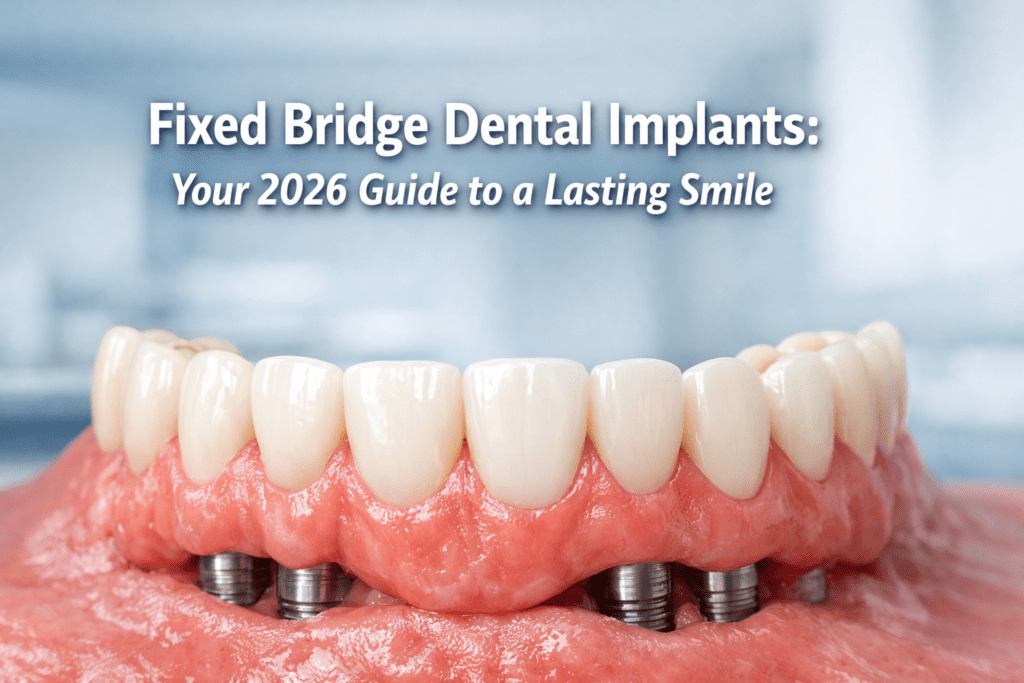
Are you living with several missing teeth and searching for a stable, long-lasting solution that feels and functions like your natural smile? If so, fixed bridge dental implants might be the answer you’ve been looking for. This advanced tooth replacement option offers significant advantages over traditional bridges and removable dentures, providing a permanent foundation for your new smile. In Dallas, Texas, patients are increasingly choosing fixed bridge dental implants for their superior stability, durability, and aesthetic appeal.
Key Takeaways
- Fixed bridge dental implants combine the stability of dental implants with the comprehensive coverage of a dental bridge, replacing multiple missing teeth.
- Unlike traditional bridges, implant-supported fixed bridges do not rely on adjacent natural teeth for support, preserving healthy tooth structure.
- Modern advancements in materials like zirconia and digital dentistry are making fixed bridge dental implants more durable, aesthetic, and efficient to place in 2026.
- Patients considering this solution should undergo a thorough consultation with a qualified dentist in Dallas to assess their oral health and suitability.
- While the initial cost may be higher, the long-term benefits, including bone preservation and extended lifespan, often make fixed bridge dental implants a cost-effective choice.
What Are Fixed Bridge Dental Implants and How Do They Work?
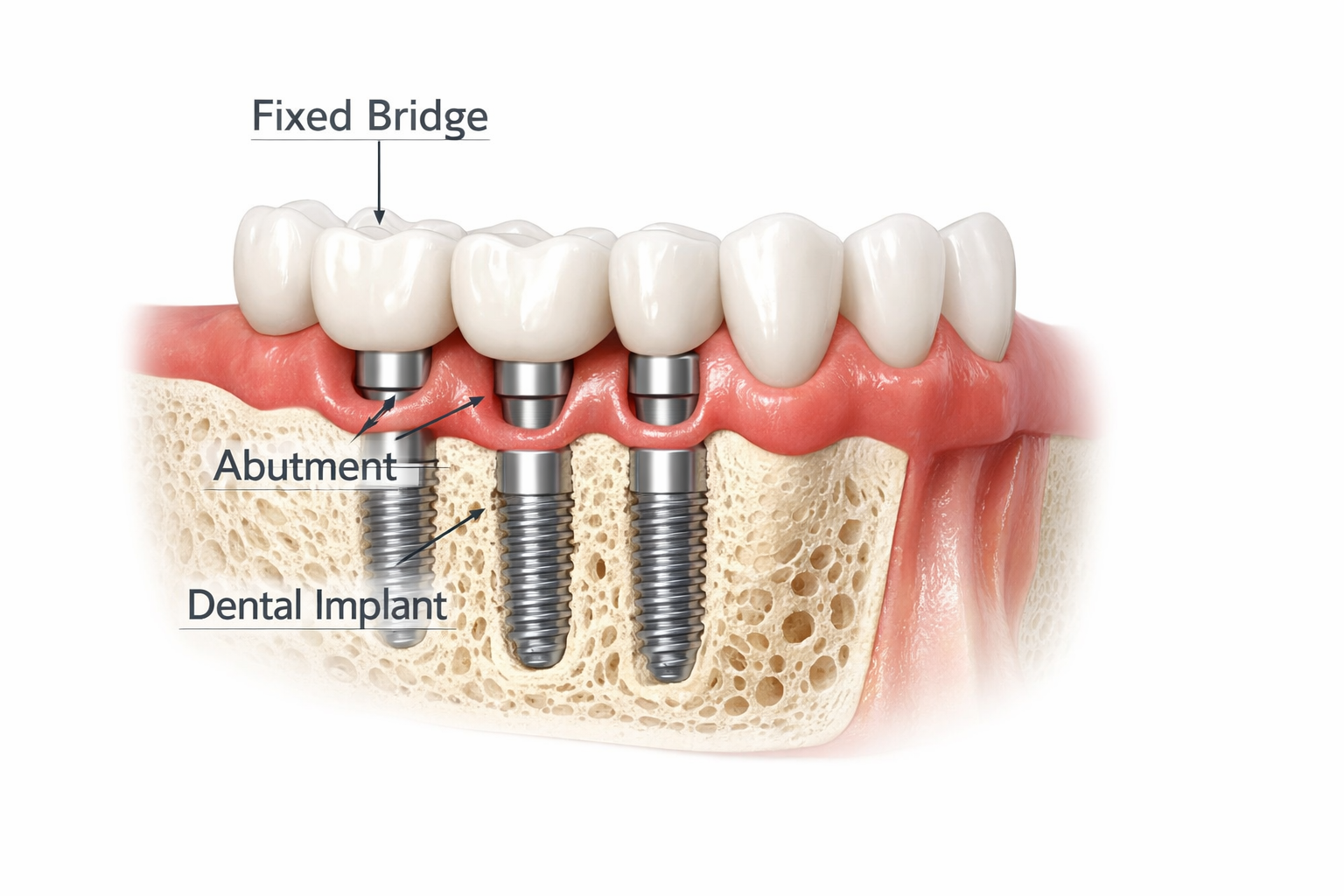
Fixed bridge dental implants are a robust tooth replacement solution designed to restore multiple missing teeth in a row without relying on adjacent natural teeth for support. This restorative approach integrates the stability of dental implants, which are surgically placed into the jawbone, with a custom-made dental bridge permanently attached to these implants [8].
Instead of a traditional bridge that “bridges” a gap by being cemented onto natural teeth on either side, an implant-supported fixed bridge uses two or more dental implants as anchors. These implants act as artificial tooth roots, providing a stable foundation to which the bridge is securely attached. This method not only replaces missing teeth but also helps preserve the jawbone, preventing the bone loss that often occurs after tooth extraction. The process typically involves a thorough examination, surgical placement of the implants, a healing period for osseointegration (where the implants fuse with the bone), and finally, the attachment of the custom-fabricated fixed bridge.
Why Choose Fixed Bridge Dental Implants Over Other Tooth Replacement Options?
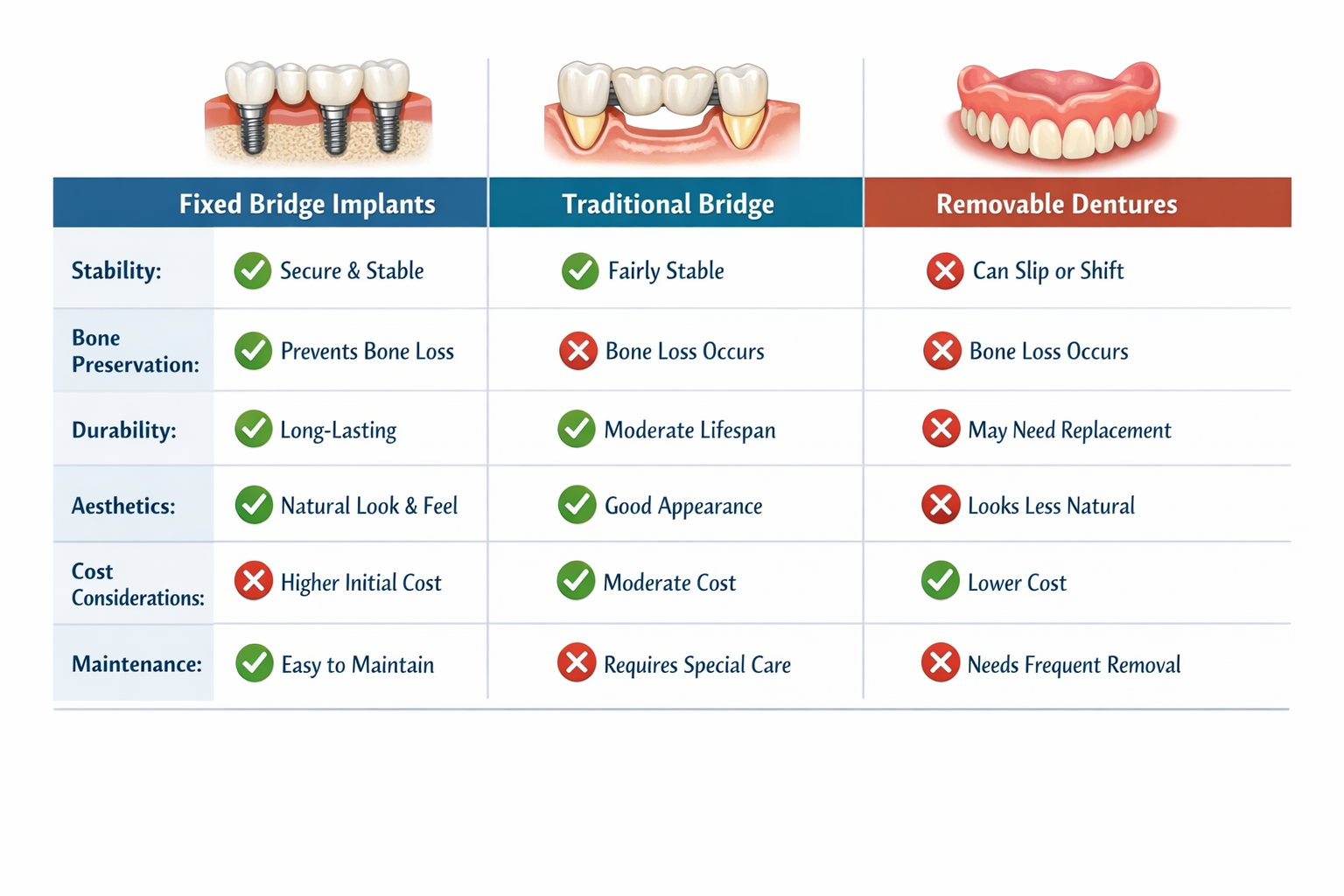
Choosing fixed bridge dental implants offers several distinct advantages over traditional bridges and removable dentures, primarily due to their unparalleled stability and long-term oral health benefits. Unlike traditional bridges that require the grinding down of healthy adjacent teeth for crown placement, implant-supported bridges stand independently, preserving your natural tooth structure [5].
| Feature | Fixed Bridge Dental Implants | Traditional Dental Bridge | Removable Partial Denture |
|---|---|---|---|
| Support Structure | Dental implants integrated into the jawbone | Natural adjacent teeth, often crowned | Rests on gums and often uses clasps on natural teeth |
| Bone Preservation | Prevents bone loss by stimulating the jawbone [8] | Does not prevent bone loss in the missing tooth area | Does not prevent bone loss, may accelerate it |
| Stability & Comfort | Extremely stable, feels like natural teeth, no slipping or shifting [8] | Stable, but can feel less secure over time | Can feel loose, may shift during eating or speaking |
| Durability | Can last 20-30 years or more with proper care [2] | Typically 5-15 years, depends on supporting teeth health | Generally 5-10 years, can warp or break |
| Impact on Adjacent Teeth | None, healthy teeth are preserved | Requires reduction (grinding) of healthy adjacent teeth [5] | Can put strain on adjacent teeth, potentially loosening them |
| Aesthetics | Highly natural-looking, custom-matched to existing teeth | Good aesthetics, but underlying natural teeth can be affected | Can look less natural, may show metal clasps |
| Maintenance | Regular brushing, flossing, and dental check-ups | Requires diligent cleaning under the bridge | Daily removal and cleaning |
For patients seeking tooth replacement options in Dallas, fixed bridge dental implants offer a superior solution for long-term oral health. This option provides a fixed, non-removable solution that avoids common issues like bone degradation and discomfort associated with other alternatives. Learn more about comparing options in our guide: Dental Implant vs Bridge vs Denture: 2026 Guide.
The Dental Implant Procedure for a Fixed Bridge: What to Expect in 2026
The procedure for receiving fixed bridge dental implants in 2026 involves several key stages, each carefully planned to ensure optimal outcomes and patient comfort. Advances in dental technology have streamlined this process, making it more predictable and less invasive than in previous years [2].
Initial Consultation and Planning:
- This critical first step involves a comprehensive oral examination, detailed imaging (like 3D scans and X-rays), and a review of your medical history. Your dentist in Dallas will assess your oral health, jawbone density, and overall suitability for dental implants. Digital impressions, created by handheld scanners, eliminate the need for traditional messy molds, providing highly accurate 3D images of your teeth and jaw [1].
- A personalized treatment plan is developed, outlining the number of implants needed, their precise placement, and the design of your custom bridge.
- Decision Rule: If bone density is insufficient, a bone graft may be necessary before implant placement to ensure a stable foundation. For more information, read our guide on Bone Graft Healing for Dental Implants: Your 2026 Timeline.
Implant Placement Surgery:
- Dental implants, typically made of biocompatible titanium, are surgically placed into the jawbone at predetermined positions.
- Minimally invasive surgical techniques, combined with advanced imaging technology, are often utilized to reduce discomfort and accelerate healing [2]. Sedation options are available to ensure a comfortable experience for patients who may be feeling anxious about the procedure. Find out more about Dental Implant with Sedation: Comfort & New Smile.
- Edge Case: For some patients, especially those with significant bone loss, mini implants might be an option, requiring less invasive surgery and offering faster recovery [1].
Healing Period (Osseointegration):
- After implant placement, a healing period of several months is required. During this time, the implants gradually fuse with the surrounding jawbone in a process called osseointegration. This creates a strong, stable anchor for your future fixed bridge [8].
- Temporary restorations may be provided to maintain aesthetics and function during this healing phase.
- Common Mistake: Rushing the healing process can compromise the success of osseointegration. Patient adherence to post-operative instructions is crucial for proper healing. See our Post Dental Implant Instructions: Essential Recovery Guide 2026.
Abutment Placement:
- Once osseointegration is complete, small connectors called abutments are attached to the implants. These abutments will serve as the foundation for the fixed bridge.
- In some cases, abutments can be placed at the same time as the implants, depending on the treatment plan and implant stability.
Fixed Bridge Fabrication and Placement:
- Another set of digital impressions or traditional molds is taken to create your custom fixed bridge. Modern bridges are increasingly constructed from advanced materials like zirconia and porcelain, offering superior durability and aesthetics [3]. CAD/CAM technology often allows for same-day fabrication and placement in some scenarios, significantly reducing treatment time [1].
- The bridge is meticulously designed to match the shape, size, and color of your natural teeth, ensuring a seamless and natural-looking smile.
- Finally, the custom-made fixed bridge is permanently cemented or screwed onto the abutments, completing your restoration.
Throughout this process, your dental team in Dallas will provide continuous support and guidance, ensuring your journey to a restored smile is as smooth and comfortable as possible. Regular follow-up appointments are essential to monitor healing and the success of your new fixed bridge.
Advances in Fixed Bridge Dental Implant Technology in 2026
The field of dental implants and fixed bridges is continuously evolving, with 2026 seeing significant advancements that enhance patient experience, durability, and aesthetic outcomes. These innovations are transforming how patients in Dallas receive their tooth replacement solutions.
- Advanced Materials: Zirconia is increasingly replacing traditional gold or metal alloys in bridge construction due to its superior durability, natural appearance, and reduced gum irritation [3]. New ceramic-based implant materials are also being engineered to enhance biocompatibility and further reduce the risk of allergic reactions or rejection, broadening candidacy for more patients [2].
- Digital Dentistry and CAD/CAM: Digital impressions, using handheld scanners, are now standard, eliminating uncomfortable traditional impression methods and providing highly accurate 3D models of your oral anatomy [1]. Computer-aided design (CAD) and computer-aided manufacturing (CAM) technology allow for the precise design and fabrication of custom bridges, often enabling dentists to create and even place bridges in a single appointment, significantly reducing total treatment time [1].
- 3D Printing for Precision: Three-dimensional printing plays a crucial role in creating precise mouth models and custom bridges that fit accurately from the outset. This technology minimizes chair time and the need for multiple adjustments, improving patient comfort and efficiency [1, 3].
- Minimally Invasive Surgical Techniques: Advancements in surgical tools and high-resolution imaging technology, coupled with bioactive implant coatings, promote faster healing and reduce the risk of infection after implant placement [2]. This means a more comfortable experience and quicker recovery for patients undergoing implant surgery.
- Enhanced Longevity: Dental implants are already known for their impressive lifespan, with many lasting 20-30 years. However, new surface treatments and osseointegration techniques are actively extending the durability of implants even further, aiming for a longer-lasting smile [2]. Stronger bonding agents are also securing bridges more firmly to implants, offering superior retention and comfort [1].
These technological strides ensure that patients receiving fixed bridge dental implants in Dallas benefit from the most effective, efficient, and comfortable treatment options available today.
Who is a Candidate for Fixed Bridge Dental Implants?
Generally, suitable candidates for fixed bridge dental implants are individuals who have lost multiple consecutive teeth and possess sufficient jawbone density to support the implants. A thorough evaluation by a qualified dentist in Dallas is essential to determine eligibility.
Ideal candidates typically:
- Have two or more adjacent missing teeth. Fixed bridge dental implants are specifically designed to replace a span of missing teeth.
- Maintain good overall oral health, free from active gum disease or untreated dental infections. Addressing these issues before implant placement is crucial for success.
- Possess adequate jawbone density and volume. Implants require a solid bone foundation to integrate properly. If bone loss has occurred, procedures like bone grafting may be recommended to build up the necessary bone [8].
- Are in good general health, without medical conditions that could significantly impair healing, such as uncontrolled diabetes or certain autoimmune disorders. However, even patients with conditions like diabetes can often be candidates with careful management and a tailored treatment plan. For more information, refer to Diabetic Dental Implant Recovery: Guide for 2026.
- Are non-smokers or willing to quit during the treatment period, as smoking can significantly hinder healing and increase the risk of implant failure.
- Are committed to maintaining excellent oral hygiene post-procedure to ensure the long-term success of the implants and bridge.
A comprehensive consultation with a dental professional is crucial to assess individual suitability. During this consultation, the dentist will conduct detailed imaging and discuss your medical history to create a personalized treatment plan. Even if you don’t immediately meet all criteria, advancements in dental technology and preparatory procedures often make fixed bridge dental implants a viable option for a wider range of patients than ever before. For those interested in understanding the consultation process, our guide on Dental Implant Consultation: What to Expect in 2026 provides more detail.
Cost Considerations for Fixed Bridge Dental Implants in Dallas, TX (2026)
The cost of fixed bridge dental implants in Dallas, TX, for 2026 can vary significantly based on several factors, including the number of implants required, the materials used for the bridge, and any preparatory procedures like bone grafting. While potentially a higher initial investment than traditional bridges, the long-term benefits often make them a cost-effective solution.
Factors Influencing Cost:
- Number of Implants: A fixed bridge replacing multiple teeth might require two or more implants, with each additional implant contributing to the overall cost [6]. For example, a “4 implant bridge” would require four implants as its foundation [6].
- Bridge Material: Modern bridges made from high-quality materials like zirconia or porcelain are more durable and aesthetically pleasing but may carry a higher price tag than older metal-based options [3].
- Preparatory Procedures: If you require bone grafting to ensure sufficient jawbone density or tooth extractions, these procedures will add to the total cost.
- Diagnostic Imaging: Advanced imaging such as 3D CT scans are necessary for precise treatment planning.
- Geographic Location and Dentist’s Expertise: Costs can vary between different dental practices and regions, with specialists often charging more for their expertise. In Dallas, competitive pricing is available.
- Sedation: The type of sedation used during the surgical phases will also factor into the overall expense.
Estimated Cost Range (2026):
While exact figures require a personalized quote, patients in Dallas considering fixed bridge dental implants can expect the cost for a multi-unit implant-supported bridge to be a significant investment, often ranging from several thousand dollars per unit to tens of thousands for more extensive restorations. This typically includes the implants, abutments, and the custom bridge itself, though preparatory procedures like bone grafts are usually separate.
Financing and Insurance:
Many dental practices in Dallas offer financing plans to help make fixed bridge dental implants more affordable. It is also advisable to check with your dental insurance provider to understand what, if any, portion of the cost might be covered. While many insurance plans do not fully cover implants, some may contribute to parts of the procedure, like extractions or bone grafting. Explore options for Best Dental Insurance Implants Dallas 2025 | Coverage Guide and Dental Discount Plans Dallas Implants: Save 20-60% in 2025.
Understanding the investment involved is a crucial step in your decision-making process. A detailed breakdown of costs will be provided during your initial consultation after a thorough assessment of your specific needs. For a broader understanding of implant costs, review our Demystifying Dental Implant Costs: A 2025 Guide to Average Prices & Value.
Maintaining Your Fixed Bridge Dental Implants for Long-Term Success
Proper care and maintenance are paramount for ensuring the longevity and success of your fixed bridge dental implants. With diligent oral hygiene and regular dental check-ups, implant-supported bridges can last for decades, often exceeding 20-30 years [2].
Here are key steps for effective maintenance:
- Brush Regularly: Brush at least twice a day using a soft-bristled toothbrush and non-abrasive toothpaste. Pay close attention to the areas around the implants and under the bridge. An electric toothbrush can be particularly effective.
- Floss Daily: Traditional floss, interdental brushes, or water flossers (oral irrigators) are essential for cleaning between the bridge and surrounding teeth, as well as around the implants. Special implant-specific floss or brushes may be recommended by your dentist.
- Regular Dental Check-ups: Schedule professional cleanings and examinations at least twice a year, or as recommended by your dentist. These appointments allow your dental team to monitor the health of your implants, gums, and remaining natural teeth, and to remove any plaque or calculus buildup that daily brushing might miss. Your Dallas dentist will also perform X-rays periodically to check the bone levels around your implants. Learn more about Dental Implant X-Ray Frequency Guide 2026.
- Avoid Hard and Sticky Foods: While fixed bridge dental implants are very strong, excessive force from chewing extremely hard foods (like ice, hard candies, or nuts in shells) can potentially damage the bridge or underlying implants. Sticky foods can also be problematic.
- Address Bruxism (Teeth Grinding): If you grind or clench your teeth (bruxism), your dentist may recommend a custom night guard. This protects your implants and bridge from excessive forces, which can lead to complications. For more information, see our guide on Dental Implant Night Guard: Essential Protection in 2026.
- Monitor for Warning Signs: Be aware of any changes, such as pain, swelling, redness, or bleeding around your implants, or any noticeable movement in the bridge. Promptly contact your dentist in Dallas if you experience any of these symptoms. Early detection of issues can prevent more serious complications, such as infection or implant failure. Our guide on Can Dental Implants Get Infected Years Later? Your 2026 Guide provides critical information.
By committing to these maintenance practices, you can protect your investment and enjoy the benefits of your fixed bridge dental implants for many years to come, ensuring a healthy and confident smile.
Benefits and Potential Drawbacks of Fixed Bridge Dental Implants
Understanding both the advantages and considerations of fixed bridge dental implants is crucial for making an informed decision about your oral health. This advanced tooth replacement option offers significant improvements for many patients, but it’s important to have realistic expectations.
Benefits of Fixed Bridge Dental Implants:
- Superior Stability and Comfort: Because they are anchored directly into the jawbone, fixed bridge dental implants offer exceptional stability. They feel and function much like natural teeth, eliminating the shifting or discomfort associated with removable dentures [8].
- Preservation of Jawbone: Dental implants stimulate the jawbone, preventing the bone loss that typically occurs after natural teeth are lost. This helps maintain facial structure and prevents a “sunken” appearance [8].
- Protection of Natural Teeth: Unlike traditional bridges, fixed bridge dental implants do not require the alteration (grinding down) of adjacent healthy teeth for support. This preserves the integrity of your natural dentition [5].
- Long-Term Durability: With proper care, fixed bridge dental implants can last 20-30 years or even longer, making them a highly durable and cost-effective long-term solution [2].
- Enhanced Aesthetics: Custom-designed to match your natural teeth in shape, size, and color, implant-supported bridges provide a highly natural-looking and confident smile. Modern materials like zirconia offer excellent aesthetic results [3].
- Improved Functionality: Patients can eat a wide variety of foods with confidence, speak clearly, and generally enjoy an improved quality of life compared to those with missing teeth or less stable restorations [8].
- Convenience: As a fixed solution, there’s no need to remove them for cleaning, offering greater convenience than removable dentures.
Potential Drawbacks and Considerations:
- Cost: The initial investment for fixed bridge dental implants can be higher than for traditional bridges or dentures. However, their long lifespan often makes them more cost-effective over time. For more information, explore our article on Unveiling the True Cost of a Dental Implant Bridge in 2025.
- Surgical Procedure: Implant placement requires minor oral surgery, which carries the typical risks associated with any surgical procedure, such as infection, swelling, or discomfort. However, these risks are generally low, especially with experienced dental professionals.
- Healing Time: The process involves a healing period for osseointegration, which can take several months. This means the complete restoration may not be immediate.
- Bone Density Requirements: Adequate jawbone density is crucial for successful implant placement. Patients with significant bone loss may require a bone graft, which adds to the treatment time and cost.
- Maintenance: While convenient, fixed bridge dental implants still require diligent oral hygiene and regular professional cleanings to prevent peri-implantitis (gum disease around implants).
By weighing these factors and discussing them with your dentist in Dallas, you can make an informed decision that aligns with your oral health goals and lifestyle.
Frequently Asked Questions About Fixed Bridge Dental Implants
How many implants are needed for a fixed bridge?
The number of implants needed for a fixed bridge depends on the number of missing teeth and the specific location. Typically, a fixed bridge replacing three or four teeth might be supported by two dental implants, one at each end of the gap [6].
How long do fixed bridge dental implants last?
With proper oral hygiene and regular dental check-ups, fixed bridge dental implants can last 20-30 years or even a lifetime [2]. The longevity also depends on factors like jawbone health and the materials used for the bridge.
Is the procedure painful?
The implant placement procedure is performed under local anesthesia, so you should not feel pain during the surgery. Discomfort after the procedure is common but can be managed with prescribed or over-the-counter pain medication. Sedation options are also available to enhance comfort [8].
Can I get a fixed bridge dental implant if I have bone loss?
If you have some bone loss, you might still be a candidate for fixed bridge dental implants. Bone grafting procedures can augment the jawbone to create sufficient support for the implants [8]. Your dentist will assess your bone density during the initial consultation.
What is the recovery time like for fixed bridge dental implants?
Initial recovery from implant surgery typically takes a few days, with most swelling and discomfort subsiding within a week. However, the implants need several months (3-6 months) to fully fuse with the jawbone (osseointegration) before the permanent bridge can be attached.
How do I clean my fixed bridge dental implants?
You clean fixed bridge dental implants much like natural teeth, using a soft-bristled toothbrush, non-abrasive toothpaste, and daily flossing. Interdental brushes or water flossers are also highly effective for cleaning around the implants and under the bridge. Regular professional cleanings are essential [8].
Are fixed bridge dental implants covered by insurance?
Dental insurance coverage for fixed bridge dental implants varies. Some plans may cover a portion of the surgical procedure or preparatory treatments like extractions or bone grafting, while others may not cover the implants or bridge itself. It’s important to check with your specific insurance provider.
What materials are used for fixed bridge dental implants?
Dental implants are typically made of biocompatible titanium, which fuses with the jawbone. The fixed bridges themselves are commonly made from durable and aesthetic materials like porcelain, ceramic, or zirconia, custom-matched to your natural teeth [3, 8].
What are the alternatives to fixed bridge dental implants?
Alternatives include traditional dental bridges, which rely on adjacent natural teeth for support, and removable partial dentures. Each option has different benefits, costs, and long-term implications for oral health. Learn more here: Dental Implant vs Bridge vs Denture: Which Is Better? 2025 Guide.
How long does the entire process take?
The entire process, from initial consultation to final bridge placement, can take several months. This timeline includes implant placement, the crucial healing period for osseointegration, and the fabrication and fitting of the custom bridge.
Conclusion
Fixed bridge dental implants represent a gold standard in modern tooth replacement, offering unparalleled stability, aesthetic appeal, and long-term functionality for individuals with multiple missing teeth. For those in Dallas, Texas, considering this robust solution, the advancements in materials and digital dentistry in 2026 make it a more predictable and comfortable experience than ever before.
By opting for fixed bridge dental implants, you’re not just replacing teeth; you’re investing in your long-term oral health, preserving your jawbone, and restoring a confident, natural-looking smile. While the journey involves a multi-stage process and a significant investment, the benefits—including enhanced comfort, durability, and prevention of further oral health issues—often outweigh the initial considerations.
We encourage anyone in Dallas exploring missing teeth solutions to schedule a consultation with a qualified dental professional. This personalized assessment is the essential first step to determine if fixed bridge dental implants are the right choice for your unique needs and to discuss the specific procedure, costs, and expected outcomes. Make an informed decision for your long-term oral health and reclaim the full function and beauty of your smile.
Key Takeaways
- Fixed bridge dental implants offer a permanent, stable solution for replacing multiple missing teeth.
- They differ from traditional bridges by using dental implants as anchors, preserving healthy adjacent teeth.
- Technological advancements in 2026, such as zirconia materials and digital planning, enhance durability, aesthetics, and treatment efficiency.
- Candidates need sufficient jawbone density and good overall oral health, though bone grafting can address deficiencies.
- The cost varies based on factors like the number of implants and materials, with financing options often available.
- Proper oral hygiene and regular dental check-ups are vital for the long-term success and longevity of implant-supported bridges.
- Benefits include superior stability, bone preservation, and natural appearance, while drawbacks include initial cost and surgical requirements.
- Consulting with a dental professional in Dallas is crucial for a personalized assessment and treatment plan.
References
[1] Advances In Dental Bridge Technology Whats New – https://www.aspiredental.ca/advances-in-dental-bridge-technology-whats-new/
[2] Dental Implants In 2026 Advances In Longevity Materials And Faster Recovery – https://trinitydentist.com/dental-implants-in-2026-advances-in-longevity-materials-and-faster-recovery/
[3] Latest Advances In Dental Bridge Technology – https://www.caledoniacrosstowndental.ca/latest-advances-in-dental-bridge-technology/
[4] Implant Supported Fixed Bridge For Maxillary Incisors – https://www.speareducation.com/resources/spear-digest/implant-supported-fixed-bridge-for-maxillary-incisors/
[5] Dental Implants Vs Bridges Dr Phil The Dentists Expert Approach To Tooth Replacement – https://www.drphilthedentist.com/dental-implants-vs-bridges-dr-phil-the-dentists-expert-approach-to-tooth-replacement
[6] 4 Implant Bridge – https://vitrinclinic.com/4-implant-bridge/
[7] Dental Implants Vs Bridges Comparison – https://www.meadowbrook.dental/blog/dental-implants-vs-bridges-comparison
[8] Dental Implants Complete Guide – https://www.magrabihealth.com/blog/dental-implants-complete-guide
Leave a Reply
Share your thoughts or ask a question about dental implants. Your email address will not be published.