

When facing the loss of a tooth, understanding your tooth replacement options is crucial for your long-term oral health and quality of life. The two most common and effective solutions are dental implants and dental bridges. While both restore your smile and chewing ability, they differ significantly in their approach, benefits, and longevity. This comprehensive guide will explore “Dental implant vs bridge: which is better and why?” to help you make an informed decision for your unique situation in Dallas, Texas.
Key Takeaways
- Dental implants replace the entire tooth, including the root, preventing bone loss and standing independently [1][5].
- Dental bridges replace a missing tooth by using adjacent teeth for support, requiring them to be altered [1][6].
- Implants offer superior durability, often lasting 15-25+ years or even a lifetime, compared to bridges that typically last 7-15 years [1][2][4][6].
- Bridges generally have a lower upfront cost, but implants can be more cost-effective over a 20-year period due to their longevity and fewer replacement needs [4][5].
- Implants preserve jawbone structure by stimulating the bone, whereas bridges allow bone loss in the missing tooth area [1][5][6].
- Bridges require modifying healthy adjacent teeth, potentially compromising their long-term health, while implants do not affect neighboring teeth [1][6].
- Implants restore greater chewing efficiency (around 90% of natural function) compared to bridges (60-70%) [5].
- The dental implant procedure is surgical and takes several months, while bridge placement is non-surgical and much faster [4].
- Consultation with a dentist is essential to determine the best missing teeth solution based on individual oral health, bone density, and budget.
Quick Answer
Choosing between a dental implant and a dental bridge largely depends on your specific oral health needs, long-term goals, and financial considerations. Dental implants are generally considered the gold standard for tooth replacement due to their ability to preserve bone, protect adjacent teeth, and offer superior longevity and chewing function. However, dental bridges can be a quicker and less expensive upfront option, particularly when adjacent teeth are already compromised.
What is a Dental Implant, and How Does it Differ from a Bridge?
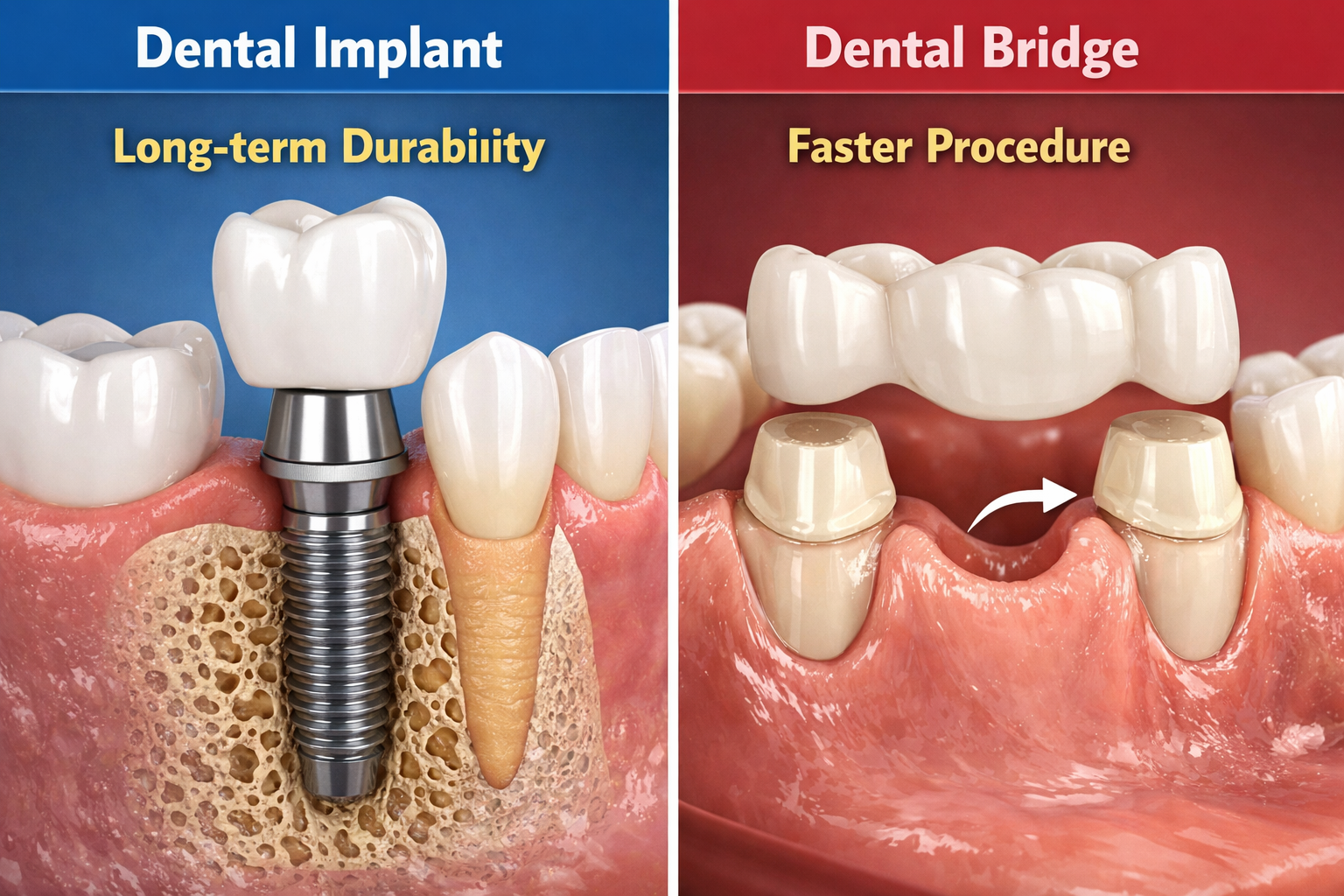
A dental implant is a permanent tooth replacement solution that involves surgically placing a titanium post into the jawbone to act as an artificial tooth root, which then supports a custom-made crown [1][4]. This differs significantly from a dental bridge, which replaces one or more missing teeth by cementing a crown-supported prosthetic to the healthy teeth on either side of the gap [1][6].
When considering dental implants in Dallas, it’s helpful to understand the core difference in how each option addresses tooth loss.
- Dental Implant: This involves three main components: a titanium post (the implant itself) surgically placed into the jawbone, an abutment that connects the implant to the crown, and the custom-made crown that looks and functions like a natural tooth [1]. The implant integrates with the bone, offering unmatched stability and preventing bone loss, which is a common consequence of missing teeth [5].
- Dental Bridge: A bridge typically consists of one or more artificial teeth (pontics) held in place by dental crowns that are cemented onto the natural teeth adjacent to the gap [1]. These adjacent teeth, called abutment teeth, must be healthy enough to support the bridge and are permanently reshaped or “prepped” to accommodate the crowns [6].
When to Choose Which
- Choose a dental implant if: You want a long-term solution that mimics a natural tooth, preserves jawbone health, and doesn’t affect your healthy adjacent teeth [1][5]. This is often the preferred choice for those seeking a durable and comprehensive missing teeth solution.
- Choose a dental bridge if: You need a quicker tooth replacement option, or if the adjacent teeth already have large fillings or require crowns. It can also be a more suitable option if bone density is insufficient for an implant and bone grafting is not desired [4].
Comparing Longevity and Durability: Dental Implant vs Bridge
When evaluating “Dental implant vs bridge: which is better and why?”, longevity is a key factor. Dental implants typically offer superior long-term durability, often lasting 15-25+ years or even a lifetime with proper care, while bridges generally last 7-15 years and often require replacement [1][2][4][6].
The long-term performance of these tooth replacement options directly impacts both your oral health and future financial commitments.
- Dental Implants: Designed to be a permanent solution, dental implants integrate directly with your jawbone through a process called osseointegration. This creates a stable foundation that can withstand natural chewing forces for decades [1][5]. The titanium material is biocompatible and highly resistant to decay, meaning the implant itself is very durable. The crown on top may eventually need replacement due to wear, but the implant post often lasts a lifetime.
- Dental Bridges: The lifespan of a dental bridge is limited by the condition of the supporting natural teeth. These teeth are susceptible to decay, gum disease, and structural stress from supporting the bridge [5]. If one of the abutment teeth develops a problem, the entire bridge may fail and need replacement, which can lead to additional dental work. Over a 20-year period, it’s common for a bridge to need replacement at least once, if not twice [5].
Impact on Oral Health: Preserving Bone and Adjacent Teeth
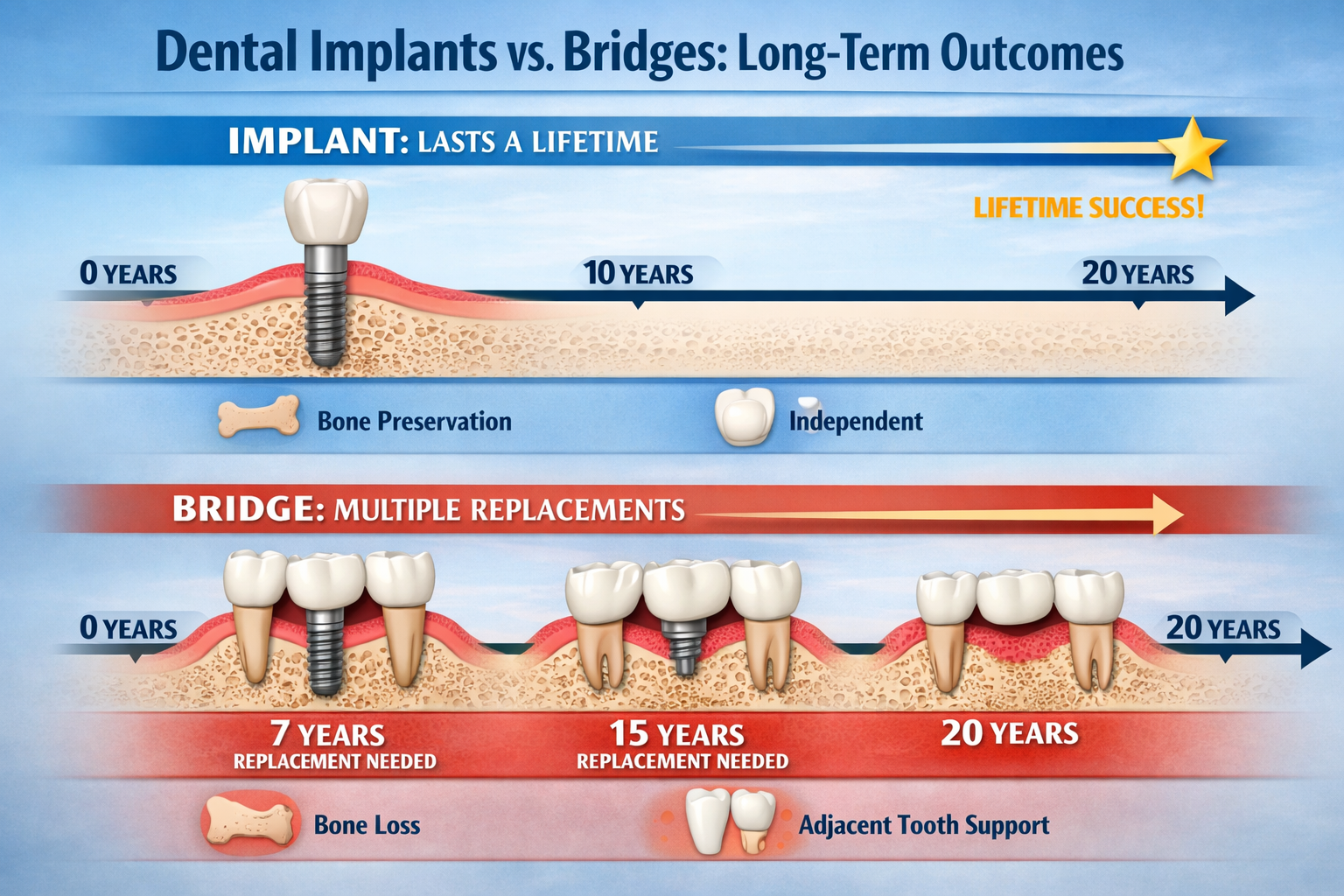
The impact on your overall oral health is a critical differentiator when considering “Dental implant vs bridge: which is better and why?”. Dental implants uniquely preserve jawbone structure by replacing the tooth root and stimulating the bone, whereas bridges allow underlying bone to deteriorate over time and require the alteration of healthy neighboring teeth [1][5][6].
Understanding how each option affects your mouth beyond just filling a gap is vital for long-term oral health.
- Bone Preservation: When a tooth is lost, the jawbone in that area no longer receives the stimulation it needs from chewing. This leads to bone resorption, where the bone starts to shrink and deteriorate [5]. Dental implants are the only tooth replacement option that addresses this by acting as an artificial tooth root, integrating with the bone, and maintaining its density and structure [1][6]. This prevents the sunken facial appearance that can occur with significant bone loss over time.
- Protection of Adjacent Teeth: A major advantage of dental implants is that they stand completely independently. This means healthy teeth surrounding the gap are not affected or altered in any way [1][6]. For many patients seeking dental implants in Dallas, preserving their natural teeth is a top priority. In contrast, dental bridges require the permanent shaving down of healthy adjacent teeth to create a stable anchor for the bridge [1][6]. This removal of enamel can make these teeth more vulnerable to decay and sensitivity in the future, potentially shortening their lifespan [5].
Bone Grafting for Implants
For patients who have experienced significant bone loss, a bone graft may be necessary before implant placement to ensure sufficient bone volume for successful integration [5]. While this adds to the overall treatment time and cost, it’s a crucial step to enable the long-term success of the implant. You can learn more about decoding bone grafting costs for dental implants.
The Procedure and Recovery: Time, Surgery, and Comfort
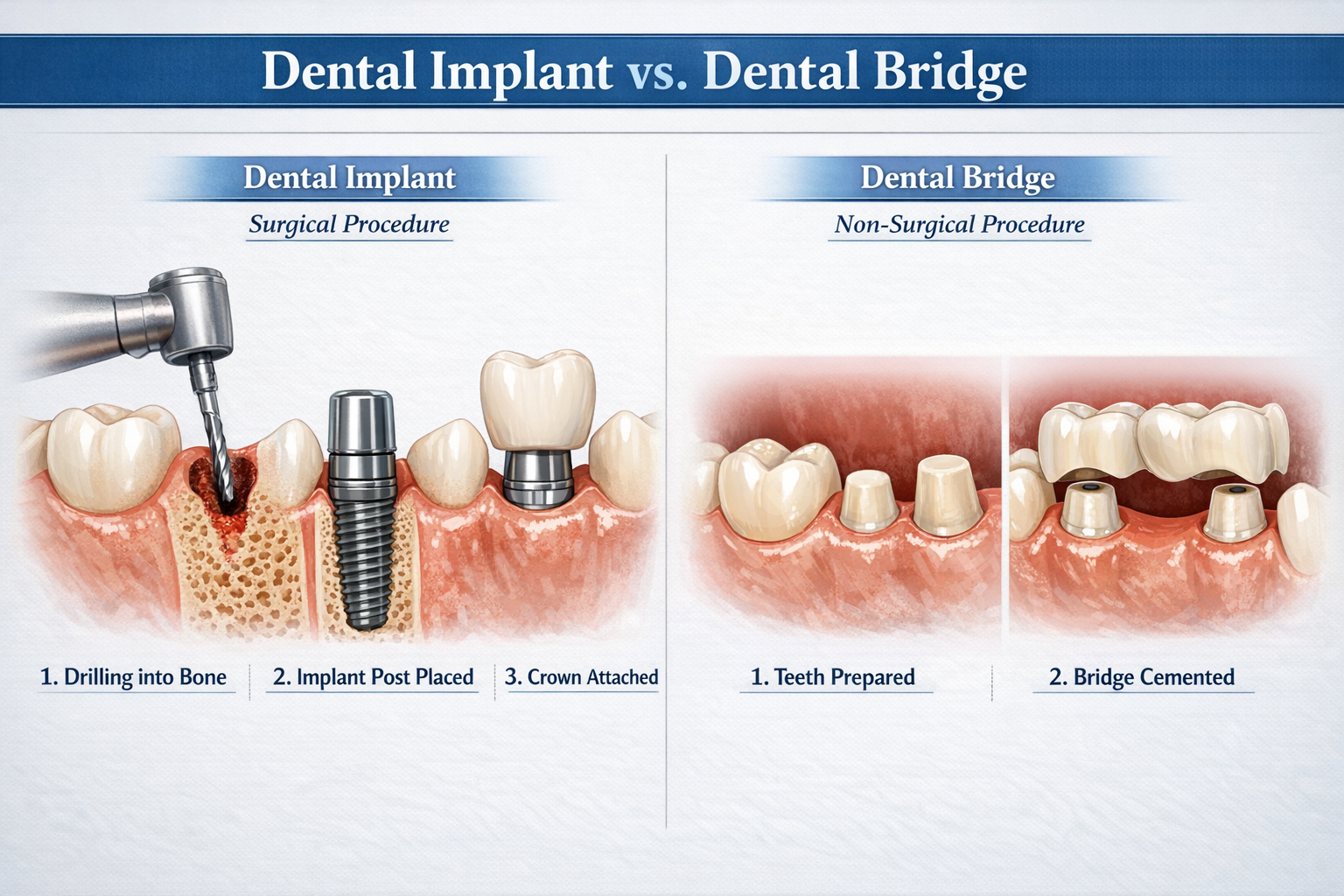
The procedures for dental implants and bridges vary significantly in terms of invasiveness, time commitment, and recovery. Dental implants require surgical intervention and a multi-stage process over several months, including healing time, while bridges are a non-surgical procedure typically completed in a few weeks [4].
- Dental Implant Procedure: The journey to a new smile with dental implants involves several steps.
- Initial Consultation: A comprehensive examination, including X-rays and possibly 3D scans, is conducted to assess oral health and bone density.
- Implant Placement: A minor surgical procedure where the titanium implant post is carefully placed into the jawbone [4]. Many patients opt for dental implant with sedation to ensure comfort during this step.
- Healing Period (Osseointegration): The implant fuses with the jawbone over 3-6 months [4]. This is a crucial phase for the implant’s long-term stability.
- Abutment Placement: Once the implant has integrated, a small connector piece (abutment) is attached to the implant.
- Crown Placement: Finally, a custom-made crown is placed on the abutment, completing the restoration [4].
This multi-stage process, while longer, ensures a durable and stable foundation. You can find more details on the dental implant procedure cost.
- Dental Bridge Procedure: The process for a dental bridge is generally faster and less invasive.
- Tooth Preparation: During the first visit, the adjacent abutment teeth are reshaped and reduced to make room for the crowns that will hold the bridge [4].
- Impressions: Molds of your teeth are taken to send to a dental lab, where your custom bridge will be fabricated. A temporary bridge may be placed.
- Bridge Placement: During a second visit, typically a few weeks later, the permanent bridge is checked for fit and bite, and then permanently cemented onto the prepped abutment teeth [4].
The quicker timeline makes bridges an appealing option for those seeking immediate results.
Recovery
- Dental Implants: Recovery after implant surgery involves managing minor discomfort, swelling, and bruising, usually with prescribed pain medication. Following dental implant post-op instructions is critical for successful healing.
- Dental Bridges: Recovery from a bridge procedure is typically minimal, with some temporary sensitivity in the abutment teeth.
Cost Considerations for Dental Implant vs Bridge
When comparing “Dental implant vs bridge: which is better and why?” from a financial perspective, it’s important to look beyond the initial price tag. While dental bridges typically have a lower upfront cost, dental implants often prove more cost-effective over a 20-year period due to their superior longevity and reduced need for replacement [4][5].
Here’s a breakdown of the cost factors:
- Upfront Costs:
- Dental Bridges: Generally range from $3,000 to $4,500 per tooth replaced, depending on the materials and complexity [4]. This often makes them more affordable for immediate tooth replacement.
- Dental Implants: The cost for a single dental implant (including the implant, abutment, and crown) can range from $3,000 to $6,000 or more in Dallas, though this can vary significantly [4]. For specific estimates, you can explore resources like the average cost of 1 dental implant in 2026.
- Long-Term Value:
- Dental Implants: Despite higher initial costs, their durability means fewer replacements and associated costs over time. With proper care, an implant can last for decades or even a lifetime, making the long-term investment often more economical [5].
- Dental Bridges: While less expensive initially, bridges typically need replacement every 7-15 years. This means multiple replacement costs, along with potential expenses for treating any issues with the supporting abutment teeth, which can add up significantly over a lifetime [5]. This can make the long-term cost of a bridge higher than an implant.
- Insurance Coverage: Dental insurance is often more likely to cover a portion of the cost of a dental bridge compared to dental implants, which are sometimes classified as cosmetic or experimental by older policies [4]. However, many modern plans are increasingly covering implants. It’s crucial to check your specific plan’s benefits and consider dental implant financing options in Dallas TX or best dental insurance for implants in Dallas 2025. For a detailed comparison of costs, refer to “Dental Implant Versus Bridge Cost: What’s the Smart Choice in 2025?” – https://dallasdentalimplantcost.com/dental-implant-vs-bridge-cost-2025/.
Comparison Table: Dental Implant vs Bridge
| Feature | Dental Implant | Dental Bridge |
|---|---|---|
| Replaces | Tooth root and crown | Missing tooth/teeth (crown only, sits on gums) |
| Impact on Jawbone | Preserves bone density, prevents bone loss [1][5] | Allows bone loss over time [1][5] |
| Adjacent Teeth | Does not affect surrounding healthy teeth [1][6] | Requires grinding down adjacent healthy teeth for support [1][6] |
| Longevity | 15-25+ years, often a lifetime [1][2][4][6] | 7-15 years, often needs replacement [4][5] |
| Chewing Function | Restores ~90% of natural chewing power [5] | Restores ~60-70% of natural chewing power [5] |
| Procedure Time | Several months (surgery, healing, crown) [4] | A few weeks (2 dental visits) [4] |
| Upfront Cost | Higher ($3,000-$6,000+ per tooth) [4] | Lower ($3,000-$4,500 per tooth) [4] |
| Long-Term Cost Value | Often more cost-effective due to durability [5] | Can become more expensive due to replacements [5] |
| Maintenance | Regular brushing, flossing, dental check-ups [5] | Regular brushing, flossing (special tools for under bridge), professional cleanings [5] |
| Requirements | Adequate jawbone density (may need bone graft) [5] | Strong, healthy adjacent teeth [6] |
| Aesthetics | Highly natural appearance, blends seamlessly | Very good appearance, but less natural bone support |
Making Your Decision: Which Option is Right for You?
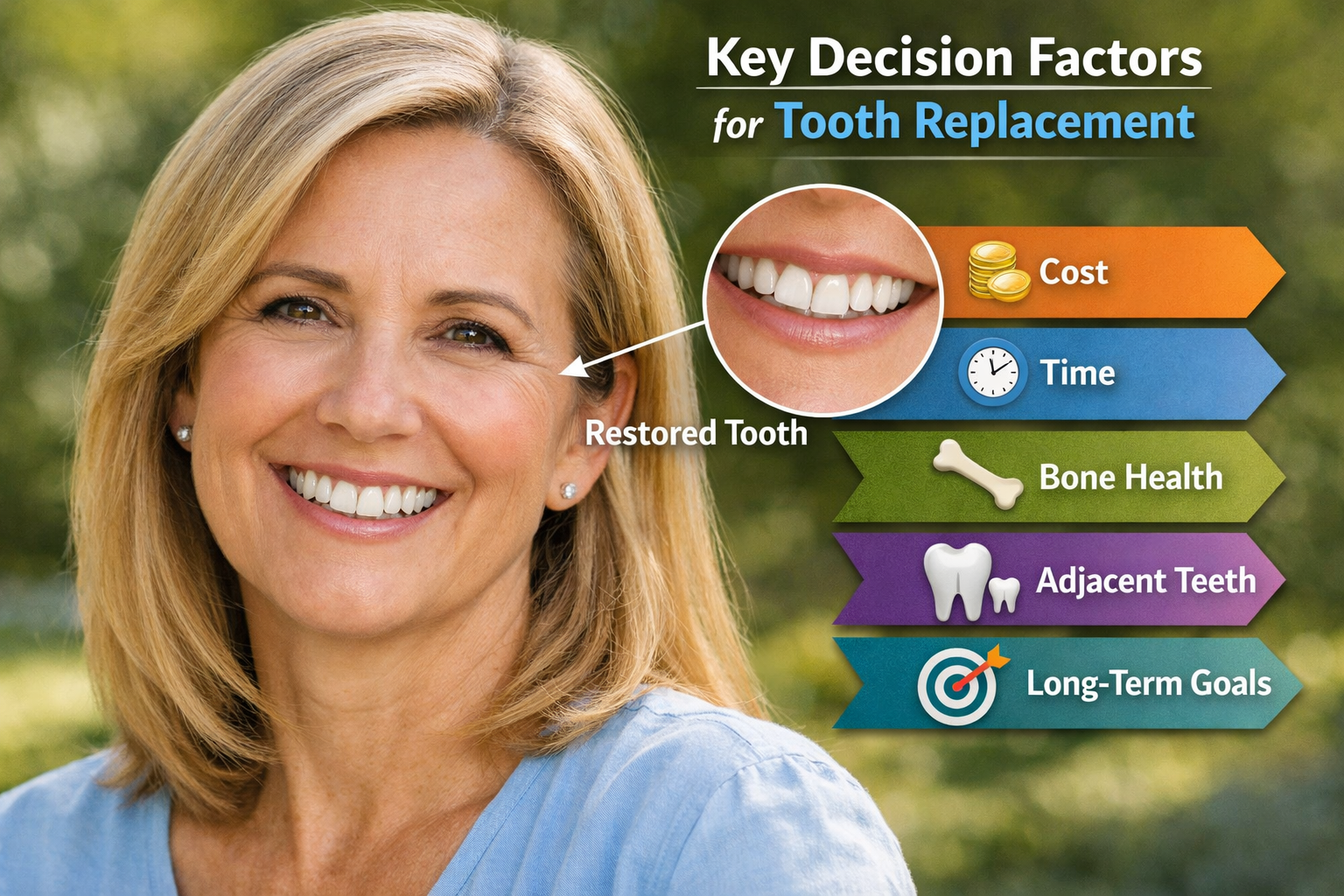
Deciding between a dental implant and a bridge is a personal choice that should be made in consultation with a qualified dental professional. There isn’t a single “better” option for everyone; the ideal choice depends on your specific oral health condition, long-term goals, financial situation, and preferences.
Consider these factors during your consultation:
- Your Oral Health Status: Do you have healthy adjacent teeth that you wish to preserve? Is your jawbone density sufficient for an implant, or would you require a bone graft? These are critical considerations.
- Long-Term Goals: Are you looking for a permanent solution that mimics a natural tooth and prevents bone loss, or is a quicker, less invasive option more appealing for immediate needs?
- Budget and Insurance: While upfront costs for bridges may be lower, consider the potential long-term costs of replacements and maintenance for both options. Discuss financing options and insurance coverage with your dentist.
- Time Commitment: Are you prepared for the multi-month process of an implant, including healing time, or do you prefer the faster timeline of a bridge?
- Overall Health: Certain medical conditions can affect eligibility for implant surgery. Your dentist will assess your overall health to ensure patient safety.
We encourage anyone in Dallas exploring missing teeth solutions to schedule a consultation with a dentist specializing in dental implant procedures. They can provide a personalized assessment, discuss the implant surgery process, and help you understand all tooth replacement options tailored to your needs. This expert guidance is invaluable for making an informed decision about your long-term oral health.
Frequently Asked Questions About Dental Implants and Bridges
Q1: Can I get a dental implant if I have bone loss?
A1: Yes, in many cases, patients with bone loss can still get a dental implant. However, they may first require a bone grafting procedure to build up sufficient jawbone density to support the implant [5].
Q2: How long does a dental bridge last?
A2: A dental bridge typically lasts between 7 to 15 years. Its lifespan largely depends on good oral hygiene, regular dental check-ups, and the health of the supporting natural teeth [4][5].
Q3: Is the dental implant procedure painful?
A3: Dental implant surgery is performed under local anesthesia, so you should not feel pain during the procedure. Post-operative discomfort is manageable with prescribed pain medication, and many patients opt for sedation for a more comfortable experience [4].
Q4: Will my insurance cover dental implants or bridges in Dallas?
A4: Insurance coverage varies significantly by plan. Many dental insurance plans in Dallas cover a portion of the cost for bridges. Coverage for dental implants is increasing, but some plans may still classify them differently. It’s best to check with your specific provider and dental office for details on your dental implant cost in Dallas.
Q5: How do I clean a dental bridge?
A5: Cleaning a dental bridge requires careful attention. In addition to regular brushing and flossing, you’ll need to use special tools like a floss threader or interdental brush to clean underneath the bridge and around the abutment teeth to prevent plaque buildup and decay [5].
Q6: Can a dental implant fail?
A6: While dental implants have a high success rate (over 95%), failure can occur due to infection, insufficient bone integration, nerve damage, or other complications. Proper maintenance and regular check-ups significantly reduce this risk. If you experience dental implant failure symptoms, consult your dentist immediately.
Q7: What are the advantages of an implant-supported bridge?
A7: An implant-supported bridge is a hybrid option where implants, instead of natural teeth, support the bridge. This avoids altering healthy teeth and still prevents bone loss in the areas where implants are placed, offering benefits of both options. You can learn more about implant supported bridge costs in Dallas TX 2026.
Conclusion
The decision between a dental implant and a bridge is a significant one for your oral health, impacting not only your smile but also the long-term integrity of your jawbone and surrounding teeth. While dental implants offer unparalleled benefits in terms of bone preservation, independent function, and remarkable longevity, dental bridges provide a quicker, often less expensive initial solution that can be ideal in certain circumstances.
As a leading resource for oral health education in Dallas, TX, we emphasize the importance of personalized care. We encourage you to seek a professional consultation with a dentist to discuss your specific situation. During this consultation, you can explore your tooth replacement options, assess your candidacy for a dental implant procedure, understand the full implant cost in Dallas, and determine the best path forward for your long-term oral health. Making an informed decision with expert guidance ensures you choose the most appropriate and beneficial solution for your unique needs.
References
[1] Dental Implant Vs Bridge – https://drfakhimi.com/blog/dental-implant-vs-bridge/
[2] Dental Implants Vs Bridge – https://theteethdoctors.com/dental-implants-vs-bridge/
[3] Single Tooth Implant Vs Dental Bridge Cost – http://www.minotdentalpartners.com/blog/single-tooth-implant-vs-dental-bridge-cost/
[4] Dental Bridges Vs Implants Which Is Better For Front Teeth – https://www.699dentalimplants.com/dental-bridges-vs-implants-which-is-better-for-front-teeth/
Leave a Reply
Share your thoughts or ask a question about dental implants. Your email address will not be published.