

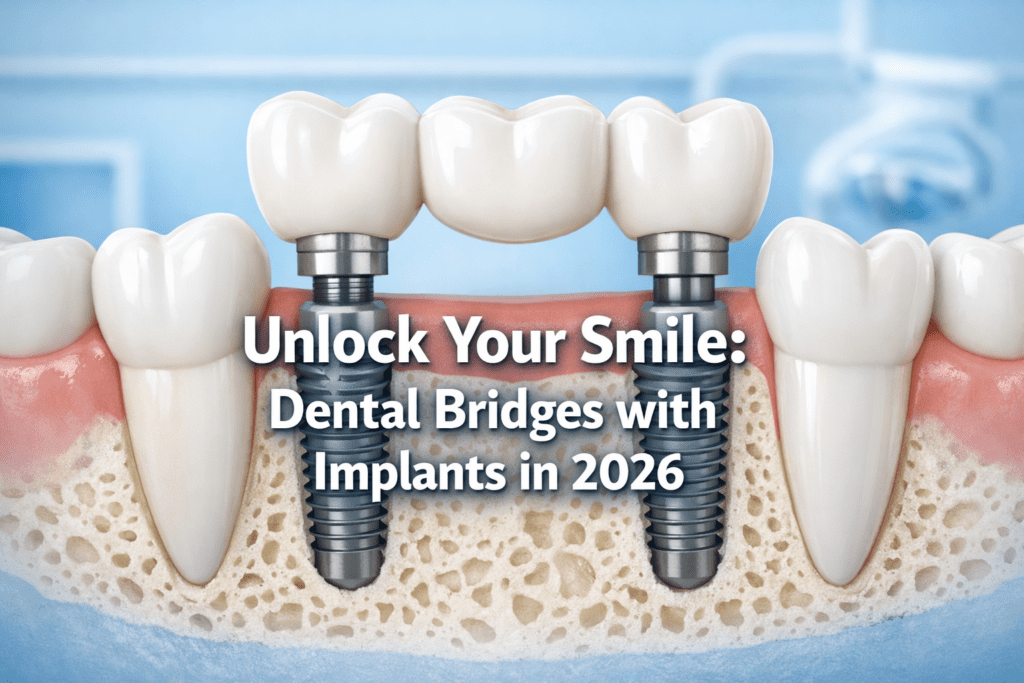
Missing teeth can impact more than just your smile; they can affect your ability to eat, speak, and even your overall confidence. While traditional tooth replacement options exist, significant advancements in restorative dentistry have made dental bridge with implants a leading solution for many individuals in 2026. This comprehensive uide from Dental Implant Education – Dallas TX aims to provide you with a clear understanding of this advanced treatment, helping you make informed decisions about your oral health.
Unlike conventional bridges that rely on adjacent natural teeth for support, a dental bridge with implants offers a more stable, durable, and bone-preserving alternative. This innovative approach integrates the benefits of dental implants – known for their remarkable stability and longevity – with the ability to replace multiple missing teeth in a row. For those in Dallas, Texas, considering their tooth replacement options, understanding this procedure is a crucial step towards long-term oral health.
Key Takeaways
- Enhanced Stability and Longevity: Dental bridges with implants provide superior stability and can last for decades, often outperforming traditional bridges by preventing bone loss in the jaw.
- Preservation of Healthy Teeth: This solution avoids placing stress on or altering adjacent natural teeth, which is a common requirement for conventional bridges.
- Improved Oral Health: By stimulating the jawbone, implants help prevent bone deterioration, supporting facial structure and contributing to overall long-term oral health.
- Advanced Technology: In 2026, practices are utilizing cutting-edge technologies like 3D printing and digital planning for more precise, aesthetic, and efficient procedures.
- Professional Consultation is Key: Choosing the right treatment requires a thorough assessment by a qualified dental professional, especially for complex cases, to ensure patient safety and optimal results.
Understanding Dental Bridges with Implants: The Modern Approach to Missing Teeth
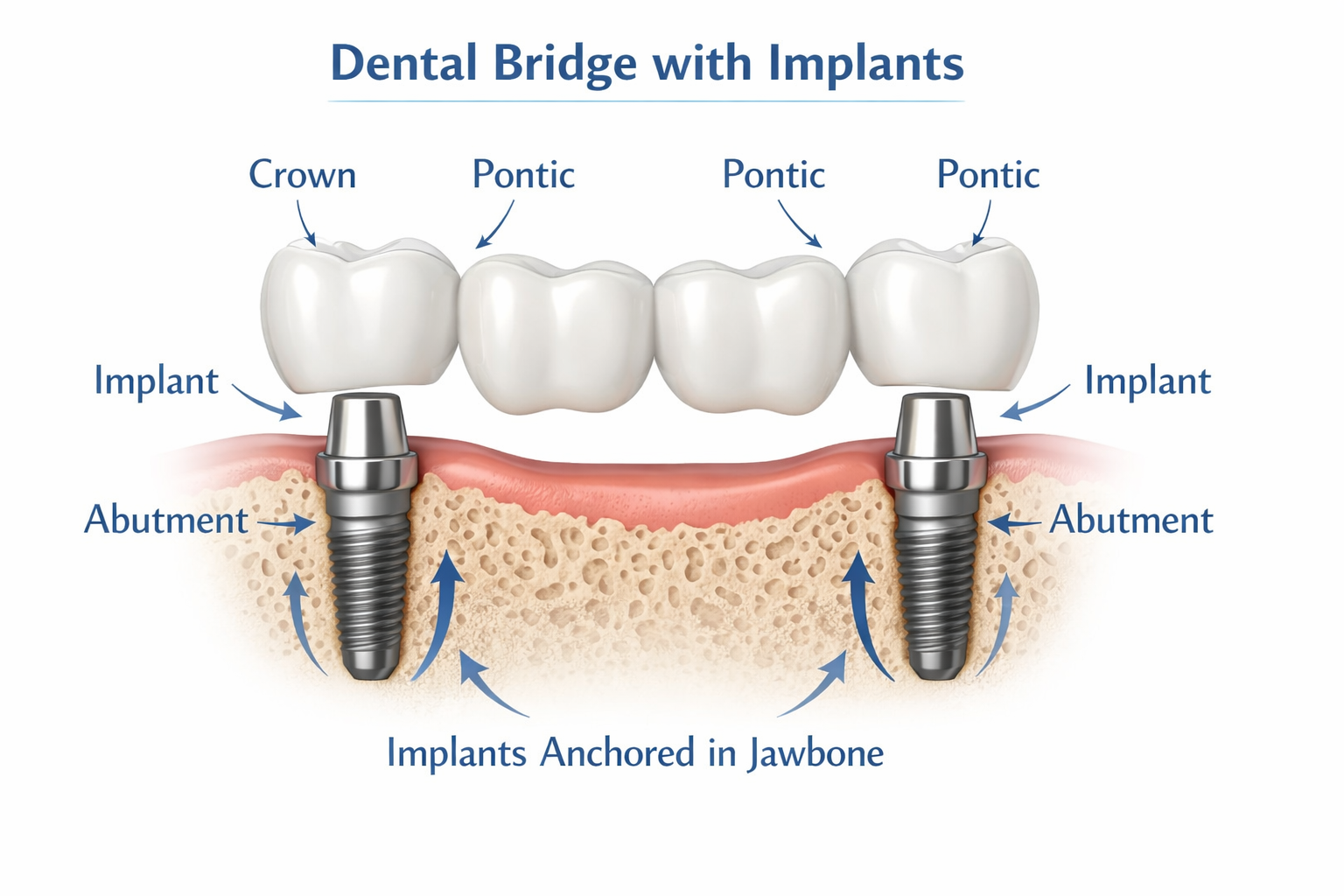
When you have several missing teeth in a row, a dental bridge is a common solution. Traditionally, a bridge consists of artificial teeth (pontics) held in place by crowns cemented onto your natural teeth on either side of the gap. While effective, this method requires modifying healthy teeth, potentially weakening them over time. This is where the concept of a dental bridge with implants truly shines, offering a robust and stable alternative.
Instead of relying on natural teeth, an implant-supported bridge uses dental implants as its foundational support. These small, screw-shaped posts are surgically placed into your jawbone, where they fuse with the bone in a process called osseointegration [1]. Once integrated, these implants act as sturdy anchors, much like natural tooth roots, to hold your bridge securely in place. This innovative approach represents a significant development in restorative dentistry, providing a more stable solution compared to traditional bridges [9].
What is an Implant-Supported Dental Bridge?
Imagine a bridge designed not to lean on existing structures, but to stand independently on its own strong pillars. That’s essentially what an implant-supported bridge is. If you have two or more missing teeth next to each other, instead of needing one implant for each missing tooth, a bridge can be supported by fewer implants. For example, two dental implants can often support a bridge of three or four artificial teeth.
This method is particularly beneficial for individuals who have lost multiple teeth but still have sufficient jawbone density to support the implants. It offers a permanent, fixed solution that looks, feels, and functions remarkably like natural teeth. The crowns and pontics that form the visible part of the bridge are custom-made to match the shade, shape, and size of your existing teeth, ensuring a seamless and natural-looking smile [2].
The Components of an Implant-Supported Bridge
To fully appreciate the stability and design of a dental bridge with implants, it’s helpful to understand its main components:
- Dental Implants: These are the titanium (or ceramic) posts surgically placed into your jawbone. They serve as artificial tooth roots, providing unparalleled stability and helping to prevent bone loss. In 2026, research continues to focus on improving osseointegration to extend implant lifespan beyond 20-30 years, directly benefiting long-term bridge stability [1].
- Abutments: Once the implants have healed and fused with the bone, small connectors called abutments are attached to them. These abutments protrude above the gum line and serve as the anchors for the bridge.
- Prosthetic Bridge: This is the visible part of the restoration, consisting of artificial teeth (crowns) that are attached to the abutments. The bridge is custom-designed to fill the gap created by your missing teeth and blend seamlessly with your natural smile. Modern materials, including newer ceramic-based and advanced alloy options, provide enhanced aesthetics and corrosion resistance for these bridge restorations [1].
The Procedure: What to Expect
The process of getting a dental bridge with implants typically involves several stages, spanning over a few months to allow for proper healing and integration.
- Initial Consultation and Planning: Your journey begins with a thorough examination, including X-rays and 3D imaging, to assess your oral health, bone density, and suitability for implants. Digital smile design and planning tools are now enabling more precise implant-supported bridge placement with improved natural shade-matching and better-fitting restorations [2]. This is a crucial step to develop a personalized treatment plan for your specific needs. For those in Dallas, Texas, seeking oral health education, a detailed consultation with a dentist is always recommended.
- Implant Placement: In the first surgical phase, the dental implants are carefully placed into your jawbone. This procedure is often performed with local anesthesia, and sedation options are available for patient comfort. For more information on comfort during procedures, you might find our guide on dental implant with sedation helpful. Advances in guided surgical techniques and restorative planning are improving the predictability and efficiency of implant placement for bridge support structures [4].
- Healing and Osseointegration: After implant placement, a healing period of several months is necessary for the implants to fuse with your jawbone. This critical process ensures the stability of your future bridge. During this time, you may wear a temporary restoration. Accelerated healing is being seen with bioactive implant coatings and minimally invasive techniques, which also reduce recovery time and infection risk [1].
- Abutment Placement: Once osseointegration is complete, small connectors called abutments are attached to the implants. In some cases, these may be placed during the initial implant surgery.
- Bridge Fabrication and Placement: Impressions of your mouth are taken to custom-fabricate your permanent bridge. Thanks to innovations like 3D printing technology, bridges, crowns, and surgical guides can now be produced faster than ever before [7], [8]. Once the bridge is ready, it is securely attached to the abutments, completing your new smile.
Benefits and Considerations of Dental Bridges with Implants
Choosing the right tooth replacement option is a significant decision. A dental bridge with implants offers a host of advantages that make it a highly desirable solution for many patients with missing teeth. However, like any medical procedure, it also involves specific considerations.
Key Benefits
The advantages of opting for a dental bridge with implants are compelling, particularly when compared to traditional alternatives:
- Superior Stability and Comfort: Because implants are integrated directly into your jawbone, they provide a level of stability unmatched by traditional bridges or removable dentures. This means your bridge will not slip, click, or cause discomfort, allowing you to eat, speak, and laugh with complete confidence [9].
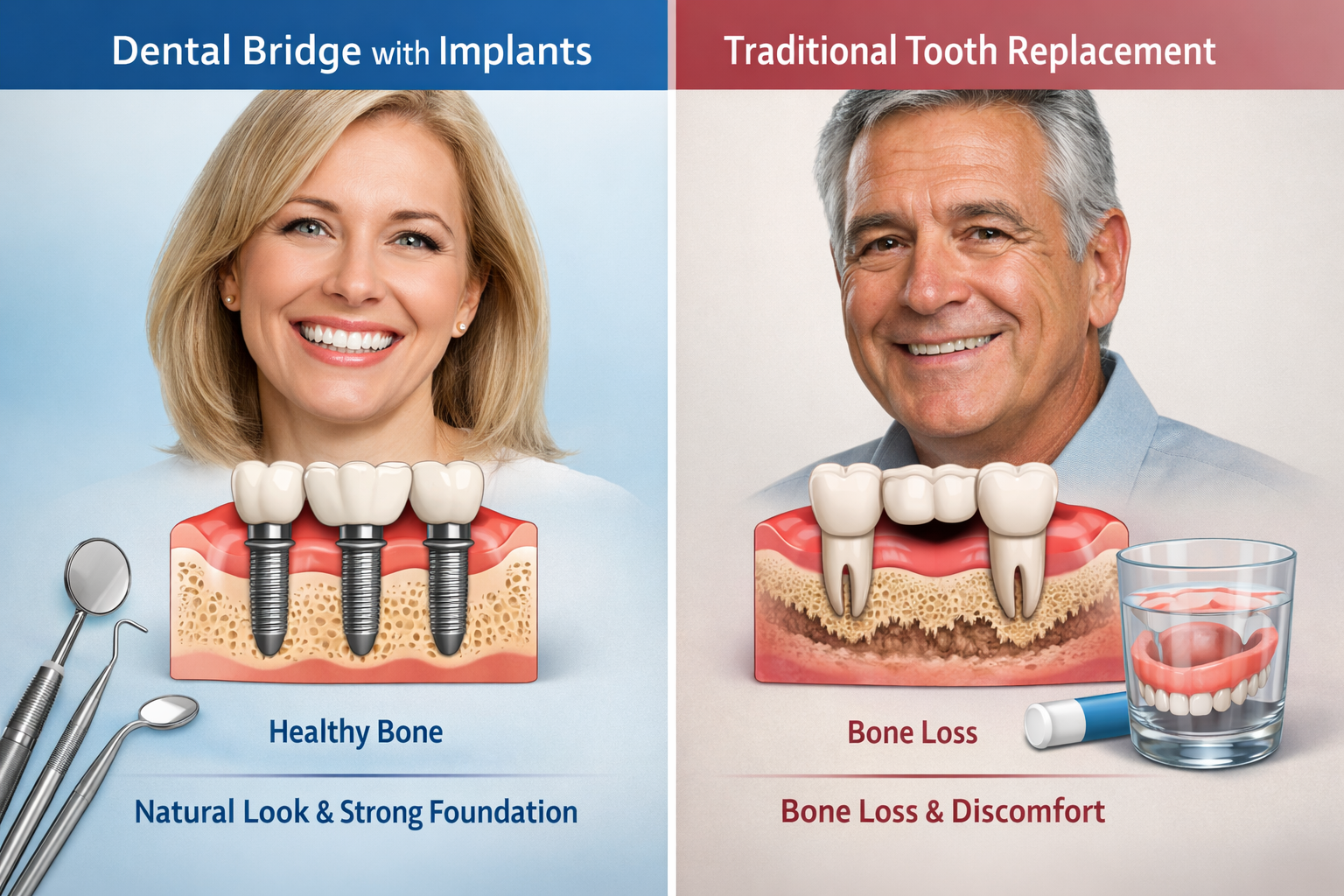
- Preservation of Jawbone and Facial Structure: One of the most significant benefits of dental implants is their ability to stimulate the jawbone. When teeth are lost, the jawbone can begin to deteriorate (resorb) due to lack of stimulation. Implants act like natural tooth roots, preserving bone density and helping to maintain the natural contours of your face [1]. This contributes significantly to long-term oral health.
- Protection of Adjacent Healthy Teeth: Unlike traditional bridges that require the grinding down of healthy adjacent teeth to support the bridge, implant-supported bridges stand independently. This preserves your natural teeth, keeping them strong and healthy and reducing the risk of future dental issues.
- Long-Term Durability and Success Rates: With proper care, dental implants can last for decades, often a lifetime. The bridge itself is also highly durable. Current research focuses on improving osseointegration to extend implant lifespan beyond 20-30 years [1]. This makes them a cost-effective long-term investment in your oral health. The year 2026 is seeing a major surge in dental implant procedures overall, indicating growing confidence in these durable solutions [6].
- Natural Appearance and Function: Custom-designed to match your existing teeth, implant-supported bridges offer an incredibly natural look and feel. They restore full chewing function, allowing you to enjoy a wide variety of foods without restriction. Digital smile design and planning tools further enhance this, enabling better-fitting and more aesthetically pleasing restorations [2].
Important Considerations
While the benefits are numerous, it’s essential to consider all aspects before proceeding with a dental bridge with implants:
- Cost: The initial investment for a dental bridge with implants can be higher than traditional bridges or dentures. However, their longevity and benefits often make them more cost-effective over time. Understanding implant cost in Dallas and comparing dental implant vs bridge cost in 2025 is important. In 2026, a 25% reduction in lab fees was announced by Shatkin F.I.R.S.T., which helps reduce costs for implant-related prosthetics, including bridges, while maintaining quality [3].
- Surgical Procedure: Implant placement is a surgical procedure, which means it involves a healing period. While modern techniques and sedation can minimize discomfort, it’s a commitment that requires patience. Recovery times are being reduced by accelerated healing techniques [1].
- Bone Density Requirements: Successful implant placement relies on sufficient jawbone density. If you have significant bone loss, you may require a bone grafting procedure before implants can be placed. Practices offering advanced procedures, including ridge augmentation, are gaining a competitive advantage in 2026 [4].
- Oral Health Maintenance: Like natural teeth, implants and bridges require diligent daily oral hygiene and regular dental check-ups to ensure their longevity and prevent complications. This includes brushing, flossing, and professional cleanings.
- Suitability: Not everyone is an ideal candidate for dental implants. Factors such as certain medical conditions (e.g., uncontrolled diabetes), smoking habits, and overall health will be evaluated during your consultation with a dentist. Patient safety is paramount in determining the best course of action.
Traditional Bridge vs. Implant-Supported Bridge
To further illustrate the advantages, here’s a quick comparison:
| Feature | Traditional Dental Bridge | Dental Bridge with Implants |
|---|---|---|
| Support | Relies on adjacent natural teeth | Supported by dental implants placed in the jawbone |
| Tooth Preservation | Requires grinding down healthy adjacent teeth | Preserves healthy adjacent teeth |
| Bone Health | Does not stimulate jawbone; bone loss may occur | Stimulates jawbone, preventing bone loss |
| Stability | Good, but can loosen over time | Excellent, acts like natural teeth |
| Longevity | Typically 5-15 years, depending on care and materials | Can last 20-30 years or more with proper care [1] |
| Cost | Generally lower initial cost | Higher initial cost, but more cost-effective long-term |
| Maintenance | Specific flossing techniques needed under bridge | Similar to natural teeth, easy to clean |
| Procedure | Non-surgical, but alters natural teeth | Surgical procedure required |
This table highlights why, for many patients seeking missing teeth solutions, the dental bridge with implants is often considered the superior long-term choice.
The Future of Dental Bridges with Implants in 2026 and Beyond
The field of dental implantology is continuously evolving, with 2026 marking a period of significant advancements and increasing patient adoption. For those considering a dental bridge with implants in Dallas, TX, these developments mean even better outcomes, increased efficiency, and enhanced patient experience.
Technological Innovations Driving Progress
Modern dentistry is leveraging cutting-edge technology to refine every aspect of the implant process:
- 3D Printing and CAD/CAM Technology: As mentioned, 3D printing is revolutionizing the manufacturing of bridges, crowns, and even surgical guides, leading to faster production times and more precise, custom-fit restorations [7], [8]. Computer-aided design (CAD) and computer-aided manufacturing (CAM) ensure that each component of your dental bridge with implants is crafted with meticulous accuracy.
- Digital Smile Design and Planning: Dentists can now use advanced software to digitally plan your treatment, predict outcomes, and even show you a preview of your new smile before the procedure begins [2]. This not only enhances precision but also allows for better aesthetic integration and patient satisfaction.
- Guided Implant Surgery: This technology uses 3D imaging to create a surgical guide, a custom template that fits over your gums during implant placement. This guide ensures that implants are placed at the exact predetermined angle, depth, and position, significantly improving the predictability and safety of the implant surgery process [4].
- Material Science Advances: Newer ceramic-based materials and advanced alloys are continuously being developed for implants and bridge prosthetics. These materials offer improved aesthetics, corrosion resistance, and biocompatibility, contributing to the longevity and success of your dental bridge with implants [1].
- Accelerated Healing Protocols: Research into bioactive implant coatings and minimally invasive surgical techniques is leading to faster healing times and reduced post-operative discomfort for patients [1]. This means a quicker return to normal activities after your implant surgery.
What the “Implant Surge” Means for Patients in Dallas
The year 2026 is recognized as a pivotal moment for a major surge in dental implant procedures globally [6]. This growing demand is a testament to the increasing awareness of the benefits of dental implants and the declining skepticism surrounding them. For patients in Dallas, this surge brings several positive implications:
- Increased Accessibility: As dental implants become more commonplace, more dental practices are investing in the technology and training required to offer these advanced solutions. This could lead to more options for patients seeking dental implants in Dallas and potentially more competitive pricing.
- Specialized Expertise: With a growing market, there’s a greater emphasis on specialization and continued education for dental professionals. This means patients have access to highly skilled and experienced practitioners who are experts in implant dentistry and complex restorative cases. Finding top dental implant specialists in Dallas TX is crucial.
- Comprehensive Care Expansion: Practices are expanding their services to include a wider range of advanced procedures, such as ridge augmentation and full-arch implant protocols, which support more complex bridge solutions [4]. This means that even patients with significant bone loss or extensive tooth loss can find tailored solutions.
Ultimately, the future of dental bridge with implants is bright. With ongoing research focusing on improving osseointegration and extending implant lifespan, patients can look forward to restorations that not only last longer but also feel even more like their natural teeth [1], [10]. For those considering this life-changing procedure, now is an excellent time to explore your options and consult with a trusted dental professional.
Conclusion
Choosing the right solution for missing teeth is a critical step toward restoring your oral health, confidence, and overall quality of life. A dental bridge with implants stands out in 2026 as a premier tooth replacement option, offering a combination of stability, longevity, and aesthetic appeal that surpasses many traditional alternatives. By providing a secure foundation rooted in your jawbone, these advanced bridges not only restore your smile but also help preserve your facial structure and prevent further bone loss.
At Dental Implant Education – Dallas TX, we believe in empowering our patients with accurate, reliable information. We’ve explored how cutting-edge technologies like 3D printing, digital planning, and guided surgery are making the dental implant procedure more precise and efficient than ever before. We’ve also highlighted the significant benefits, such as superior stability, protection of healthy teeth, and long-term durability, alongside important considerations like initial cost and the need for sufficient bone density.
If you are in Dallas, Texas, and are evaluating your tooth replacement options, we encourage you to consider the transformative potential of a dental bridge with implants. This investment in your long-term oral health can dramatically improve your ability to eat, speak, and smile with renewed confidence.
Your Next Steps:
The most crucial step is a personalized assessment. We invite you to schedule a consultation with a dentist specializing in dental implants. During this visit, a qualified professional will:
- Evaluate Your Oral Health: A thorough examination, including advanced imaging, will determine if a dental bridge with implants is the right solution for your unique situation.
- Discuss Your Treatment Plan: You’ll receive a detailed explanation of the procedure, including timelines, materials, and any necessary preparatory treatments like bone grafting.
- Address Your Questions and Concerns: This is your opportunity to understand every aspect of the process, from dental implant cost in Dallas to post-operative care.
Making an informed decision about your oral health is essential. We are committed to providing you with the educational resources needed to choose the best path forward for your smile and your well-being.
References
[1] Dental Implants In 2026 Advances In Longevity Materials And Faster Recovery – https://trinitydentist.com/dental-implants-in-2026-advances-in-longevity-materials-and-faster-recovery/
[2] Dental Trends 2026 – https://www.brightsmiledesign.com/post/dental-trends-2026
[3] Watch – https://www.youtube.com/watch?v=JEWoIRIc3n8
[4] Set Your Implant Practice Up For Success In 2026 – https://glidewelldental.com/company/blog/Set-Your-Implant-Practice-Up-for-Success-in-2026
[5] New Year New Smile The Perfect Time For Dental Implants – https://www.bridgforddental.co.uk/latest-news/new-year-new-smile-the-perfect-time-for-dental-implants/
[6] The Implant Surge In 2026 And What It Means For Missing Tooth Solutions – https://trinitydentalcares.com/the-implant-surge-in-2026-and-what-it-means-for-missing-tooth-solutions/
[7] 7 Latest Dental Technologies 2026 – https://mainstreetdentalnewark.com/7-latest-dental-technologies-2026/
[8] Evolving Dental Implant Solutions Journey From Traditional To Modern – https://clarahyundmd.com/blog/our-office/2026/14834/evolving-dental-implant-solutions-journey-from-traditional-to-modern/
[9] Revolutionizing Dental Restoration Future Implants Bridges – https://sharp-dentistry.com/articles/12871/revolutionizing-dental-restoration-future-implants-bridges/
[10] Dental Implants Could Feel More Real Teeth – https://now.tufts.edu/2025/06/11/dental-implants-could-feel-more-real-teeth
Leave a Reply
Share your thoughts or ask a question about dental implants. Your email address will not be published.