


Let’s be real—dental implants can transform your smile and your confidence, but the price tag? That’s enough to make anyone’s teeth hurt. With single implants costing anywhere from $3,000 to $6,000 and full-mouth restorations reaching $50,000 or more, most people don’t have that kind of cash sitting around.
Here’s the good news: you don’t need to drain your savings account or skip the treatment you need. Today’s dental financing landscape offers more options than ever before, from zero-interest promotional periods to flexible payment plans that fit virtually any budget.
But with so many financing options available, how do you choose the right one? That’s exactly what we’re tackling in this comprehensive guide. We’ve reviewed the seven best dental implant financing options, breaking down the pros, cons, and real-world applications of each so you can make an informed decision that works for your financial situation.
Whether you’re considering a single implant or exploring All-on-4 dental implants, understanding your financing options is just as important as choosing the right dental provider.
Quick Comparison Table: Dental Implant Financing at a Glance
| Financing Option | Typical APR | Maximum Amount | Approval Speed | Credit Required | Best For |
|---|---|---|---|---|---|
| CareCredit | 0% promo, then 17-30% | Varies by credit | Same day | 650+ score | Quick approval with good credit |
| Cherry (BNPL) | 0% for qualified | Up to $50,000 | 60 seconds | Soft check only | Fast approval without credit impact |
| In-House Plans | Low-moderate (varies) | Practice-dependent | Immediate | Varies by practice | Direct provider relationship |
| Bank/Credit Union Loans | 7-30% | $1,000-$100,000+ | 1-7 days | 650+ score | Traditional loan structure |
| FSA/HSA | 0% (no interest) | Account balance | Immediate | N/A | Tax savings on existing funds |
| Proceed/LendingPoint | 0-23.99% | Up to $75,000 | Same day | 650+ score | Large implant cases |
| Home Equity Loans | 5-15% | Based on equity | 2-6 weeks | Homeownership required | Full-mouth restorations |
Detailed Reviews: The 7 Best Dental Implant Financing Options
1. CareCredit: The Healthcare Financing Veteran
Price Range: 0% promotional APR periods available; 17-30% APR after promotional period ends
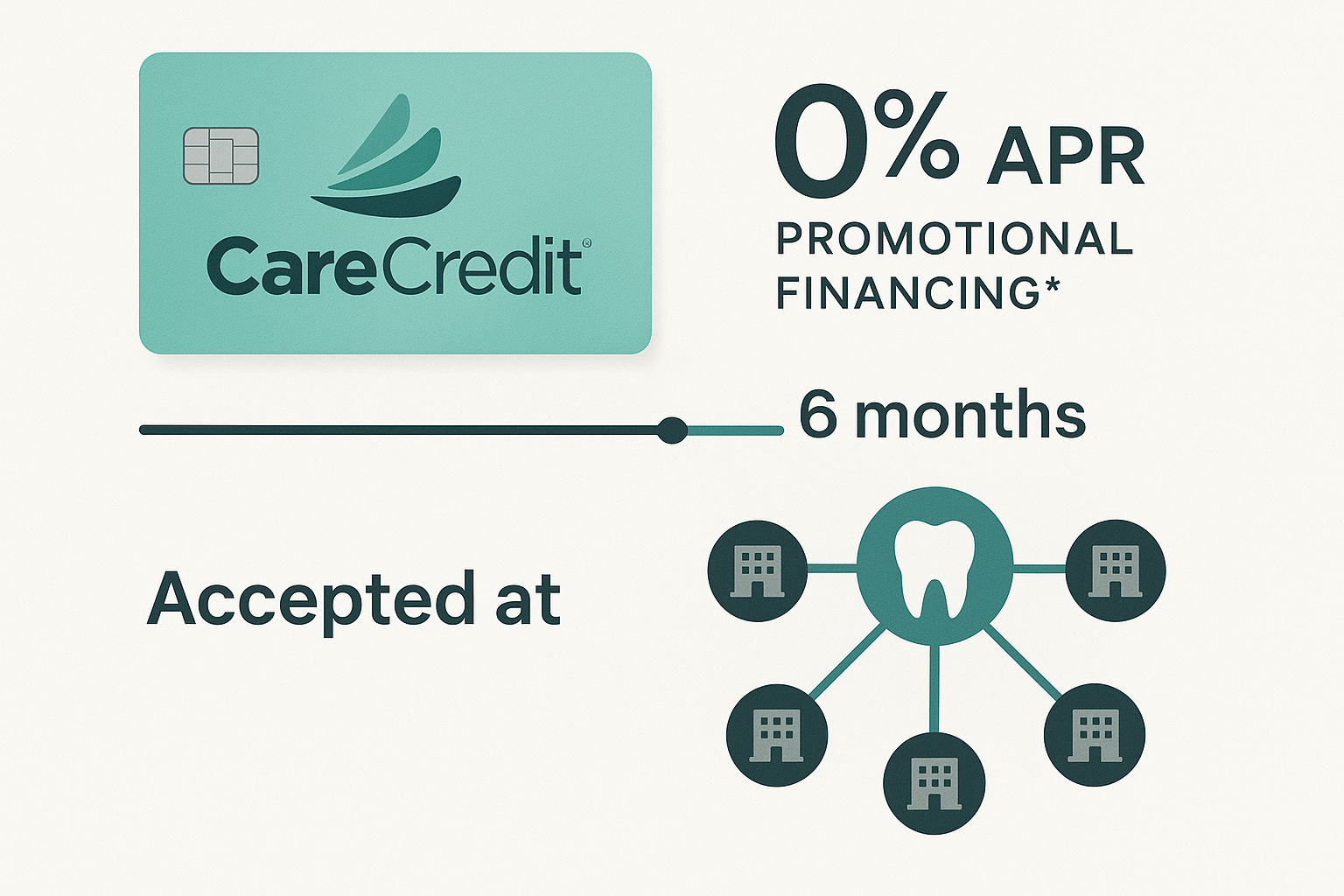
CareCredit has been the go-to medical credit card for healthcare expenses since 1987, and for good reason. This specialized financing option is accepted at over 250,000 healthcare providers nationwide, including the vast majority of dental practices offering implant services.
How It Works:
CareCredit functions like a traditional credit card but is exclusively designed for healthcare expenses. Once approved, you receive a credit line that can be used for dental implants and other medical procedures. The card offers promotional financing periods ranging from 6 to 24 months with 0% interest, provided you pay off the balance in full before the promotional period ends.
Key Features:
- Multiple promotional financing options (6, 12, 18, or 24 months at 0% APR)
- Reusable credit line for future dental work
- Online account management and mobile app
- No annual fee
- Can be used for family members’ dental care
✅ Pros:
- Designed specifically for healthcare expenses, including dental implants
- Special promotional 0% APR periods make large expenses manageable
- Widely accepted at dental practices nationwide
- Can provide immediate funding for urgent treatment needs
- Flexible repayment terms based on procedure cost
- No prepayment penalties
❌ Cons:
- Higher interest rates (17-30% APR) kick in after promotional period ends
- Requires credit qualification with typically 650+ credit score needed
- Deferred interest accrues from purchase date if not paid off during promo period
- Can impact credit utilization ratio
- Late payments result in loss of promotional rate
Who It’s Best For:
CareCredit shines for patients with good to excellent credit who can realistically pay off their balance during the promotional period. If you’re getting a single dental implant costing $4,000 and qualify for 18 months at 0% APR, you’d pay about $222 per month with zero interest charges—a manageable solution for many budgets.
Bottom Line:
CareCredit remains a solid choice for dental implant financing, particularly if you have good credit and can commit to paying off the balance before the promotional period expires. Just be cautious about the deferred interest trap—if you don’t pay the full balance in time, you’ll owe interest on the entire original amount from day one.
2. Cherry (Buy Now, Pay Later): The Modern Financing Disruptor
Price Range: 0% APR for qualified borrowers; financing up to $50,000
Cherry represents the new generation of healthcare financing, bringing the “buy now, pay later” model that’s disrupted retail to the dental industry. This modern approach prioritizes accessibility and speed, making it an attractive option for patients who’ve been frustrated by traditional financing hurdles.
How It Works:
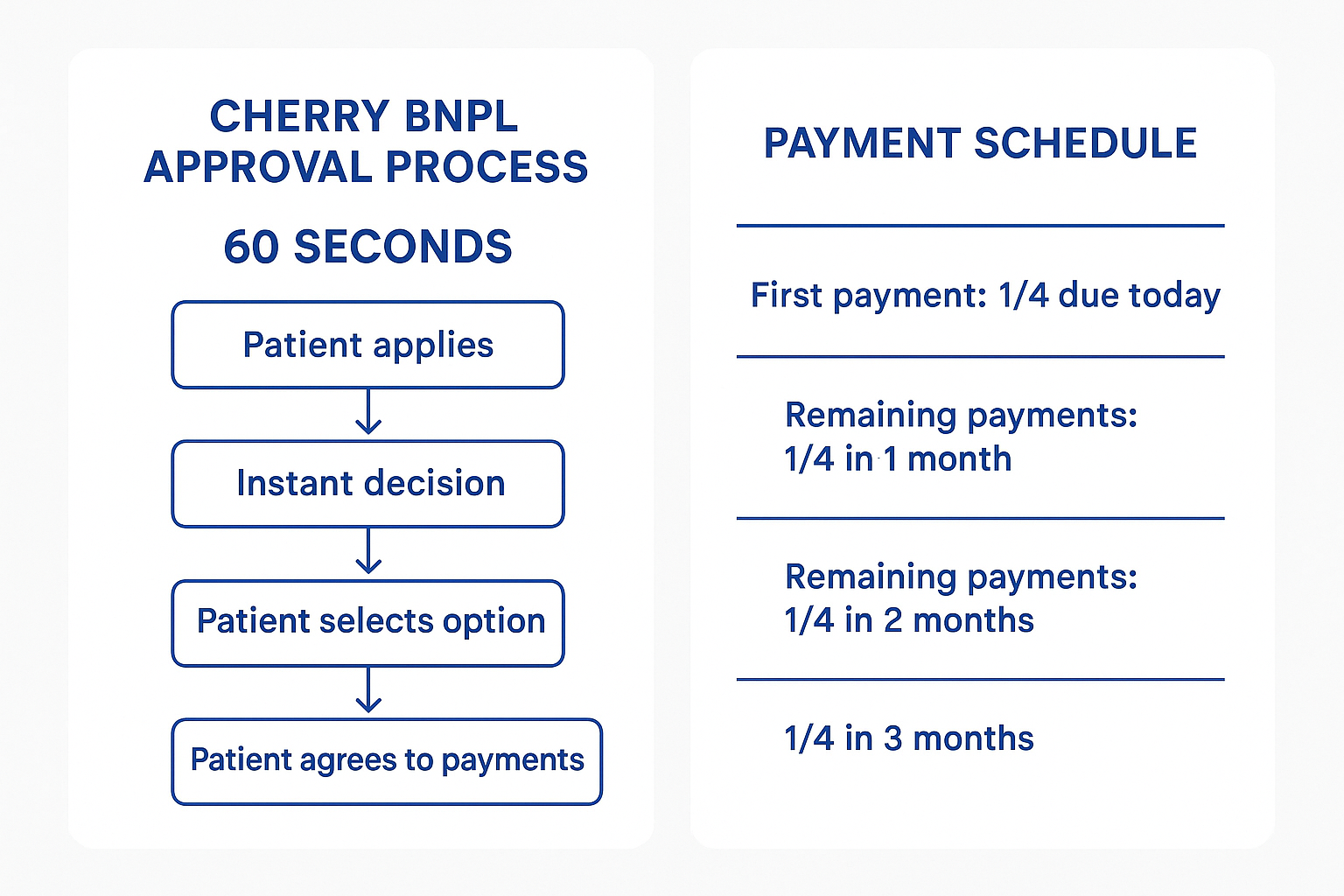
Cherry’s application process takes just 60 seconds and uses a soft credit check that won’t impact your credit score. Once approved, you select your payment plan (ranging from 3 to 60 months), and the dental practice receives payment upfront while you make monthly installments to Cherry.
Key Features:
- 60-second application with instant decision
- No hard credit inquiry during application
- Approval rates exceeding 80%
- True 0% APR available for qualified borrowers
- Payment plans up to 60 months
- Mobile-friendly application process
✅ Pros:
- Lightning-fast 60-second application process
- No hard credit check means no negative impact on credit score
- Exceptionally high approval rates (over 80%)
- True 0% APR for qualified borrowers (not deferred interest)
- Repayment periods extending to 60 months provide flexibility
- Dental offices receive payment immediately
- User-friendly digital experience
❌ Cons:
- May have specific eligibility requirements for 0% APR qualification
- Limited to $50,000 maximum (may not cover extensive full-mouth cases)
- Relatively newer company compared to established lenders
- Not as universally accepted as CareCredit (though growing rapidly)
Who It’s Best For:
Cherry is ideal for patients seeking quick approval without the credit score anxiety and those who want genuinely interest-free payment options. It’s particularly valuable for individuals with fair credit who might not qualify for traditional medical credit cards or those who simply don’t want another hard inquiry on their credit report.
If you’re planning All-on-4 dental implants costing $25,000 and qualify for 0% APR over 48 months, your monthly payment would be about $521—with no interest charges whatsoever.
Bottom Line:
Cherry has quickly become a favorite among both dental practices and patients for good reason. The combination of fast approval, no credit score impact, and true 0% financing makes it a compelling option for most dental implant candidates. The only real limitation is the $50,000 cap, which might be restrictive for extensive full-mouth reconstruction cases.
3. In-House Dental Payment Plans: The Personalized Approach
Price Range: Low to moderate interest rates; often negotiable based on individual practice policies
In-house financing represents the most personalized approach to dental implant payment, with terms and conditions set directly by your dental provider rather than a third-party lender. This option has been gaining popularity as practices recognize that removing financial barriers increases treatment acceptance.
How It Works:
Your dental practice acts as the lender, creating a customized payment plan specific to your treatment needs and financial situation. Terms are negotiated directly with the practice manager or financial coordinator, often with more flexibility than traditional lenders can offer.
Key Features:
- Direct negotiation with your dental provider
- Customizable payment schedules
- Often lower interest rates than third-party options
- Potential for income-based sliding scale pricing
- No involvement of external credit agencies in some cases
✅ Pros:
- Lower interest rates compared to traditional personal loans
- Flexible terms tailored specifically to patient needs and circumstances
- Sliding scale options based on income available at some practices
- Potential discounts for upfront payment or comprehensive treatment packages
- No prepayment penalties at many practices
- Direct relationship with dental provider builds trust
- May not require credit check at some practices
❌ Cons:
- Not all dental practices offer this option (availability varies significantly)
- Terms and conditions vary substantially by practice
- May still require credit check or down payment
- Limited recourse if disputes arise
- Typically not reported to credit bureaus (doesn’t help build credit)
- May require personal guarantees or collateral
Who It’s Best For:
In-house payment plans work exceptionally well for patients who want to work directly with their dental provider and prefer avoiding third-party lenders. This option is particularly valuable for individuals with complicated financial situations, those with limited credit history, or patients seeking affordable local full mouth dental implants from a trusted provider.
Bottom Line:
If your dental practice offers in-house financing, it’s absolutely worth exploring before committing to third-party options. The personalized approach, potential for lower rates, and direct relationship with your provider can make this the most comfortable financing choice. However, make sure to get all terms in writing and understand what happens if you’re unable to make payments.
4. Personal Bank Loans / Credit Union Loans: The Traditional Route
Price Range: 7-30% APR with fixed repayment terms; typically based on creditworthiness
Traditional personal loans from banks and credit unions represent the time-tested approach to financing major dental work. While they may lack the healthcare-specific features of specialized options, they offer predictability and structure that many borrowers prefer.
How It Works:
You apply for an unsecured personal loan through your bank or credit union, receive a lump sum upon approval, and repay it in fixed monthly installments over a predetermined period (typically 2-7 years). The funds can be used for any purpose, including dental implants.
Key Features:
- Fixed interest rates and payment amounts
- Structured repayment schedules
- Lump sum disbursement
- No restrictions on fund usage
- Credit unions often offer member benefits and lower rates
✅ Pros:
- Fixed interest rates provide predictable monthly payments
- Often easier to obtain than specialized medical financing for those with established banking relationships
- Predictable monthly payments simplify budgeting
- Can borrow larger amounts for comprehensive implant work
- Credit unions frequently offer more favorable rates than traditional banks
- Builds credit history when payments are made on time
- No deferred interest surprises
❌ Cons:
- Higher interest rates than in-house plans or promotional medical cards
- Requires good credit score (typically 650+ for competitive rates)
- Longer approval process than BNPL options (often 1-7 business days)
- Monthly payments can be substantial for large implant costs
- May require relationship with bank (existing accounts)
- Origination fees sometimes apply
Who It’s Best For:
Personal bank loans suit patients with established credit looking for traditional loan structures with predictable terms. They’re particularly appropriate for individuals who value the simplicity of fixed payments and want to avoid the complexity of promotional periods or deferred interest.
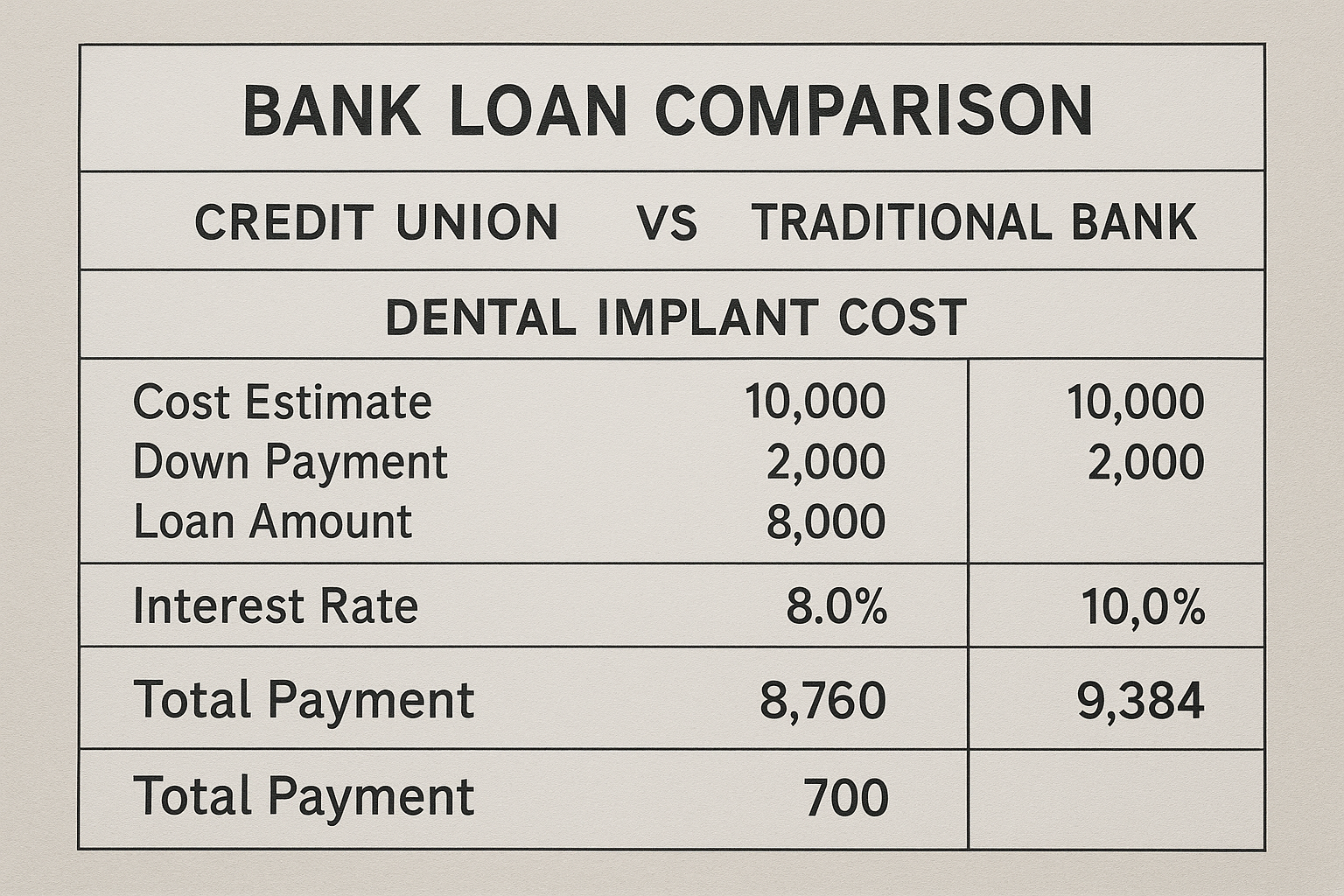
For example, if you’re financing $30,000 for All-on-6 dental implants at 10% APR over 5 years, you’d pay approximately $637 per month with total interest of about $8,220—higher than promotional options but with complete transparency.
Bottom Line:
While personal loans may not offer the promotional rates of healthcare-specific financing, they provide straightforward, predictable financing that some borrowers prefer. Credit union members especially should explore this option, as member-focused institutions often provide rates 2-5 percentage points lower than traditional banks.
5. FSAs/HSAs (Flexible Spending Accounts / Health Savings Accounts): The Tax-Smart Option
Price Range: No interest; utilizes existing pre-tax account balances
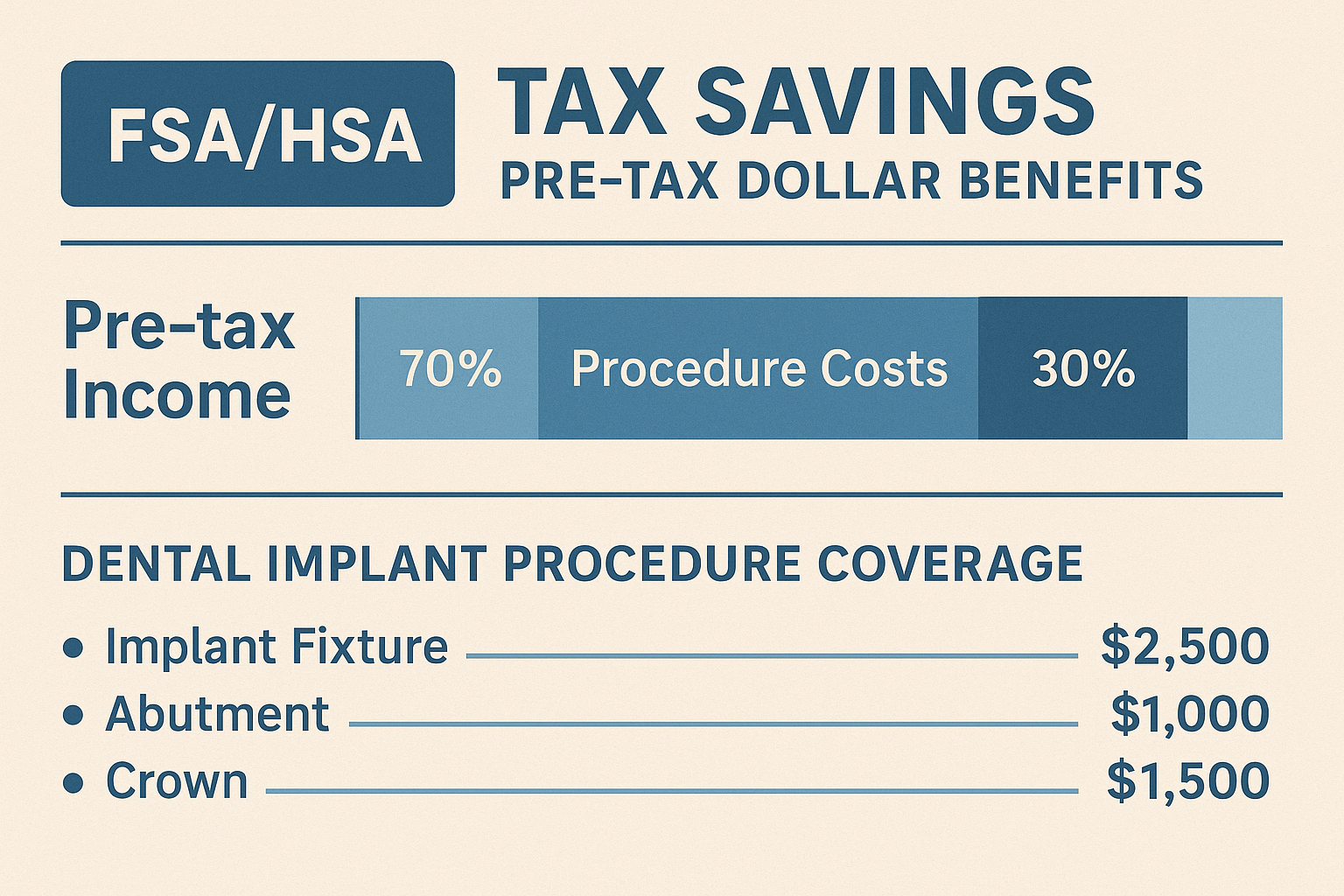
FSAs and HSAs represent the most tax-efficient way to pay for dental implants, though they require advance planning and existing account balances. These employer-sponsored or individually-owned accounts allow you to set aside pre-tax dollars specifically for qualifying medical and dental expenses.
How It Works:
You contribute pre-tax dollars to your FSA or HSA throughout the year, reducing your taxable income. When it’s time for dental implant treatment, you use these funds to pay for qualifying expenses, including many components of implant procedures such as bone grafting, surgical placement, and abutments.
Key Features:
- Pre-tax contributions reduce taxable income
- No interest charges or repayment terms
- HSAs offer investment opportunities for long-term growth
- FSAs are “use-it-or-lose-it” with annual deadlines
- HSAs roll over indefinitely and are portable
✅ Pros:
- Use pre-tax dollars, effectively reducing procedure cost by your tax rate (22-37% for most people)
- No interest charges whatsoever
- Can cover medically necessary implant components (bone grafting, abutments, surgical procedures)
- HSAs offer flexibility with funds rolling over year to year
- Significant tax savings potential (can save 25-40% through tax benefits)
- No credit check or approval process required
- Funds are immediately available
❌ Cons:
- Requires employer sponsorship (FSA) or HDHP enrollment (HSA)
- FSAs have strict ‘use-it-or-lose-it’ deadlines (though some offer grace periods)
- Must have sufficient account balance before scheduling treatment
- Limited to medically necessary portions of procedure (cosmetic elements may not qualify)
- Annual contribution limits ($3,200 for FSA, $4,150 for individual HSA in 2025)
- Requires advance planning and budgeting
Who It’s Best For:
FSAs and HSAs are perfect for employed individuals with existing accounts and sufficient balances for their implant procedure. They’re especially valuable for those who plan ahead and can accumulate funds over time before needing treatment.
If you’re in the 24% tax bracket and use $5,000 from your HSA for dental implant procedures, you’ve effectively saved $1,200 in taxes compared to paying with after-tax dollars—that’s like getting a 24% discount on your treatment.
Bottom Line:
While FSAs and HSAs won’t help if you need immediate treatment without existing funds, they’re unbeatable for planned procedures. The tax savings alone make them worth maximizing before considering other financing options. If you know you’ll need implants within the next year or two, start contributing now to build your balance.
6. Proceed Finance / LendingPoint: The High-Limit Specialist
Price Range: 0% to 23.99% APR depending on creditworthiness; financing up to $75,000
Proceed Finance (now part of LendingPoint) specializes in healthcare lending with a focus on dental procedures, offering higher loan amounts than many competitors. This makes them particularly valuable for extensive implant cases requiring significant funding.
How It Works:
Apply online through a dental practice that partners with Proceed/LendingPoint or directly through their website. The application process includes a soft credit check for pre-qualification, followed by a hard inquiry if you proceed with the loan. Upon approval, funds are disbursed quickly, often within 24-48 hours.
Key Features:
- Loan amounts up to $75,000 for major cases
- Repayment terms extending to 120 months (10 years)
- Fast online approval process
- Pre-qualification available without credit score impact
- Competitive rates for qualified borrowers
✅ Pros:
- Loan amounts up to $75,000 accommodate major implant cases
- Repayment terms extending to 120 months provide very low monthly payments
- Fast online approval process (often same-day decisions)
- Pre-qualification option without credit score impact
- High approval rates compared to traditional banks
- Specialized understanding of dental financing needs
- No prepayment penalties
❌ Cons:
- Requires minimum credit score (typically 650+) for most plans
- Interest rates can range significantly based on creditworthiness (0-23.99%)
- Hard credit inquiry required for final approval
- May have origination fees
- Not as widely known as CareCredit
- Limited to healthcare expenses only
Who It’s Best For:
Proceed/LendingPoint excels for patients requiring larger loans for full-mouth or complex implant cases who want fast approval. If you’re considering comprehensive treatment like All-on-X dental implants costing $60,000, the ability to borrow up to $75,000 with terms up to 10 years can make the monthly payment surprisingly manageable.
For instance, a $60,000 loan at 12% APR over 10 years would cost approximately $861 per month—steep, but far more manageable than trying to pay off the same amount in 2-3 years.
Bottom Line:
For extensive dental implant cases requiring substantial financing, Proceed/LendingPoint offers loan amounts and terms that few competitors can match. The extended repayment periods make even large procedures financially accessible, though you’ll pay more in total interest over the life of the loan.
7. Home Equity Loans / HELOCs: The Homeowner’s Advantage
Price Range: 5-15% APR (varies by lender and market conditions); amounts based on available home equity
Home equity loans and Home Equity Lines of Credit (HELOCs) leverage your home’s value to secure lower interest rates for major expenses like comprehensive dental implant treatment. While they require homeownership and come with significant considerations, they can offer the lowest rates available for large dental expenses.
How It Works:
A home equity loan provides a lump sum based on your available equity (typically up to 80-85% of your home’s value minus your mortgage balance). A HELOC functions more like a credit card, providing a revolving line of credit you can draw from as needed. Both use your home as collateral, which secures lower interest rates but also means your home is at risk if you can’t repay.
Key Features:
- Lower interest rates due to secured nature
- Large borrowing limits (often $50,000-$500,000+)
- Potential tax deductibility of interest (consult tax professional)
- HELOCs offer flexible draw periods
- Fixed rates available with home equity loans
✅ Pros:
- Lower interest rates than unsecured loans (often 5-8 percentage points lower)
- Higher borrowing limits suitable for full-mouth implants and extensive reconstruction
- HELOC offers flexible borrowing on as-needed basis (draw only what you need)
- Potential tax deductibility of interest in some circumstances
- Fixed-rate options provide payment predictability
- Longer repayment terms available (up to 30 years in some cases)
❌ Cons:
- Risk of foreclosure if unable to repay
- Requires home ownership and sufficient equity
- Longer approval process than unsecured options (typically 2-6 weeks)
- Not suitable for patients with unstable financial situations
- Closing costs can be substantial ($2,000-$5,000)
- Reduces home equity available for other purposes
- Variable rates on HELOCs can increase over time
Who It’s Best For:
Home equity financing is best suited for homeowners with substantial equity seeking to fund comprehensive dental implant cases like full-mouth restorations. It makes particular sense when you’re financing $40,000+ in dental work and have stable income to support repayment.
Consider this scenario: financing $50,000 in comprehensive implant work at 7% APR (home equity loan) versus 15% APR (personal loan) over 10 years. The home equity loan would cost approximately $581/month with total interest of $19,720, while the personal loan would cost $807/month with total interest of $46,840—a difference of $27,120 in interest charges.
Bottom Line:
Home equity financing offers the lowest interest rates for major dental implant cases, but the risk to your home makes it appropriate only for financially stable homeowners who are confident in their ability to repay. Never put your home at risk for cosmetic procedures alone—this option makes most sense for medically necessary dental reconstruction.
Comprehensive Buying Guide: Choosing Your Dental Implant Financing
Now that you understand the available options, let’s discuss how to choose the right financing for your specific situation. Making the wrong choice could cost you thousands in unnecessary interest or create financial stress that overshadows the benefits of your new smile.
Assess Your Financial Situation First
Before applying for any financing, take an honest look at your financial picture:
Credit Score Matters:
Your credit score dramatically impacts your options and rates. Check your score before applying (you can do this for free through Credit Karma, Credit Sesame, or your credit card company). Here’s how different scores affect your options:
- 750+ (Excellent): Qualify for best rates on all options; consider CareCredit promotional periods or bank loans with competitive rates
- 650-749 (Good): Qualify for most options with reasonable rates; Cherry, Proceed, or credit union loans are solid choices
- 600-649 (Fair): Limited options; focus on Cherry (soft credit check), in-house plans, or credit union relationships
- Below 600 (Poor): In-house financing or FSA/HSA (if available) may be your best bets; consider improving credit before treatment if timing allows
Monthly Budget Reality Check:
Calculate what you can realistically afford monthly without creating financial stress. A good rule of thumb: your dental implant payment shouldn’t exceed 10-15% of your monthly take-home pay. Remember to account for:
- Existing debt payments
- Essential living expenses
- Emergency fund contributions
- Other upcoming major expenses
Treatment Timeline Considerations:
How quickly do you need treatment? This affects your options:
- Immediate need: Cherry (60-second approval), CareCredit (same-day), or in-house plans
- Can wait 1-2 weeks: Bank/credit union loans, Proceed Finance
- Can wait 1-2 months: Home equity loans, building FSA/HSA balance
- Can wait 6-12+ months: Maximize FSA/HSA contributions for tax-free payment
Match Financing to Treatment Scope
Different types of implant treatments have different financing needs:
Single Implant ($3,000-$6,000):
- CareCredit 12-18 month promotional period
- Cherry with 24-36 month term
- In-house payment plan
- FSA/HSA if you have the balance
Multiple Implants ($10,000-$25,000):
- Cherry (up to $50,000 available)
- CareCredit with longer promotional period
- Personal loan from credit union
- Proceed Finance with extended terms
Full-Mouth Restoration ($25,000-$50,000+):
- Proceed/LendingPoint (up to $75,000)
- Home equity loan/HELOC for lowest rates
- Combination of FSA/HSA plus secondary financing
- In-house plan if available for large cases
Calculate True Cost, Not Just Monthly Payment
Many people focus solely on monthly payment affordability, but the total cost matters significantly. Here’s how to evaluate:
Compare Total Interest Paid:
A $20,000 dental implant case financed different ways:
- 0% for 24 months (CareCredit, paid off in time): Total cost = $20,000
- Cherry at 0% for 48 months: Total cost = $20,000
- Personal loan at 12% for 5 years: Total cost = $26,697
- Home equity at 7% for 5 years: Total cost = $23,762
The monthly payment might be lower on the longer-term options, but you’ll pay thousands more overall.
Watch for Hidden Costs:
- Origination fees (1-6% of loan amount)
- Late payment fees
- Prepayment penalties (rare but check)
- Annual fees on credit cards
- Closing costs on home equity loans
Understand the Fine Print
Before signing any financing agreement, ensure you understand:
Promotional Period Details:
If using promotional financing like CareCredit:
- Exact length of promotional period
- What happens if not paid off in time (deferred vs. waived interest)
- Minimum monthly payment requirements
- Whether promotional rate applies to entire balance or just original purchase
Repayment Flexibility:
- Can you make extra payments without penalty?
- Can you pay off early?
- What happens if you miss a payment?
- Are there grace periods?
Default Consequences:
Understand what happens if you can’t make payments:
- Impact on credit score
- Collection procedures
- Legal consequences
- Risk to collateral (for secured loans)
Consider Combination Strategies
Sometimes the best approach combines multiple financing sources:
Strategy 1: FSA/HSA + Promotional Financing
Use your FSA/HSA balance for the down payment or initial costs, then finance the remainder with 0% promotional financing. This minimizes total interest while maximizing tax benefits.
Strategy 2: Partial Payment + Short-term Financing
Pay what you can upfront (perhaps 25-50%), then finance the remainder over a shorter period with lower total interest costs.
Strategy 3: Staged Treatment
If your treatment can be broken into stages (like doing bone grafting first, then implant placement later), you can finance each stage separately, potentially paying off the first before starting the second.
Red Flags to Avoid
Watch out for these warning signs when evaluating financing:
- Too-good-to-be-true rates: If a lender offers rates dramatically below market, read the fine print carefully
- Pressure tactics: Legitimate lenders don’t pressure you to decide immediately
- Unclear terms: If you can’t understand the agreement after reading it twice, ask questions or walk away
- Upfront fees before approval: Legitimate lenders don’t charge application fees before approval
- No credit check claims for traditional loans: If it sounds like a traditional loan but claims no credit check, investigate thoroughly
Questions to Ask Your Dental Provider
Before committing to financing, discuss these points with your dental office:
- Which financing options do you accept? Not all practices accept all lenders
- Do you offer any cash discounts? Some practices offer 5-10% discounts for full payment upfront
- Can treatment be staged? Breaking treatment into phases might make financing easier
- What’s included in the quoted price? Ensure you understand what’s covered to avoid surprise costs
- Do you have a financial coordinator? They can often help navigate financing options
Frequently Asked Questions About Dental Implant Financing
What credit score do I need to finance dental implants?
The credit score required varies significantly by financing option. CareCredit and traditional bank loans typically require a minimum score of 650 for approval, with better rates available for scores above 700. Cherry uses a soft credit check and has much higher approval rates, often approving applicants with scores in the 600-650 range or even lower. In-house dental payment plans vary by practice—some don’t check credit at all, while others have similar requirements to traditional lenders.
If your credit score is below 650, focus on Cherry financing, in-house payment plans, or improving your credit before treatment. Even a 30-60 point increase can significantly improve your financing options and rates.
Can I use dental insurance and financing together?
Absolutely! In fact, this is a common and smart approach. Most dental insurance plans cover a portion of implant costs (typically 50% of the procedure up to annual maximums of $1,000-$2,000). You can use your insurance benefits to reduce the total amount you need to finance.
Here’s how it typically works: Your dental office submits the claim to insurance, receives the insurance payment, and then you finance the remaining balance. For example, if your dental implant treatment costs $5,000 and insurance covers $1,500, you’d only need to finance $3,500. This significantly reduces your monthly payment and total interest paid.
What happens if I can’t make my dental implant financing payments?
The consequences of missed payments depend on your financing type:
For CareCredit and medical credit cards: You’ll lose any promotional 0% APR benefits, and deferred interest will be applied retroactively. Late fees will be charged, and missed payments will be reported to credit bureaus, damaging your credit score.
For bank and personal loans: Late fees apply, your credit score will be negatively impacted, and after 90-120 days of non-payment, the loan may be sent to collections. This can result in wage garnishment or legal action.
For in-house dental payment plans: Consequences vary by practice. Some may work with you to restructure payments, while others might send the debt to collections. The key is communicating with your provider immediately if you’re struggling—many are willing to work out alternative arrangements.
For home equity loans: This is the most serious situation, as your home serves as collateral. Extended non-payment can ultimately result in foreclosure.
The best approach if you’re struggling is to contact your lender immediately. Many offer hardship programs, payment deferrals, or restructuring options—but only if you communicate before you’re seriously delinquent.
Is it better to use a credit card or specialized dental financing?
Specialized dental financing almost always beats regular credit cards for major dental work. Here’s why:
Credit cards typically charge:
- 18-29% APR with no promotional periods
- Interest from day one
- Higher minimum payments
- Negative impact on credit utilization ratio
Specialized dental financing offers:
- Promotional 0% periods (CareCredit, Cherry)
- Lower interest rates even after promotional periods
- Longer repayment terms
- No impact on credit utilization (for loans, not credit cards)
The only scenario where a regular credit card makes sense is if you have a 0% balance transfer offer and can pay off the balance before the promotional period ends, or if you have a rewards credit card and can pay off the balance immediately to earn points while paying no interest.
For treatment costing more than $1,000-2,000 that you can’t pay off within 1-2 months, specialized financing is almost always the better choice.
Can I finance dental implants with bad credit?
Yes, but your options are more limited. Here are your best strategies with bad credit (scores below 600):
Best Options:
- Cherry financing: Uses soft credit checks and has high approval rates even for lower scores
- In-house payment plans: Many practices don’t require credit checks or are flexible with credit requirements
- Credit union loans: If you have a relationship with a credit union, they may be more flexible than traditional banks
- Co-signer: Having someone with good credit co-sign can open up more options and better rates
Options to Avoid:
- Payday loans or title loans (extremely high interest rates)
- Unregulated lenders
- Any financing with predatory terms
Alternative Approach:
If time allows, spend 3-6 months improving your credit score before applying. Even modest improvements (paying down credit card balances, disputing errors on your credit report, making all payments on time) can move you into a better approval category with significantly better rates.
Final Verdict: Our Top Recommendations for Dental Implant Financing
After reviewing all seven financing options, here are our recommendations based on different situations:
Best Overall: Cherry (Buy Now, Pay Later)
For most patients, Cherry offers the best combination of fast approval, no credit score impact, true 0% APR options, and reasonable loan amounts. The 60-second application and 80%+ approval rate make it accessible to the widest range of patients, while the genuine 0% interest (not deferred) prevents surprise charges.
Choose Cherry if: You want fast approval, have fair to good credit, need up to $50,000, and value simplicity.
Best for Excellent Credit: CareCredit
If you have a credit score above 700 and can commit to paying off your balance during the promotional period, CareCredit’s widespread acceptance and established reputation make it a reliable choice.
Choose CareCredit if: You have excellent credit, can pay off the balance during the promotional period, and want maximum flexibility in provider choice.
Best for Large Cases: Proceed Finance / Home Equity Loans
For comprehensive full-mouth restorations exceeding $50,000, Proceed Finance offers loan amounts up to $75,000. For even larger cases or the absolute lowest interest rates, home equity loans provide the best terms—if you’re comfortable using your home as collateral.
Choose Proceed/Home Equity if: You need more than $50,000, have good credit and stable income, and are financing comprehensive reconstruction.
Best for Tax Savings: FSA/HSA
If you have access to these accounts and can plan ahead, the tax savings (25-40% depending on your tax bracket) make FSAs and HSAs unbeatable for planned procedures.
Choose FSA/HSA if: You have an existing account with sufficient balance or can build one before treatment, and your procedure qualifies as medically necessary.
Best for Personalized Service: In-House Dental Payment Plans
For patients who value direct relationships and flexible terms, in-house financing from your dental provider can offer the most personalized experience and often the most flexible approval criteria.
Choose in-house financing if: Your provider offers it, you have credit challenges, or you prefer working directly with your dental office.
Best for Predictability: Credit Union Personal Loans
If you value fixed payments, transparent terms, and building credit history, credit union loans offer straightforward financing without promotional period complications.
Choose credit union loans if: You’re a credit union member, want fixed payments, and prefer traditional loan structures.
Take the Next Step Toward Your New Smile
Dental implants represent a significant investment in your health, confidence, and quality of life. While the cost might seem daunting at first, the financing options available today make this life-changing treatment accessible to virtually anyone committed to improving their oral health.
The key is choosing the financing option that aligns with your credit situation, budget, and treatment timeline. Whether you opt for the speed and accessibility of Cherry, the promotional periods of CareCredit, the tax advantages of FSAs/HSAs, or the personalized service of in-house financing, there’s a solution that fits your needs.
Remember: the best financing option is the one you can comfortably afford while maintaining your overall financial health. Don’t let the excitement of getting your new smile push you into financing terms that will create stress down the road.
Ready to explore your dental implant options? Contact our team to discuss your specific situation and learn which financing options we accept. We’re here to help you navigate both the clinical and financial aspects of your dental implant journey.
And if you’re still in the research phase, check out our guides on what to expect after All-on-4 implants, the best foods during recovery, and how to care for your new implants to ensure the best possible outcome from your investment.
Your new smile is closer than you think—and with the right financing, it’s more affordable than you might imagine.
Leave a Reply
Share your thoughts or ask a question about dental implants. Your email address will not be published.